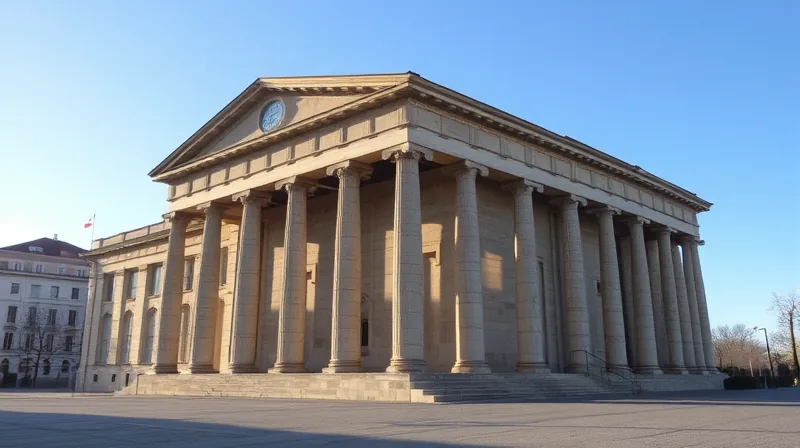
Global Democracy Downturn Reaches Eleven Straight Years
Fifty Years of Data, One Direction
The health of a democracy can be measured. The yardstick has a fifty-year memory and covers 174 countries, and this year’s reading for the United States is the lowest in half a century.
The measurement is not a metaphor. The global rule of law has been significantly undermined by the administration’s threats and actions, according to the 2025 Global State of Democracy report by the International Institute for Democracy and Electoral Assistance. That combination matters: the American reading is the sharpest single movement in the assessment, and it sits inside a worldwide slide rather than apart from it.
The global picture has its own floor. Judicial independence, credible elections, freedom of expression, press freedom and access to justice are all at their lowest levels for at least 30 years.
The instrument behind those numbers is worth describing, because its reach is what makes the finding hard to dismiss. The annual Global State of Democracy report, published by the Stockholm-based International Institute for Democracy and Electoral Assistance, known as International Idea, is described by the organisation as the most comprehensive of its kind, covering 174 countries and measuring democratic performance since 1975. It places every country in one of three categories: democracies, “hybrid” governments — a mix of democratic forms and authoritarian practice — and authoritarian regimes.
The trend line is now long enough that “wobble” is the wrong word. The year 2025 was the 11th consecutive year in which more countries declined democratically than improved. [1] That is the longest continuous downturn since International Idea’s records began. Eleven straight years also mean the newest figures are not a shock reading but the continuation of a documented path.
How Power Concentrated and Alliances Got Tested
The report’s authors named what they believed compounded the problem. “In 2025, the global challenges to democracy and the difficulty in stemming its erosion were both exemplified and compounded by political developments in the United States,” they wrote. President Donald Trump, in their account, quickly amassed power in the executive branch and wielded it to further a narrow set of personal goals and to pursue retaliation against perceived enemies. The results, they said, have been far-reaching: they undermine the rule of law at home and abroad and test longstanding alliances and multilateral cooperation.
The American entry into the “backsliding” column is not new. International Idea added the United States to that list for the first time in 2021, pointing to a visible deterioration that it says began in 2019. A category like that is a reading of a trajectory, not a verdict on a single vote.
Kevin Casas-Zamora, International Idea’s secretary general, describes how the effect travels outward. “Whatever happens in the US goes global,” he said. He went further: “There is now an epidemic of election denialism, of which the patient zero is the current occupant of the White House.” [1] That is a claim about influence, which is harder to measure than a court’s independence or a ballot’s integrity.
The Weakest Pillar
In 2025, the weakest area of democracy was the rule of law — the principle that the same rules bind the people who write them. 71 countries, 41 % of those assessed, were ranked as low-performing, and 29 countries registered downturns. [1] The pillar meant to restrain power is the one bending fastest.
Not every movement went backward. In Australia, civil society groups were consulted on an anti-racism strategy and on children’s online privacy, among other issues. In Syria, the repressive dictatorship of Bashar al-Assad was overthrown. In Bangladesh, Nepal and Sri Lanka, youth-led popular protests unseated long-serving leaders — though the report notes that it has proven difficult to create far-reaching, meaningful reform in a short period of time.

Where restraint is missing, the room for citizens shrinks. The report’s authors put it plainly: while people continue to push back against democratic deterioration, civic space is narrowing. Civil society and civic engagement have suffered, due in part to the widespread use of strategic lawsuits against public participation — litigation that wears critics down through cost rather than argument — along with foreign agent laws and the criminalisation of peaceful protests.
Casas-Zamora refuses the fatalistic reading of his own material. “I am not willing to say the deterioration of the quality of democracy is inevitable or permanent,” he said. “It can be reversed.” A volatile world, he adds, means things can happen which create very positive political openings. The security planner is the unexpected ally in this research. A separate dataset at Uppsala University in Sweden, the Uppsala Conflict Data Program, records 2025 as the year with the most violent conflicts — including the most interstate conflicts — of any year in its dataset, which stretches back to 1946. [4] Casas-Zamora connects the two findings himself: the risk of conflict rises as democracies deteriorate. Hence his conclusion that investing in democracy should be at the heart of any country’s security strategy — and his complaint that this connection is not being made either in policymaking or in the public debate. For defence ministries and security analysts, democratic erosion abroad is now a threat to be budgeted for.
Sources
1. International Institute for Democracy and Electoral Assistance
2. White House