The afternoon the sky stopped moving
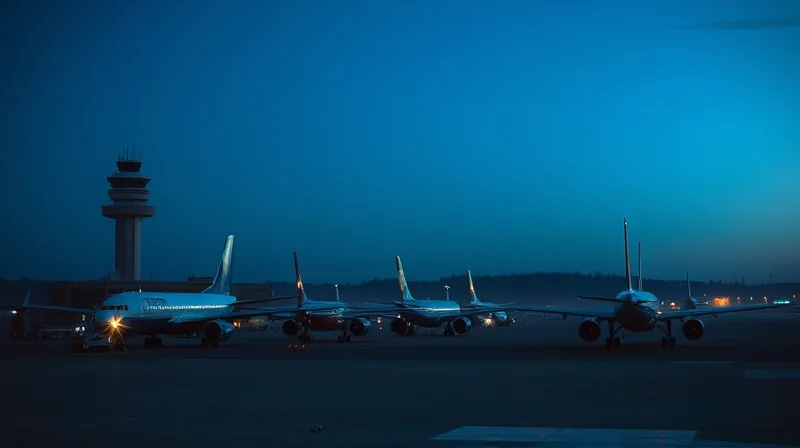
Storms at least announce themselves. They gather over the plains, show up as a red smear on a radar loop, and hand a dispatcher two hours to route a hundred aircraft around them; the sky telegraphs its intention. The failure that hit American aviation on a Friday afternoon in November 2026 gave no such notice. There was no weather in it at all — only data that stopped arriving in the form it was expected, and an order that followed within minutes. At 15:54 Eastern Time the Federal Aviation Administration issued an advisory grounding every flight departing within the United States until further notice. A ground stop is a blunt instrument: an instruction that no covered aircraft may take off, regardless of whether the aircraft, the crew or the weather at the far end are ready. A subsequent advisory cited a communications failure as the cause, and the agency’s stated reason was “extraordinary circumstances” arising from a communication issue affecting all air traffic control centres. More than 3,500 aircraft were already airborne when the order landed. For those aircraft the stop changed nothing about the flight in progress — it applied to departures — but it changed everything about the next one. Some were diverted to other airports; others flew on to their destinations. A nationwide stop is rare because it is expensive in a very specific way: it halts aircraft that are perfectly airworthy and crews that are perfectly rested, which is why it is reserved for the moments when the system that sequences them can no longer be trusted. The initial advisory carried no end time, which is the standard vocabulary of an agency that does not yet know the shape of its problem. For more than four hours, no flight departed anywhere in the United States. The order was lifted at 20:15 Eastern Time. It was the longest nationwide ground stop since the attacks of 11 September 2001, and only the second such nationwide stoppage since then.
The flight-tracking firm FlightAware recorded more than 8,500 delayed flights and nearly 8,000 cancelled flights on the Friday. The aviation analytics company Cirium counted more than 8,000 cancellations as well, and calculated that nearly a third of all departing flights in the United States were scrubbed. Around 11,000 flights carrying more than 1.5 million passengers had been scheduled to leave American airports after 4 pm Eastern Time. At the lowest point of the crisis, at 8:30 pm Eastern, just 336 aircraft were in the air bound for US airports — less than 10 percent of the normal figure. By 10:30 pm, more than 5 percent of Saturday’s flights had already been cancelled, and that number was expected to climb. The mechanism behind the climb is mechanical rather than mysterious: aircraft and crews had been left far from where the next day’s schedule needed them, and a crew that is out of position cannot be fixed by an order to resume. None of these four units measures the same thing. A delay is an aircraft that left late; a cancellation is a flight that never left; a seat is a passenger; an airframe is a machine that has to be in the right city by morning. A single stranded large twin-aisle long-haul airliner therefore appears in all four counts at once, which is how a number like 8,000 can feel both enormous and incomplete. The schedule damage is arithmetic; the recovery is a puzzle in which every moved aircraft changes the shape of the next day.
The stop was American in origin and global in effect. All US-bound air traffic from the 42 member states of Eurocontrol was suspended. Australia’s largest international airport, Sydney, grounded all US-bound flights, though scheduled departures were later expected to resume as planned. Air Canada cancelled flights between the United States and Canada. By Saturday morning, flights from the United Kingdom were largely unaffected, but passengers had been warned to brace for possible disruption. A small number of flights were cancelled, and inbound services from the United States to Manchester and Heathrow were running with minor delays. Then there is the part of the record that shows how information behaves in a vacuum. Hawaii’s Department of Transportation posted on Facebook that “All west coast flight have been halted due to debris from SpaceX launch”. The Starship had in fact launched successfully that evening, and the launch had not taken place anywhere near the west coast flight corridors. The post is a small artefact, but a revealing one: during an outage, the first explanation to reach the public is often not the explanation.
Restoring an order is not the same as restoring a system. In the hours after the national ground stop was lifted, much of the air travel network remained in a state of semi-chaos. Some airports, such as JFK, began launching aircraft quickly. Others, including Newark and LaGuardia, took more than an hour to get back into operation. Partial ground stops were imposed, barring certain carriers from certain airports because of crew or equipment shortages. Delta Air Lines and United Airlines said they were resuming operations. American Airlines said it was “focused on operating as many remaining flights as possible this evening”. JetBlue said it would resume flights on Saturday morning. British Airways, which had a few US-bound flights affected, advised passengers to check their flight status but to travel to the airport as planned. The Transportation Secretary, Sean Duffy, described the arithmetic of the recovery plainly: “It’s going to take us some time to unwind what’s happened this afternoon.” [1] He also described the human side of it. Tens of thousands of people were stranded in airports around the country, many of them, in his words, “without any knowledge of where they’re going to sleep tonight”. A ground stop of four hours produces a queue; unwinding the queue produces a second and longer disruption, and that second disruption does not appear in the count of cancelled flights on the day it was caused.
An analogue switchboard under a modern sky
The second question was the one every aviation outage now attracts. The Homeland Security Secretary, Markwayne Mullin, told the same White House briefing that there was “zero evidence” that the telecommunications issue was a cyber-attack. [1] “The public was never at danger through this process,” he said. “There was never any lives. There was no flights at risk.” He described the absence of the usual signs: no chatter, no footprints, no identification of people who had got into the system. “It appears that this was mechanically driven,” he said. He added that investigators were still looking and would not rule the possibility out. He also ruled out any link to the global Microsoft outage that had begun the previous day, and Microsoft said it had found no indication that the ground stop was linked. President Donald Trump told Fox News that the disruption did not appear to be the result of a cyber-attack or an issue involving artificial intelligence. Mullin’s own account of the trigger was the introduction of some new technology into an old air traffic control system, which he said had overwhelmed it. Both cabinet secretaries insisted that the public was never in danger during the stoppage. The distinction they were drawing is the difference between a system that was attacked and a system that was asked to do more than it was built to do.
The historical benchmark makes the four hours legible. Dr Guy Gratton, an associate professor of aviation at Cranfield University, described the event as looking like the worst since 9/11 “but clearly not on that scale”. He pointed to the January 2023 grounding caused by a failure in the Notice to Air Missions system — the system that publishes safety notices to pilots. “That lasted 1 hour and 52 minutes, delayed about 9,500 flights and cancelled about 1,300,” he said. [1] In that episode, air traffic safety notices could no longer be published, and flights were grounded until the system was restored. The comparison is not a matter of opinion: 1 hour and 52 minutes against more than four hours is a ratio, and the 2026 event ran at a busier point in the week, which is why the disruption was expected to bleed into the weekend. One caveat belongs here: other accounts put the 2023 stop at about 90 minutes, so the exact multiple depends on which clock is used. Duffy was explicit that he did not know whether this exact scenario would recur, and equally explicit that failure in general would. Certainty about recurrence combined with uncertainty about form is an awkward place for an infrastructure agency, because it justifies spending without being able to specify what the spending buys.
Who pays when the radar goes quiet
The bill for four hours of grounded aircraft does not fall where a passenger might expect. In the United States, the United Kingdom and the European Union, airlines may be liable for compensation when the reason for a delay is deemed to be within their control, such as a fault with the plane or pilot sickness. Air traffic control problems are not within their control, so carriers do not have to provide compensation to passengers for them. Protection does not stop there, but it changes character. Under the FAA Reauthorization Act of 2024, cancelled or “significantly delayed” flights — defined as three hours for domestic flights and six hours for international routes — must be offered alternative travel or a full refund of the fare if the passenger chooses not to fly. The same law requires all air carriers to issue refunds for tickets purchased with a credit card within seven business days of the request, and within 20 days for tickets bought with another form of payment. A passenger who accepts a new flight cannot receive a refund. In the United States there is no requirement for airlines to provide meal vouchers or accommodation, though some may offer complimentary support to customers. A refund returns money the airline never earned, because the flight was not operated. Compensation is a penalty for a failure the airline owns. The November 2026 outage produced the first and not the second.
Travellers on the other side of the Atlantic hold a different set of claims, and the difference is jurisdictional rather than moral. Under UK law, airlines have a duty to look after passengers when flights are delayed or cancelled for whatever reason. That duty covers a reasonable amount of food and drink, often through vouchers. It covers a way for the passenger to communicate, often by refunding the cost of calls. It covers free accommodation if a passenger has to stay overnight to fly the next day. If the airline is unable to arrange that assistance, the passenger has the right to organise it and claim the cost back later. The Civil Aviation Authority advises people to keep receipts and not to spend more than necessary. The rules bite when a passenger is travelling from the UK to the US, or flying with a UK carrier.
The money question that follows Duffy’s $50bn overhaul estimate is legislative rather than technical, and the timing of the paperwork is the detail to hold on to. On the morning of the ground stop — hours before the order — the administration sent a letter to Congress asking for $30bn in additional funding for aviation infrastructure. At the White House briefing, Duffy repeatedly urged Congress to act on legislation that would give the agency more money to improve its systems. “You will have more of them unless the American people and the Congress tell us to build,” he said, “and I can’t wait for that.” The legislative vehicle already exists. Senator Eric Schmitt, a Republican who sits on the Commerce, Science and Transportation Committee, introduced the Modern Skies Act in September, which would provide $30bn in additional federal funding to update the nation’s aviation infrastructure. He is pushing for it to be included in reconciliation, the budget procedure that lets certain spending measures move with fewer procedural obstacles, so that the funding can pass sooner. Schmitt called the President before the evening briefing, and the President used the call to press for Congress to pass legislation modernising air traffic control, airport towers, terminals and other critical infrastructure as soon as possible. The gap between the $50bn the agency says the system needs and the $30bn now on the table is the most honest number in the story, because it measures the distance between what the system needs and what the political process has so far agreed to pay for.
Because the cause sat with air traffic control rather than with an aircraft or a crew, US and European rules do not oblige carriers to pay compensation for the disruption. An airline that stranded tens of thousands of people therefore carries a schedule problem, a reputational problem and a refund obligation, but not a compensation bill. It also means the cost lands in an unusual order: passengers absorb lost days first, airlines absorb rebooking and refunds second, and the public budget absorbs the rebuild last, if it absorbs it. The second force pushing the rebuild is the event itself. A four-hour shutdown that produced no confirmed cyber-attack, no confirmed injury and no confirmed near-miss is exactly the kind of event that is hard to legislate against and easy to postpone. Every figure in the record — 8,500 delays, nearly 8,000 cancellations, 336 aircraft airborne at the low point, $50bn estimated for an overhaul, $30bn requested — is now evidence in a budget argument that started before the ground stop and will continue long after the last stranded passenger has been rebooked. The people who slept in terminal buildings will not be parties to that argument. Depending on the ticket they bought, they will end up with a refund inside seven business days, a hotel room they booked and paid for themselves, or simply a later flight.
Sources
Mentioned organisations (context, not sources)
- FlightAware — Organisation (homepage)
- Cirium — Organisation (homepage)
- Eurocontrol — Organisation (homepage)
- Hawaii Department of Transportation — Organisation (homepage)
- SpaceX — Organisation (homepage)
- Delta Air Lines — Organisation (homepage)
- American Airlines — Organisation (homepage)
- JetBlue — Organisation (homepage)
- Microsoft — Organisation (homepage)