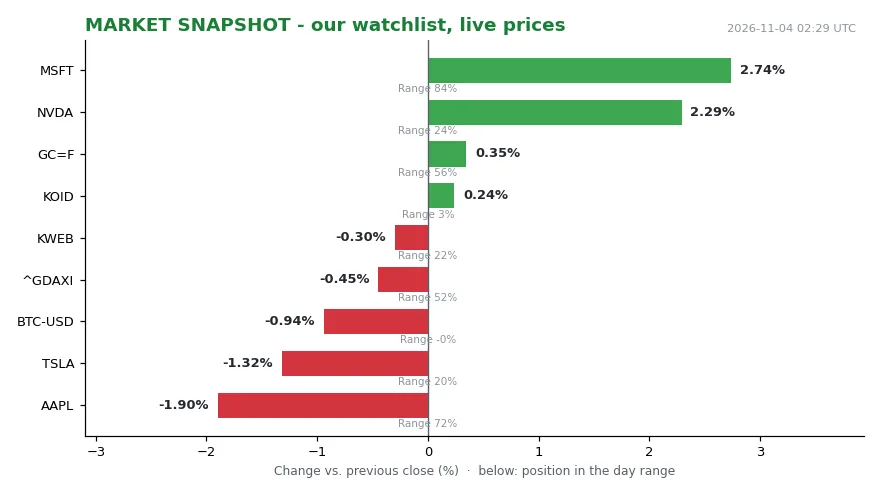
At 02:25 UTC our watchlist printed NVDA at 206.69, +2.29%, sitting at 24% of its daily range — near the lows. MSFT printed 520.99, +2.74%, at 84% of range — near the highs. AAPL printed 331.90, -1.90%, at 72% of range, the middle. Two statements follow, and both are true at once. The headline tape is quiet. The tape underneath it is not.
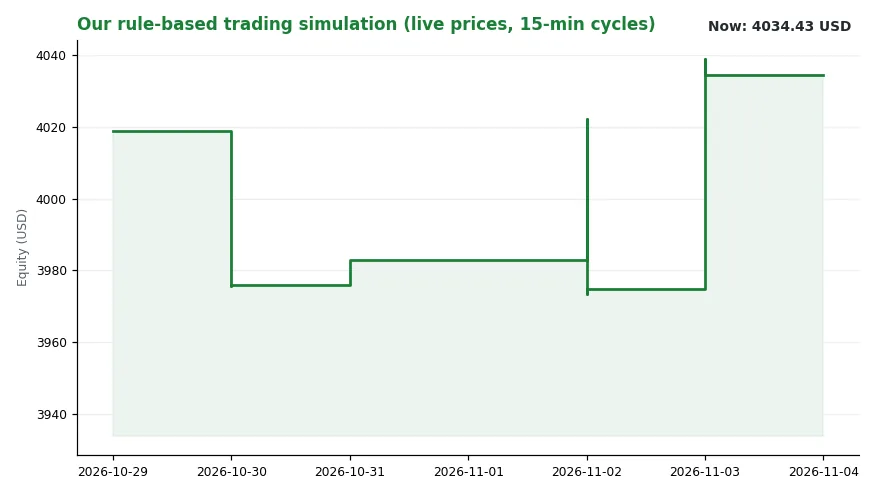
The rest of our board repeated the pattern. TSLA at 398.50 was -1.32% and at 20% of range. BTC-USD at 76,623.09 was -0.92% and at -5% of range, below its own band. Gold at 3,948.40 was +0.20%, mid-range at 44%. The DAX at 25,864.62 was -0.45% and 52% of range — dead centre. KOID at 33.67 was +0.24% but at 3% of range, the weakest position we logged. KWEB at 23.28 was -0.30%, 22% of range. Our regime line read trend=falling, level=3.63. The busiest signal channel of the day was “other”, with 8 events. Simulated equity held at 4,034.43 USD, unchanged against the same time yesterday, with 2,018.02 in cash. The latest rule-based decision was WATCH KWEB at 0.00.
That is a rotation, not a verdict. Money changed seats inside the vehicle; it did not leave the building. For a supplier, that distinction is the entire argument. An index-level calm reading says nothing about whether a customer pays in thirty days or in pennies.
What was reported
Poundland’s owner, Gordon Brothers, has given the business until Thursday to find a rescue deal. One of its suppliers has now priced its own exposure in public. Adam Turner is sales director at Highcrest Retail Brands, a family-owned Bradford business. Highcrest mainly sells confectionery to Poundland and turns over about £50m. Poundland is one of its biggest customers, and the relationship runs over decades.
Turner’s own figure: Highcrest “will lose a few million” if Poundland becomes insolvent [Q1]. [2] That amount becomes a gap in next year’s balance sheet. Highcrest, in his description, is a “longstanding business that can stomach this” [Q2]. Others are not. Medium and small suppliers have told Turner: “if Poundland goes under, so do they” [Q3].
Founder Steve Smith put the count of suppliers that work only for Poundland at two or three thousand. That is the part of the story which does not fit inside a headline about 12,000 staff. The board of Poundland Limited stated it had been “working on a formal sale process for Poundland” [2]“.
The queue that sits behind the jobs number
It is also a queue. Administration imposes an order, and suppliers do not stand at the front of it. The recovery rate for suppliers, in Turner’s account: “pennies in the pound” [Q4]. Gordon Brothers, as owner, would be a secured creditor and therefore first in line for repayment. Suppliers “who have done nothing wrong” take the financial hit [Q5].
The jobs arithmetic has two versions. Poundland employs up to 12,000 people. If stores are sold, some staff may be re-employed on the same premises. Buyers are understood to be interested in roughly half the stores at present. That implies around 6,000 employees would not be re-employed [2].
Smith’s version is wider. He put the exposure at “more like 20 or 30,000 jobs” [Q12], against the 12,000 direct. [2] The company has 600 stores in the UK and Ireland, and Smith put the customer count at between four and five million a week [2].
The visible survivor and the invisible casualty
Turner is explicit that his own firm survives. That is the sentence people will quote, and it is the least useful one standing alone. Survival at Highcrest is a statement about £50m of turnover, not about the supply base. The same event, at the same moment, is described by smaller suppliers as terminal.
This is how supplier shocks propagate. The visible firm absorbs the hit and carries on; the invisible one does not. That is the point of them.
Why the golden quarter is the worst quarter to fail in
Retail insolvency has a calendar, and the calendar is not flat. The last three months of the year are, in Turner’s phrase, the “golden quarter”. Poundland takes Halloween stock from July and Christmas stock from September. Those are the weeks when suppliers are owed the most.
So the exposure is largest exactly when the cash position is most fragile. One insider familiar with the situation told the BBC the timing was “odd”, since most retailers do not fall over in the run-up to Christmas [2]. Gordon Brothers makes money partly through stock liquidation, selling off stock from collapsed businesses. On whether the process was deliberately timed to exploit high stock levels, Turner has no knowledge either way. That is the honest position: a coincidence with a motive-shaped hole in it, and no evidence in either direction. We mark it as unresolved.
Half an estate is not a rescue
A sale is not a single event with a single outcome. Gordon Brothers said it was evaluating interest for the whole business and formal and indicative offers for significant viable parts of it [2]. Parts is the operative word. Martin Property Group’s rejected takeover bid is the concrete example of a whole-business approach that did not proceed [2]. Half the estate is the current level of interest. The other half is where the 6,000 come from.
What a minister can and cannot change
Business minister Kate Dearden told MPs the government does not want to interfere with “current ongoing commercial negotiations”, while ministers seek “clarity” on the plans. She stated: “Poundland is not currently in administration and the business continues to trade, but this is a worrying time for employees, suppliers and communities” [Q9]. [2] She added she was “deeply concerned about the uncertainty surrounding Poundland’s future and the impact it could have on its staff and their families” [Q8].
The government’s leverage is informational, not contractual. Dearden meets Poundland executives on Wednesday. Business secretary Jonathan Reynolds meets Gordon Brothers later this week, after he and Prime Minister Andy Burnham questioned why a solvent deal had not been made [2]. Government sources concede limited scope for ministers to intervene in a commercial transaction. The Dearden meeting is characterised as predominantly fact-finding. Dearden has said she stands ready to support employees who need to move into new employment. None of that alters a payment waterfall.
A £1 purchase price and a contested ledger
The numbers do not settle the question. Gordon Brothers bought the firm from Pepco for £1 [2]. It has stopped funding the business and rejected a takeover offer from Irish firm Martin Property Group [2]. The head of Gordon Brothers’ European operations reportedly told the government the firm stood by its stewardship and had provided £85m in additional financing since its 2025 purchase [2]. Concerns have been raised that an offer to keep Poundland afloat was declined in order to ensure repayment of a £30m loan the buyer inherited [2].
Smith’s counter-numbers are equally awkward. Sales were up 11.2% on last year, he stated [2]. His verdict: “Although Poundland made a loss last year, they’re going to make a good profit this year, so it’s just crazy” [Q11]. He had tried to contact the owners over the last three months without reply, and said that if there were an opportunity he wanted money back in. His words: “I definitely want to put some money back in there” [Q15].
Liam Byrne, chair of the Business, Innovation, Science and Trade Committee, said the deal “stinks to high heaven right now” [Q13]. [1] He described an owner that “could well be trying to cut and run” [Q14]. [1] That is an allegation from a select committee chair, not a finding.
Who wins, who loses, who decides
Winners, if the process runs to liquidation: whoever buys stock at liquidation prices. Stock liquidation is part of Gordon Brothers’ own business model, which is a fact about the firm, not an accusation.
Losers, in the order of the waterfall: suppliers holding unpaid invoices, then the staff whose stores find no buyer, then the surrounding high street. Smith argued that Poundland’s absence would “cause a lot of other retailers to fall as well” [Q15] — his estimate, not a measured figure.
Deciders: Gordon Brothers as owner and secured creditor, the buyers circling half the estate, and Thursday’s deadline. Ministers control neither the deadline nor the waterfall. They control the tone of engagement and whatever support follows.
What we watch next
Three dates. Wednesday, when Dearden meets Poundland executives. Later this week, when Reynolds meets Gordon Brothers. Thursday, the deadline for a rescue deal. Beyond that, the October-to-December window, when supplier exposure peaks [2].
We hold no position and we make no recommendation. Our own tape, as measured at 02:25 UTC, shows dispersion and a falling trend reading of 3.63 — a market pricing individual outcomes rather than one shared narrative.
Sources
- Business, Innovation, Science and Trade Committee — Quote source (original article)
- BBC — Quote source (original article)