Tesla SpaceX merger talks target December shareholder vote
Tesla is bid, megacap tech is soft, and behind the ticker sits a date: a shareholder meeting in December, two special committees, and what would be the largest merger in corporate history.
The tape before the headline
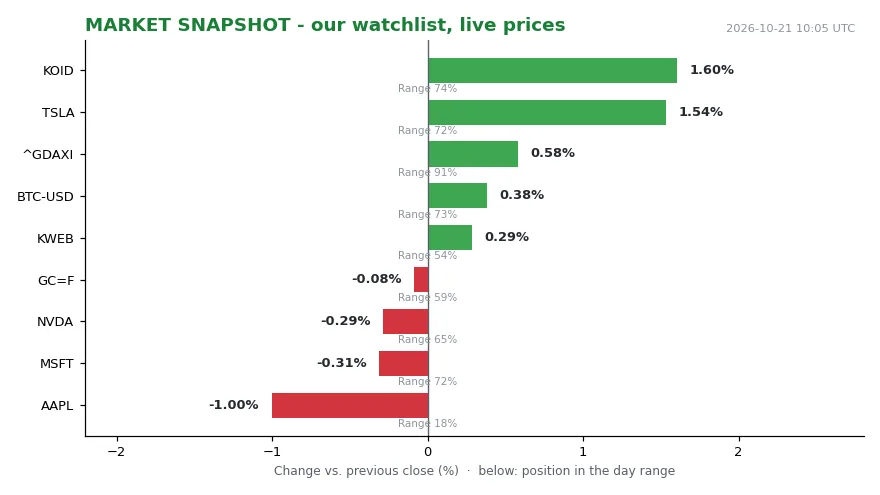
Our own measurement at 10:02 UTC on 21 October begins with Tesla (TSLA) at 373.71, up 1.54 % against the previous close and sitting at 72 % of its daily range. The German benchmark ^GDAXI printed 25,466.65, up 0.64 % and at 100 % of its range — the very top of the session. Bitcoin (BTC-USD) traded at 83,360.75, up 0.51 % and at 85 % of its range. Apple (AAPL) went the other way, down 1.00 % to 339.50, near its day low at 18 % of range. Nvidia (NVDA) eased 0.29 % to 216.47, mid-range at 65 %. Gold (GC=F) was essentially flat at 4,140.20, at 63 % of range, and the KWEB China internet ETF added 0.29 % to 24.35.
Read together, those prints do not describe a broad risk-on morning. They describe rotation. One megacap name in our watchlist is being bid while the wider megacap complex softens. In our reading, that is the signature of a company-specific event rather than a macro tide.
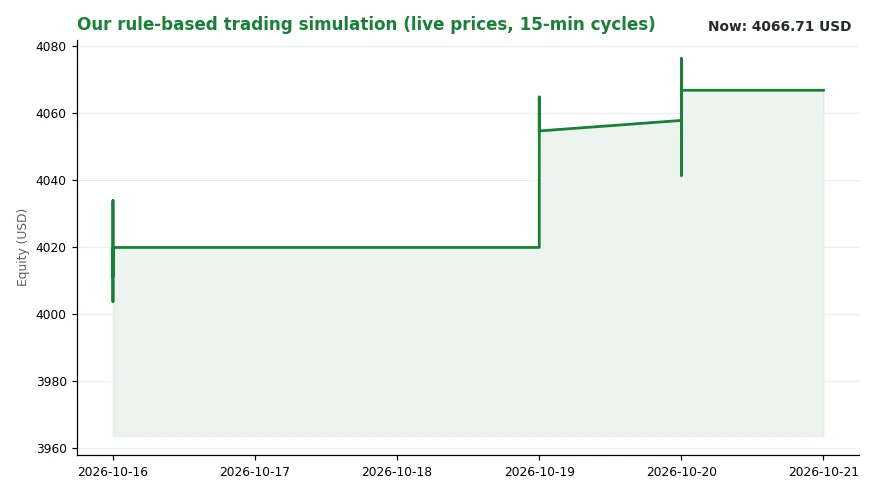
Our rule-based simulation sits at 4,066.71 USD, unchanged versus the same time yesterday, with 2,036.50 USD in cash. Its latest logged decision was to watch KWEB. The machine did not chase the headline.
Our regime reading shows trend=falling at level 3.63. A single merger story is landing in a market whose broader direction is not rising. The busiest signal channel of the day was “central banks”, with three events.
Two committees and a one-word answer
On Tuesday, Musk was asked whether a merger of Tesla and SpaceX would be a good idea. His answer was a single word: yes.
The word was not idle. Musk said special committees have been formed to assess a potential deal. He also stressed there is no guarantee a merger will happen. Nothing has been agreed.
The committees were formed at the request of shareholders. They are made up of independent directors. Those directors would need to agree on transaction terms before anything reaches a shareholder vote. Musk said his conflict of interest prevents him from taking part in their discussions.
The scale is the story. Tesla is valued at roughly $1.5 trillion. SpaceX is valued at about $2 trillion. Combined, that is around $3.5 trillion. That would mark the largest merger ever by deal value. It could surpass SpaceX’s $250 billion acquisition of xAI in February, which set the current record.
It is a capital-structure event: it would re-price ownership of two of the largest technology assets in existence.
December as the deadline
Tesla’s annual shareholder meeting falls in December. Last week, Barclays analysts suggested a merger could be announced before that meeting. Tuesday’s call was the first confirmation that the two companies were formally exploring a combination. That is the deadline structure of this story: not a signed document, but a calendar.
Where the deal meets the market
The first channel is the vote. Half of Tesla’s shareholders would need to back the deal. Musk himself called that threshold “quite a high hurdle”. As boss of both companies, he cannot participate in shareholder discussions.
The second channel is control. Musk owns around 48 % of SpaceX and around 20 % of Tesla. The special committee assessing the deal would have to weigh that factor.
The third channel is pricing. Telos Wealth Advisors analyst Dan Sheehan points to the absence of a template: “There’s no real precedent for how a public company like Tesla gets priced in this.” The fourth channel is regulation. JPMorgan analysts flagged regulatory approval in China as a potential stumbling block. Morningstar analysts said a merger could raise US national security concerns involving the combined company’s supply chain. Congressional scrutiny is a further risk, and it could intensify if Democrats win control of either chamber.
Then there is the technology channel. The transaction would combine Tesla’s cars, robots and self-driving technology with SpaceX’s rockets, data centres, satellites and telecommunications operations. Musk’s argument is that both firms work on chips, artificial intelligence and adjacent projects.
His words on the SpaceX investor call: “I do think there’s a lot of merit to combining the companies as we are pretty much in the superintelligence singularity, and there’s a lot to be gained from cooperating.” [1] He added: “I think it would be a good idea, but it’s really up to the special committees of both companies.” This is not new rhetoric. On a 22 July earnings call, Musk spoke of “more and more overlap” between the two firms.
The winners, the voters and the wait
Musk is the first name on the winners’ list. He is probably the biggest winner Sheehan’s framing is sharper: “The deal itself doesn’t add to Musk’s wealth, but it concentrates it further in one stock.” [1] Tesla shareholders face a trade-off. They would likely hold a “smaller slice of a much larger and more complex business”, in Sheehan’s phrasing. The market delivered a first verdict: SpaceX shares rose 8 % in after-hours trading, while Tesla stock climbed 2 % in the same window.
The operating picture matters here. SpaceX, which went public in June, reported a quarterly net profit of $4.4 billion. Musk told investors he expects annual recurring revenue of between $500 billion and $1 trillion by the end of 2027. Over the past year he has consolidated steadily — SpaceX absorbed xAI and X, formerly Twitter, before listing.
On the car side, Tesla said earlier this year it would prioritise its best-selling Model Y and Model 3, shifting focus away from less popular models. It also started using a California plant to produce humanoid robots known as Optimus. Competition is intense: BYD overtook Tesla as the world’s biggest EV maker in January.
Futurum Group’s David Nicholson goes further. Vehicles seem almost like “an afterthought”, he says, overshadowed by the combined technical capability. Sheehan puts the open question plainly: “The question is how much priority cars get inside a company increasingly driven by AI infrastructure.” Tu Le, founder of Sino Auto Insights, sees a commercial upside. SpaceX technology could be pulled into future Tesla products, which could attract more customers. The Roadster unveiled last week, powered by SpaceX rocket thrusters, hints at exactly that. Nicholson calls it a “symbolic embodiment” of the two companies converging.
Shareholders have backed Musk before. Last year, Tesla investors approved an unprecedented compensation package valued around $1tn. As Nicholson puts it: “I honestly don’t think Musk will be keeping track of what the merger will do for his wealth.”
Sources
Mentioned organisations (context, not sources)
- Tesla — Organisation (homepage)
- SpaceX — Organisation (homepage)
- Apple — Organisation (homepage)
- Nvidia — Organisation (homepage)
- Time — Organisation (homepage)
- Barron’s — Organisation (homepage)
- Barclays — Organisation (homepage)
- JPMorgan — Organisation (homepage)
- Morningstar — Organisation (homepage)
- BBC — Organisation (homepage)