
UK Five Year Fixed Mortgage Average Reaches 6 Percent
There is no ticker for a mortgage, so start with what our board does carry.
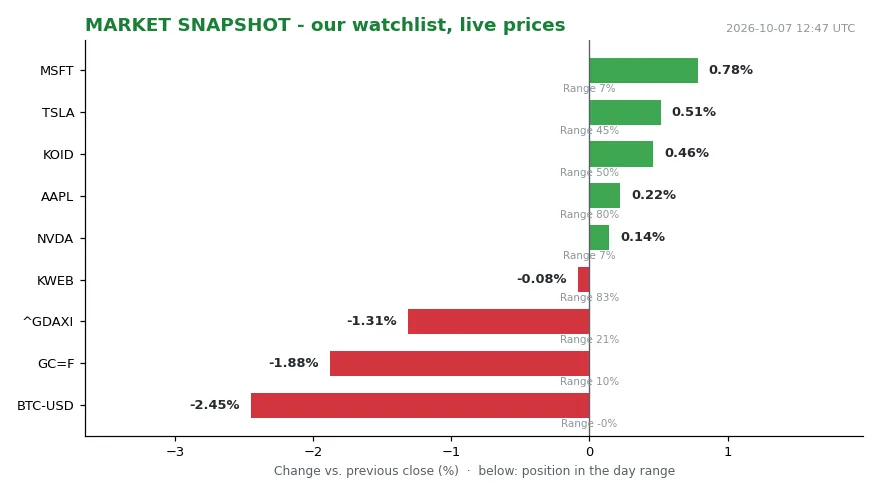
Bitcoin traded at 83,498.99 US dollars, down 2.39% against the previous close, at 2% of its daily range — pinned to the floor.
Gold futures, GC=F, printed 4,109.90, off 1.84%, at 11% of range.
Germany’s ^GDAXI stood at 25,107.79, down 1.34%, at 18% of range.
Three readings, one direction.
The board is not uniform, though.
Apple at 333.63 was up 0.22% and near its session high, at 80% of range.
The China internet basket KWEB at 24.54 was down 0.08% and still at 83% of range — close to the top of its own day.
Tesla at 380.68, up 0.51%, held the middle at 45% of range.
KOID at 37.02, up 0.46%, split its range at 50%.
Nvidia at 239.24, up 0.14%, and Microsoft at 529.30, up 0.78%, both finished near their lows, at 7% of range each.
So of nine instruments on the watchlist, five sat near the bottom of their range, two near the top, and two in the middle.
Up on the day and near the day’s low are not contradictory readings.
Both describe where a price ended inside its own daily range, not where it stands against yesterday.
Read together, this is less a crash than a sorting.
Money is not leaving everywhere at the same speed; it is leaving some places faster than others.
Our regime line compresses the pattern into two values: trend = falling, level 3.63.
The busiest channel in our signal layer on 2026-10-07 was “central banks”, with two events.
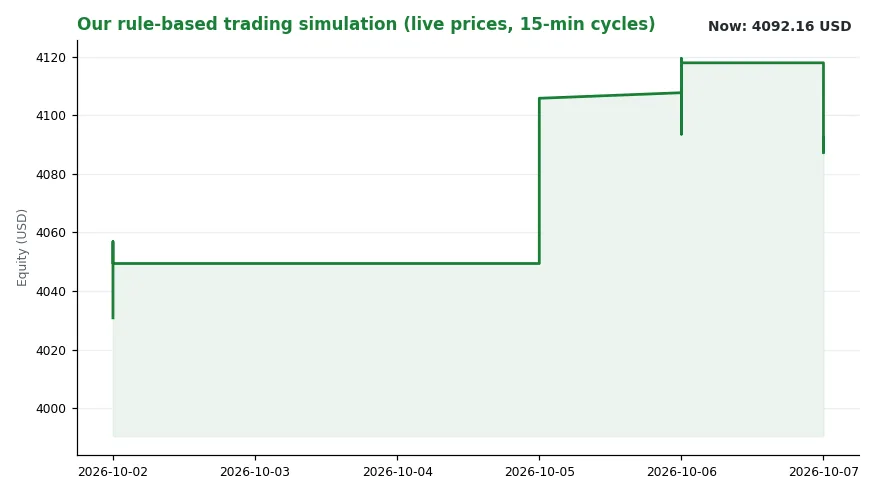
Our simulated equity book — rule-based, documented, and making no claim to skill — stood at 4,092.16 US dollars, down 0.62% on the same time yesterday.
Cash made up a little more than half of that book, at 2,081.91.
Its most recent logged decision was to watch KWEB at 0.00.
That is a decision to do nothing.
Now the absence that runs underneath all of it.
Nothing on that board prices a British household’s loan against a house.
That price lives elsewhere, and this week it crossed a line.
The threshold nobody screens
The average cost of a five-year fixed-rate mortgage in the UK has hit the 6% barrier for the first time in three years. [1] Moneyfacts, the financial information provider behind the figure, puts the average at 6.00%, its highest point since September 2023. [1] The average two-year fixed rate reached 5.98%, its highest since December of that same year. [1]
Two records set three months apart in 2023, and now within two basis points of each other.
The event being marked is not a single deal but a market average.
In our interpretation, an average is not an offer.
In our interpretation, it is the middle of a range of offers, and the middle has moved.
Three years is the frame the reporting supplies, because the last time this threshold was crossed was in 2023.
Everything between then and now priced below it.
In our interpretation, round numbers are landmarks, not mechanisms.
In our interpretation, that is what makes 6.00% a headline rather than a data point.
What changed is where the average sits, not how any single loan is priced.
What the record says is driving it
The named driver is not a change in the Bank of England’s base rate. [2].
That rate was held again last month. [2].
Mortgage costs rose anyway.
The contrast is direct: if the base rate did not move, why are mortgage rates climbing? [2]?
The answer is not a policy story.
It is a funding story.
Jitters in the money markets have made the loans more expensive for lenders to offer. [1].
That distinction matters more than the headline.
Who carries the number
The Guardian’s call-out asks the question that sits underneath the average. [1].
It wants to hear from people affected by the 6% rate.
It asks how the rise will affect their finances.
It asks whether the rise will change their plans to buy a house or move.
Those are the two decisions a mortgage rate actually touches: entering the market, and leaving a home.
Anyone already fixed at an older, lower rate is insulated until the fix expires.
Anyone buying now, or rolling off a deal onto current pricing, meets the new average.
In our interpretation, a first-time buyer and a remortgager meet that same average from opposite directions.
In our interpretation, one is choosing to enter the market.
In our interpretation, the other is already inside it and must re-price or leave.
Lenders set the prices.
Moneyfacts publishes the averages.
The Bank of England sets the base rate that no longer tells the whole story.
Brokers sit between the borrower and the rate.
The Guardian collects the human cases.
The call-out even specifies a maximum file size of 5.7 MB. [1].
In our interpretation, that detail is small and telling at once.
This is a request for individual circumstances, not aggregate statistics.
It is also a reminder that an average of 6.00% is assembled out of households.
What we watch next
Four things are worth watching, and none of them is on our board.
First, the Moneyfacts averages, because 6.00% and 5.98% are reference points, not endpoints.
Second, money-market conditions, because that is the channel the reporting names.
Third, the next Bank of England decision on the base rate, because one hold does not guarantee the next.
Fourth, whether mortgage rates climb even higher. [2].
Our own instruments offer no shortcut here. “Central banks” was the busiest channel in our signal layer, which tells us where attention sits, not where prices go.
The book is mostly watched.
That is honest and unimpressive in equal measure, which is what an honest record looks like.
The question attached to it is the one the call-out asks: does the plan change, or does it hold? [1]?