
Music’s Q3: Investors Paid for Margin, Not Momentum
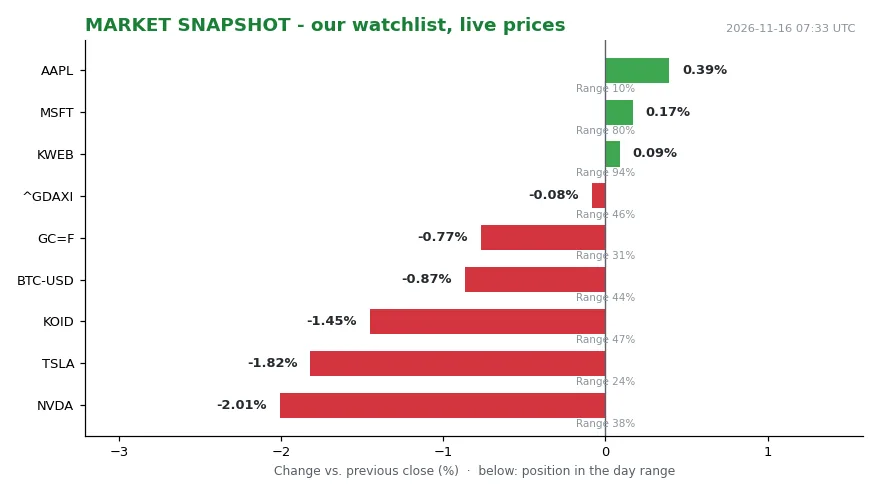
At 07:30 UTC our own tape reads narrower than the headlines. NVDA prints 162.85, down 2.01 % and parked at 38 % of its daily range. TSLA trades at 390.22, off 1.82 %, near the session lows at 24 % of range. MSFT holds 523.88, up 0.17 %, pressed against the top of its range at 80 %. KWEB changes hands at 22.93, up 0.09 %, at 94 % of range. Gold slips 0.75 % to 3857.30. Our regime line reads trend=falling, level=3.63. The simulated book carries 1839.73 USD in cash against 3652.10 USD of equity, down 0.39 % on the day, with WATCH KWEB as the last logged decision.
That is rotation, not evacuation. High-beta semiconductors and autos are being sold. Quality software is being held. China internet is being bid. Gold is not being bought as insurance. Cash sits at roughly half the book, and the busiest signal channel on Nov. 15 was central banks, with a single event logged. The posture is patience.
The music industry showed the same pattern. Over the past two weeks the listed music companies reported results for the quarter ending Sept. 30, and the pattern in the numbers rhymes with the pattern on our screen: growth is no longer being rewarded on its own. Margin, churn and the cost line are.
A sector already braced for bad news
Spotify had raised prices across markets. The reasonable base case was subscriber growth stalling and advertising staying soft.
Spotify did the opposite. It added 6 million net subscribers in the third quarter, 1 million ahead of guidance, and the stock rose 11 % the day after earnings. Total revenue climbed 14 % in constant currency to 4.97 billion euros ($5.63 billion), subscription revenue rose 15 % to 4.5 billion euros ($5.08 billion), and monthly active users grew 11 % to 788 million. Gross margin hit a record 33 %. Free cash flow generation set a record too.
Universal Music Group grew revenue 11.7 % to 3.39 billion euros ($3.87 billion), or 5.3 % without the newly acquired Downtown Music Group. Subscription and streaming revenue reached 1.81 billion euros ($2.063 billion), an increase of 17.9 %, and grew by 8.4 % on an organic basis. Downtown contributed 195 million euros ($222.3 million) to overall revenue.
Live Nation reported 61 million concertgoers, a record, driven by 30 % audience growth outside the U.S., and revenue growth of nearly 20 % to $10.1 billion. The concerts business alone booked $8.7 billion.
HYBE delivered the biggest quarter in its history: 1.5257 trillion Korean won ($1.135 billion) in revenue and 188.5 billion won ($140.35 million) in operating profit. Sony’s music segment posted 598 billion yen ($3.75 billion), more than 10 % top-line growth, and revised its full-year music target upward for the second straight quarter.
SM Entertainment is the exception that draws the line. SM Entertainment revenue fell 9 %, operating profit dropped 26 % to 35.5 billion won ($25 million), and the company ran a net loss of 1.1 billion won ($775,000). The stock sank more than 7 % on Nov. 4. The stated cause was a light release slate while its biggest acts pursue international careers — a headwind management expects to persist into 2027.
How a price rise travels to a margin
Four transmission channels are doing the work here.
The first is pricing power measured against churn. Spotify’s price increases did not dent subscriber additions. SiriusXM went the other way: it stabilized self-pay subscriptions with 5,000 net adds and pushed churn down to 1.5 %. That is stabilization, not growth, and the market treated it as enough — the stock rose more than 4 % on Oct. 29.
The second is mix. Deezer spent the quarter letting low-margin legacy telecom partnerships roll off. The partnership segment shrank 17 %, which is the point: Deezer gives up revenue when it onboards listeners through a carrier. Average revenue per user from partnership subscribers rose nearly 16.7 % to 3.7 euros a month, while direct-subscriber ARPU held flat at 5.4 euros.
The third is the cost line. SiriusXM cut marketing spend to compensate for flat revenue. Spotify’s operating expenses reached 967 million euros ($1.1 billion), nearly a fifth of revenue, driven by what the company described as temporarily elevated growth in marketing and cloud/AI spend.
The fourth is advertising, which is no longer a single line. Spotify’s ad-supported revenue rose 9 % in constant currency to 482 million euros ($546 million). SiriusXM’s ad revenue was flat at $465 million, but podcast advertising rose 20 % and offset softness in music ad revenue.
Live entertainment runs on a different channel entirely: sold-out inventory. MSGE grew revenue 37 % to $217 million, with an extra $30 million from concerts and entertainment revenue up 33 % to $174.9 million. A significant majority of its concerts sold out in the quarter, and food, beverage and merchandise spend per concertgoer rose by double-digit percentages. Currency added a tailwind at Sony, compounding growth in streaming, physical, live and merchandise.
The bill lands on the release calendar
The winners this quarter were the companies that could raise price without losing volume and cut cost without losing product: Spotify, UMG, Live Nation, HYBE, Sony, MSGE, Deezer and SiriusXM. Deezer and SiriusXM both raised full-year profitability guidance. MSGE forecast further growth in event counts, including residencies.
The losers were concentrated. SM Entertainment paid for a release calendar it could not fill. Deezer’s carrier partners lost subscribers by design. UMG’s departing staff absorbed the cost of the savings target. Investors in music advertising absorbed another flat quarter.
The decisions sit with a small group. UMG management decides how fast Downtown integration turns into revenue rather than just reported percentage points — its chief executive put the case plainly: “The numbers are already proving why we made this deal.” [1] MSGE’s calendar decides how much of a residency lands inside a fiscal quarter; only 16 of Harry Styles’ 30 shows fell into the first fiscal quarter. Its chief executive framed it as “an additional positive on top of that underlying strength, but you know we do believe the garden delivered robust growth … in the number of concerts year over year on an underlying basis.” [1] Sony’s top sellers were ATEEZ, Michael Jackson, Ella Langley, Bad Bunny and SZA.
The next set of numbers on the desk
Next week Warner Music Group and others report their last quarter, which turns this roundup from a snapshot into a comparison.
Three things are worth tracking. First, whether Spotify’s expense ratio holds near 20 % of revenue while the add-on tiers scale — that is the difference between a margin story and a marketing story. Second, whether UMG’s organic 8.4 % survives the loss of easy Downtown comparables. Third, whether SM Entertainment’s 2027 slate arrives on time, because its current numbers are a calendar problem, not a demand problem.
On our own screen the same discipline applies. MSFT sits near its highs while NVDA sits in the lower half of its range, and 1839.73 USD of cash is doing nothing in particular. The file stays open on the desk until Warner Music Group and the rest of the sector print their last quarter.
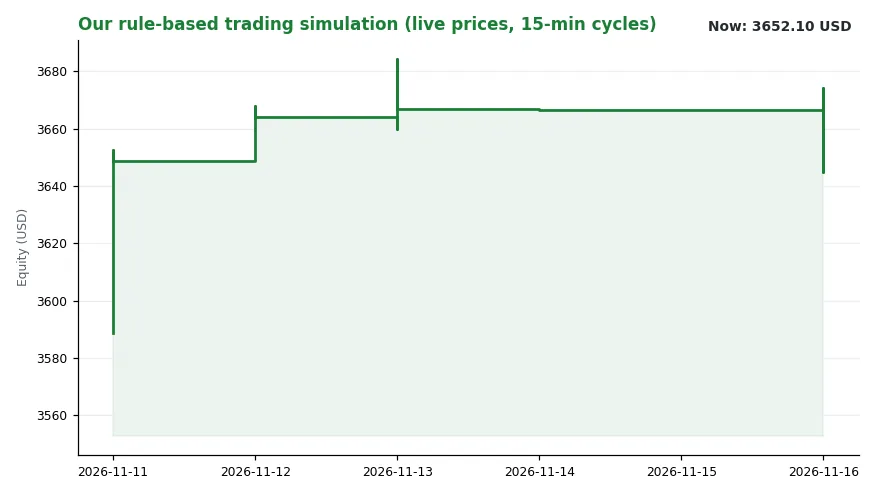
This is market education, not investment advice. Figures are as reported by the companies and as measured in our own data at 2026-11-16 07:30 UTC.
Sources
Mentioned organisations (context, not sources)
- NVIDIA — Organisation (homepage)
- Tesla — Organisation (homepage)
- Microsoft — Organisation (homepage)
- Spotify — Organisation (homepage)
- Universal Music Group — Organisation (homepage)
- Downtown Music Group — Organisation (homepage)
- Sony — Organisation (homepage)
- SM Entertainment — Organisation (homepage)
- SiriusXM — Organisation (homepage)
- Deezer — Organisation (homepage)