
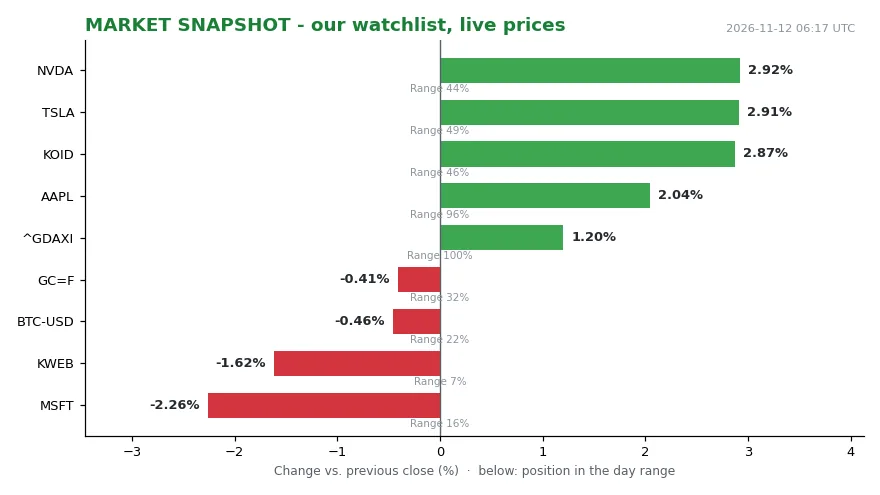
At 06:13 UTC on 12 November 2026 our watchlist showed a market splitting against itself rather than moving as one block. NVDA traded at 173.73, up 2.92% versus the previous close and sitting mid-range at 44% of the day’s span, where 0% is the day’s low and 100% the day’s high. AAPL stood at 355.63, up 2.04% and pressed against the top of its range at 96%. MSFT went the other way at 521.12, down 2.26% and near the day’s low at 16% of its range. TSLA at 390.84 (+2.91%, 49% of range) and KOID at 34.44 (+2.87%, 46%) filled in the middle ground. The DAX at 26662.77 (+1.20%) sat at the very top of its range, 100% of the day’s span. Three of the world’s largest technology names, three different verdicts on the same session — that is a rotation signature — money leaving one group of stocks and moving into another — not a broad rally.
The defensive side of the board was quieter. BTC-USD traded at 73558.65, down 0.50% and near its lows at 18% of range. Gold (GC=F) at 3983.00, down 0.44%, mid-range at 29%. KWEB at 23.67, down 1.62%, close to the bottom at 7% of range. Neither bitcoin nor bullion behaved like a hedge against anything in particular during this session.
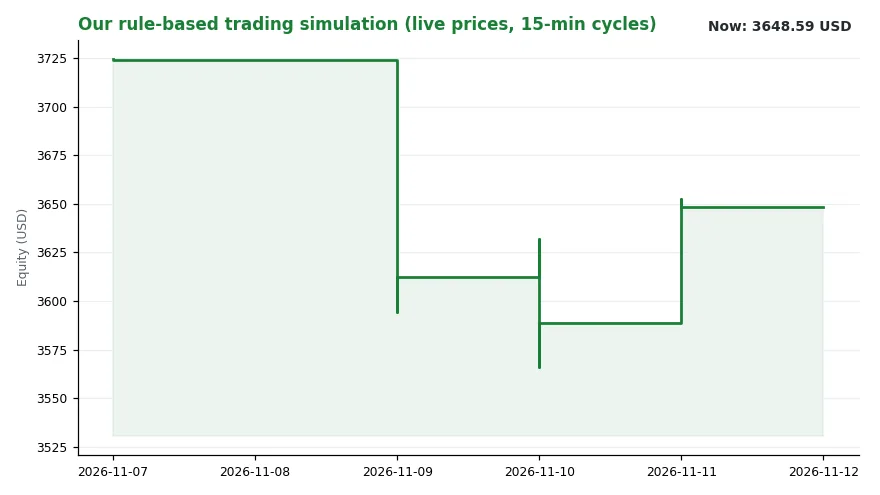
Our simulated equity book stood at 3648.59 USD, flat against the same time yesterday, with 1824.65 USD held in cash. The latest rule-based decision was to watch KWEB at 0.00, and the regime reading — our model’s summary label for the current market state — was trend=falling with level 3.63. Cash-heavy, unexcited, waiting.
None of those instruments carries a UK state pension liability, a gilt yield or a longevity assumption. What it can do is describe the mood in which that story lands: dispersed, selective, with a falling trend reading and a book that prefers to sit still.
The claim and the number behind it
The claim at the centre of the row is compact: a Conservative government that kept the triple lock — the rule that raises the state pension each year by whichever is highest of inflation, average earnings or 2.5% — would have to raise the state pension age above 70 [1]. Its author is Torsten Bell, Treasury minister, MP for Swansea West since 2024 and previously director of the Resolution Foundation thinktank, who kept the pensions brief across the Treasury and the Department for Work and Pensions when Andy Burnham took power in July [1].
Labour’s announced reform, due to come into force in the next parliament, changes the formula rather than the promise. The state pension would rise each year by the higher of inflation or 2.5 %. Earnings growth would only be used when the pension’s value had slipped behind recent wage growth [1]. The initial proceeds are earmarked for Burnham’s national care service [1]. The Conservatives have attacked the move and insisted they would keep the triple lock as it stands [1].
The figure that does the argumentative work is a government estimate: an unreformed triple lock costs £50bn by 2050 [1]. The current state pension age, already under review, is expected to reach 68 between 2044 and 2046 [1].
Bell’s case rests on precedent rather than projection, and he states it in his own words:
“If you don’t want to have an adjustment to the triple lock, then you will need to do other things to make the state pension remotely sustainable.” [1] “We don’t need to guess what they would do because they’ve literally just done it, which is they repeatedly and at very short notice accelerated the increases in the state pension age.” [1]
Those accelerations came in 2011 and 2014, and some people received as little as five years’ notice [1]. In 2013 the then chancellor, George Osborne, called raising the pension age “one of the less controversial things we have done” while noting it had delivered “absolutely enormous savings” [1].
The mechanism: two dials, one bill
A triple lock has three legs — inflation, earnings and a flat 2.5 % floor — and the pension tracks whichever is highest. Removing the earnings leg does not abolish the promise; it changes the long-run growth path of every payment made under it. The liability therefore stops compounding at wage growth and starts compounding at prices or 2.5 %, whichever is greater.
A fixed bill can be met by turning one of two dials. The first is generosity: the formula itself. The second is eligibility: the age at which payment starts. Bell’s argument is arithmetic before it is political — if the first dial is locked, the second one moves.
The age dial has an operational advantage that the formula dial lacks. A formula change is felt immediately by everyone already drawing a pension. An age change is deferred, lands on future cohorts, and can be legislated years ahead and then accelerated. The 2011 and 2014 episodes show the mechanism precisely: not a change of direction, but a shortening of the notice period [1]. Bell’s summary of the consequence is blunt: “And even though they know that the triple lock should change, they are opposing it – and the consequence of that is they would end up making people wait into their 70s.” [1] There is a third channel that our data cannot touch, and it should be named as such. Long-dated pension obligations are sensitive to the discount rate used to value them — the interest rate used to convert a future payment into today’s value — and discount rates live in bond markets. Our watchlist holds no gilts — UK government bonds — and no UK pension-linked assets, so we cannot verify anything about how the reform is being priced by holders of UK duration — a measure of how sensitive a bond’s price is to changes in interest rates.
Who wins, who pays, who decides
The clearest losers under the Conservative version Bell describes are cohorts approaching retirement who would absorb a shortened notice period — the group that took the hit in 2011 and 2014 [1]. The clearest beneficiaries of the Labour design are today’s pensioners, who keep the 2.5 % floor and inflation protection, and future pensioners, whom Burnham’s 10-year plan is meant to promise “a better deal” [1].
On the deciding side sit three actors. The first is the Conservative leadership: Bell notes that Badenoch herself suggested last year that the triple lock should be means tested, and he argues that “her brand is principled, know what you think, tell it straight”, which he says she has contradicted here [1]. The second is the prime minister’s office, where the 10-year plan may now slip until the new year [1].
The political risk is documented rather than hypothetical. The triple lock had been treated as too risky to reform, particularly given the backlash against Labour’s plan to strip the winter fuel allowance from most pensioners — a plan subsequently abandoned [1]. Bell’s counter-argument is that the public would prefer Burnham’s willingness to make an argument to what he calls the Conservatives’ failure to be honest, and he reaches for a large phrase:.” [1] Former Conservative chancellor Jeremy Hunt has described the policy as an “anchor drag” on the public finances [1].
What we watch next
Four markers, in order of information value. First, the pension age review: whether the 2044-2046 window for a pension age of 68 holds, moves forward, or is reopened entirely. Second, whether the Conservative party publishes costed pension numbers of its own — the “above 70” figure is a ministerial claim, not a costing. Third, the timing of Burnham’s 10-year plan, which may land in the new year or later [1]. Fourth, whether the £50bn-by-2050 estimate survives scrutiny as an official projection rather than a departmental talking point.
Two honest caveats. Bell is a Treasury minister advocating for his own government’s reform, which makes him an interested witness to the consequences he describes. And our own measurement says nothing about UK fiscal risk: the dispersion we logged — AAPL at 96% of range against MSFT at 16% — is a rotation inside equities, with cash at 1824.65 USD and a falling trend reading, not a verdict on British retirement policy.
The coordinates to hold onto are dates, not prices. 2011 and 2014 behind us, when notice periods were cut short. 2044 and 2046 ahead, when 68 was meant to arrive. 2050, where the £50bn sits. And a review with no publication date at all. That is the landscape this argument is being fought across — and the pension age is the piece of it that moves.
Source: [1] Guardian report on state pension reform and Torsten Bell’s comments, 11 November 2026, plus syndicated copies (MSN). All figures, quotes and attributions above are drawn from that source. Market data from our own measurement, 12 November 2026, 06:13 UTC. This is educational analysis, not investment advice.