When cheap AI probes predict costly training
The Question Every Team Faces Too Late
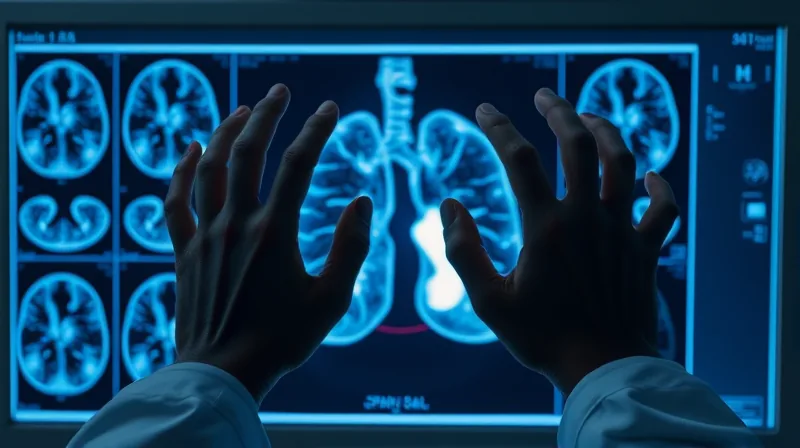
A team has a frozen 3D-CT encoder and a text-generation task it was never explicitly trained for. Before committing GPU weeks to fine-tuning, someone runs a probe: a small model trained on top of the encoder, cheap enough to finish in minutes. The probe returns a number. The question is whether that number means anything. Not the architecture, not the training cost, not the benchmark score. Just: does the cheap signal hold up when the expensive run begins, or does it only look good until you spend real money finding out?
That question has a name in machine learning research, and a paper by Renjie Liang and eight co-authors gives it a clean answer. The work asks when a cheap test can predict whether an expensive training run will pay off. [1] The title frames it as a probe problem. The finding is more interesting than the framing.
What a Probe Actually Measures
A probe, in this context, is a small model trained on top of a frozen encoder — the part of a system that has already learned to represent images or text. The probe is cheap. You train it in minutes on a laptop. It tells you how well the encoder’s internal representations can be read out for a downstream task, like generating a text description from a 3D CT scan.
The appeal is obvious. Before committing GPU weeks to fine-tuning a large model, you run a probe. If the probe performs well, you assume the full training will too. That assumption, the paper shows, is not always safe. Sometimes the cheap signal tracks the expensive outcome. Sometimes it diverges in ways that cost real money and real time.
Where the Gain Lives
Here is the concrete benefit the research delivers: it identifies the conditions under which probing is trustworthy. When the probe and the full training share the same representation space — when you are not asking the encoder to learn something fundamentally new — the cheap test predicts the expensive result with useful accuracy. Teams can screen candidates before committing resources. That is a genuine lift: fewer wasted runs, faster iteration, better use of limited compute.
The gain is not a new model. It is a decision rule. And decision rules, unlike models, do not need to be retrained every quarter.
The Temptation to Over-Trust
The danger arrives when the probe is treated as a universal oracle. The paper’s experiments with 3D-CT encoders for text generation show that when the downstream task requires the encoder to develop capabilities it did not already have — spatial reasoning that was never in its pretraining, for instance — the probe’s verdict becomes unreliable. [1] It may say “ready” when the model is not. It may say “hopeless” when the model would have succeeded.
That failure mode is not a bug in the probe. It is a category error. The probe measures what is already legible in the representation. It cannot measure what training will create.
Why This Matters Beyond Radiology
The same logic applies anywhere a frozen model is being evaluated for a new job. A language model screened for legal summarization. A vision encoder tested for defect detection on a factory line. A speech model probed for a language it has never seen. In each case, the cheap test is useful only if the gap between the probe task and the target task is small enough that the representation does not need to change fundamentally.
When the gap is large, the probe becomes a mirror: it reflects the assumptions of the person running it. A team that trusts a probe beyond its domain is not making a technical mistake. It is making a judgment call about risk, and it is making it without the evidence it thinks it has.

The Boundary Between Signal and Noise
The research does not offer a threshold. It offers a diagnostic. The distinction matters. A threshold — “probe accuracy above 80 percent means go” — would be a product. A diagnostic — “check whether the probe and target share a representation space” — is a way of thinking. The first can be sold. The second has to be understood.
That is where human judgment re-enters. The probe does not decide. It informs. The decision to spend money on training, to trust a model in a clinical setting, to deploy a system where errors have consequences — that decision remains with the person who understands what the probe can and cannot see.
The Consequence Nobody Wants to Name
If probing is reliable only when the target task is close to what the encoder already knows, then the most valuable AI applications — the ones that solve problems the model was never trained for — are precisely the ones where cheap prediction fails. [1] The tool that saves money on incremental improvements is silent on the breakthroughs.
That is the finding no one wants to follow to its end. It means the economics of AI development are structurally biased toward the incremental. The cheap test rewards the safe bet. The expensive gamble, the one that might actually change what a model can do, has no early warning system. You either take it blind or you do not take it at all.
The paper does not say this. It does not need to. The result says it for anyone willing to read past the method section.