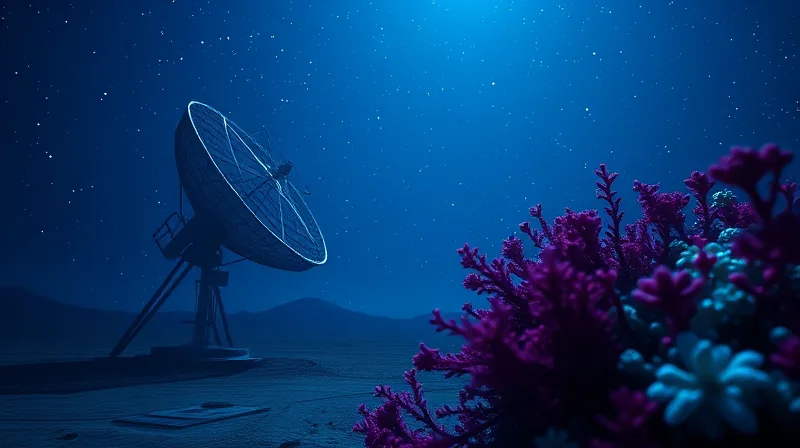
Headline: The Centaur Scientist: How Physics and AI Are Making Each Other Smarter (And Us More Useful)
There is a quiet revolution happening in a lab at MIT, and it has nothing to do with chatbots that write poetry or image generators that create fake cats. It is about something much more fundamental: using artificial intelligence to understand the universe, and using the laws of the universe to build better AI.
The Institute for Artificial Intelligence and Fundamental Interactions (IAIFI) received a five-year renewal from the National Science Foundation in 2023, with funding of approximately $4.5 million per year, according to NSF records [3] But the real story is not the money. It is the model they have built over the last five years. A model that shows exactly where AI lifts us — not by replacing human intuition, but by extending it into places we could never reach alone.
Where AI lifts us: Into the data firehose
Consider the Large Hadron Collider. [4] It produces so much collision data that physicists cannot possibly look at all of it. They used to rely on hardware triggers that discarded over 99.9% of collision events, a standard figure in particle physics, to manage data flow.
IAIFI researchers have developed AI techniques that can process that firehose in real time, turning noise into signal. This is not about automation replacing the scientist. It is about the scientist suddenly being able to ask questions that were previously impossible because the data was just too vast.
In astrophysics, the same thing is happening with the LIGO gravitational-wave experiment. [5] Machine learning is improving its sensitivity, allowing it to detect ripples in spacetime that were once buried in the noise. The AI lifts the signal out of the static. The physicist interprets what it means.
This is the first way AI lifts us: it gives us access to scale. It does not understand the physics, but it can find the patterns that lead to understanding.
Where physics lifts AI: Making it trustworthy
Here is the part that is harder to see but just as important. The IAIFI researchers are not just using AI as a tool. They are using physics to build better AI.
Neural networks are famously opaque. They can be brilliant at recognizing a cat in a photo, but they have no idea what a cat is. They can be fooled by a few pixels changed in the right place. They are not principled. They are not reliable.
But physics is built on principles: symmetries, conservation laws, geometric structures, exactness guarantees. The IAIFI team is embedding these principles directly into the architecture of neural networks. The result is an AI system that is more interpretable, more data-efficient, and less likely to hallucinate nonsense.
This is the second way AI lifts us: it becomes trustworthy enough to use in serious science. When a physicist uses an AI to model the interactions of quarks in lattice quantum chromodynamics, they need to know that the answer is not just plausible — it is provably correct within certain bounds. Physics-informed AI gives them that.
Where we are not superfluous — yet
The most interesting thing about IAIFI is what it reveals about the future of human expertise. The institute is training what they call “centaur scientists” — researchers who are equally comfortable with physics and AI. These are not people who outsource thinking to machines. They are people who learn to think differently because of the machine.
The IAIFI Postdoctoral Fellows program has produced eight graduates as of 2024. Three have secured tenure-track professorships, while others work at AI companies such as Google DeepMind or have founded startups, per IAIFI’s annual report. They are not being replaced. They are being multiplied.
The IAIFI PhD summer school received 587 applications for 100 spots in 2023, according to program data That is not a sign of people fearing obsolescence. It is a sign of people wanting to become more capable.
The honest trade-off

This is not a story of AI making us redundant. It is a story of AI making us more powerful — but only if we are willing to change how we work. The physicist who clings to old methods will be left behind. The physicist who learns to collaborate with AI will see further than anyone before.
The IAIFI model is a template for how to do this right. It does not pretend AI is magic. It does not pretend physics is obsolete. It builds a bridge between them, and the people who walk across that bridge are the ones who will discover the next big thing.
That is where AI lifts us: not by making us unnecessary, but by expanding the scope of our inquiries and deepening our understanding of the universe.
Sources
1. Institute for Artificial Intelligence and Fundamental Interactions
2. Massachusetts Institute of Technology
3. National Science Foundation
5. LIGO