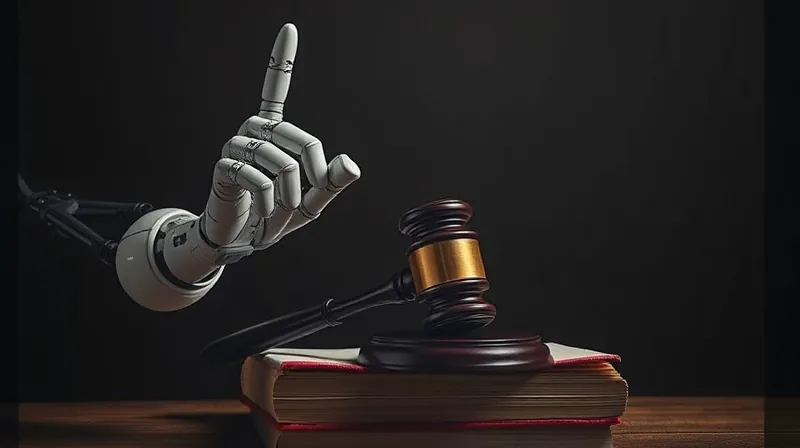
AI Ethics Education Addresses Human Judgment Decline
The word “judgment” has always implied a human presence. A court ruling, a hiring decision, a medical diagnosis — each rests on the assumption that someone with experience, training, and a sense of responsibility made a call. That assumption is quietly dissolving. The new interdisciplinary AI & Ethics minor at William & Mary, blending computer science with philosophy, exists precisely because the line between human judgment and machine output has become too blurry to ignore. The question is no longer whether AI can make decisions, but whether we still need the people who used to make them. This program confronts that question directly, training students to see what machines cannot.
The Uncomfortable Question at the Core
Every technological shift has a moment when its real cost becomes visible. For the printing press, it was the scribe. For the assembly line, it was the craftsman. For AI, that moment is now arriving in fields where judgment was once considered irreplaceable — not manual labor, not repetitive tasks, but the kind of nuanced evaluation that universities spent centuries training people to perform. When William D’Alessandro, assistant professor of philosophy at William & Mary, helped design the new minor, he framed it around teaching students “to think more deeply about the human implications and ethical dimensions of AI.” William & Mary The framing is revealing: the human implications are precisely what gets lost when the technology replaces the human.
The uncomfortable truth is that AI does not need to be perfect to make human judgment superfluous. It only needs to be good enough most of the time, and cheap enough to deploy at scale. A radiologist who catches 95 percent of tumors is valuable. An AI that catches 94 percent and never gets tired, never needs sleep, and costs a fraction of the salary is a business decision waiting to happen. The remaining 1 percent becomes a moral problem, not a technical one — and moral problems are exactly the kind of thing that philosophy departments have been studying for two and a half millennia.
What Philosophy Offers That Code Cannot
Chris Tucker, Francis S. Haserot Professor of Philosophy at William & Mary, put the distinction plainly: “Computer science provides background on the technology so that students know how AI functions. What the philosophy side does is give you training on how to evaluate values.” William & Mary That sentence contains the entire problem in miniature. Knowing how something works tells you nothing about whether it should work that way. A self-driving car can navigate traffic perfectly and still face the impossible choice of who to hit when a collision becomes unavoidable. The code will make a decision — it has to — but the code did not arrive at that decision through moral reasoning. It arrived through a series of if-then statements written by engineers who were told to pick something.
This is where the human role becomes genuinely endangered. Not because AI is smarter, but because the institutions that once trained people to make difficult judgments are being asked to justify their existence. Why spend four years teaching students to evaluate arguments, weigh evidence, and consider competing values when a language model can produce a plausible essay on any topic in seconds? The answer, according to the faculty behind William & Mary’s new program, is that the plausibility is precisely the problem. A machine can generate an argument that sounds reasonable. It cannot be held responsible for that argument. It cannot be wronged by it. It cannot learn from being challenged on it.
Evgenia Smirni, the Sidney P. Chockley Professor of Computer Science at William & Mary, emphasized the practical stakes: “Being able to know how to use, design, and build AI ethically is very important.” William & Mary The word “ethically” does a lot of work there. It acknowledges that the technology itself is neutral — a tool, like a hammer or a spreadsheet. But the people who deploy it are not neutral, and the decisions they make about where to deploy it, what data to feed it, and who gets to challenge its outputs are moral decisions dressed up as technical ones.
The Global Divergence in How We Answer
The debate over whether AI makes human judgment obsolete is not happening evenly around the world. Different societies are answering it in radically different ways, and the contrast reveals what is at stake. In the European Union, the AI Act has created a regulatory framework that treats certain uses of AI as inherently risky, requiring human oversight for decisions in areas like hiring, credit scoring, and criminal justice. European Union The assumption behind that regulation is that human judgment has intrinsic value — that even if an AI is more accurate, the human should remain in the loop because the human can be held accountable.
In the United States, the approach has been more fragmented. United States Some states have passed laws requiring transparency in AI-driven decisions. Others have let the market sort it out. The result is a patchwork where a person in one state might be able to demand a human review of an AI denial of health insurance, while a person in a neighboring state has no such recourse. William & Mary’s location in Williamsburg, Virginia, recently identified by Microsoft as having the highest AI user share of any county in the United States, places the university at the center of this experiment. The faculty are not just teaching about AI ethics in the abstract; they are doing it in a community where the technology is already deeply embedded in daily life.
The international comparison matters because it shows that the question “does AI make humans superfluous?” is not a technical question at all. It is a political question, a cultural question, a question about what kind of society we want to build. The same technology that is tightly regulated in Brussels is being deployed aggressively in Silicon Valley and adopted eagerly in Williamsburg. Neither approach is obviously correct, but the divergence itself proves that human judgment still has a role — the judgment about how much judgment to delegate to machines.
The Technical Problem Is Solved
Here is the part that rarely gets said aloud: the technical problem of AI making human judgment superfluous is largely solved. The systems work. They classify, predict, recommend, and decide with enough accuracy that in many domains, they are already better than the average human practitioner. The research is not the bottleneck. The bottleneck is social. It is the question of whether we are willing to accept the trade-offs that come with replacing human judgment — not because the machines are inadequate, but because they are adequate in ways that make us uncomfortable.
That discomfort has a name: accountability. When a human judge makes an error, there is a process for appeal, a record of reasoning, a person who can be questioned. When an AI makes an error, the process is murkier. The training data was biased. The model was overfitted. The deployment context differed from the training context. None of these explanations satisfies the person who was denied a loan, or a parole hearing, or a medical procedure. The machine cannot be cross-examined. The engineers who built it can, but they did not make the specific decision that harmed this specific person. The responsibility diffuses until it evaporates.
Israt Farah, a first-year student at William & Mary who served as a student representative in the minor’s approval process, saw the stakes clearly: “I think it’s important to combine ethics with data science because data science is a new realm in technology with lots of untapped potential.” The potential she refers to is not just technical. It is the potential to create systems that are both powerful and accountable, efficient and fair. That combination does not emerge naturally from the technology. It has to be designed, argued about, and built by people who understand both the code and the values.
The Role That Remains
The faculty behind the new minor are not Luddites. They are not arguing against AI. They are arguing for something more subtle: that the human role in an AI-driven world is not to compete with the machines on their own terms, but to do the things the machines cannot do. A machine can analyze a legal document faster than any human. It cannot decide what justice requires. A machine can read a thousand medical studies and identify the most effective treatment. It cannot weigh the patient’s values against the statistical odds. A machine can generate a thousand variations of an argument. It cannot know which one is true.
Smirni described the goal of a William & Mary education in terms that sound almost old-fashioned: “The William & Mary student goes out into the world as a thinker.” In an age of AI, thinking has become a kind of resistance. The machine can produce output, but it cannot engage in the slow, difficult, often painful process of figuring out what matters and why. That process is what the new minor is designed to preserve. Not because it is efficient, but because it is irreplaceable.
The technical problem is solved. The social problem is not. And the social problem is the one that requires human judgment. The machines have taken over the calculations. The humans are left with the values. That is not a diminished role. It is the only role that was ever truly ours. The students graduating from William & Mary’s new minor will not be competing with machines for the right to decide. They will be the ones deciding what the machines are allowed to do in the first place.