Zebrafish reveal brain’s social decision preparation
Imagine standing at the edge of a crowded room. You see a familiar face across the floor. Before your feet take a single step toward that person, something has already begun inside your skull. A silent wave of activity spreads through your brain, building for seconds before your muscles even twitch. This invisible preparation, this neural prelude to action, has remained largely hidden from science—until now.
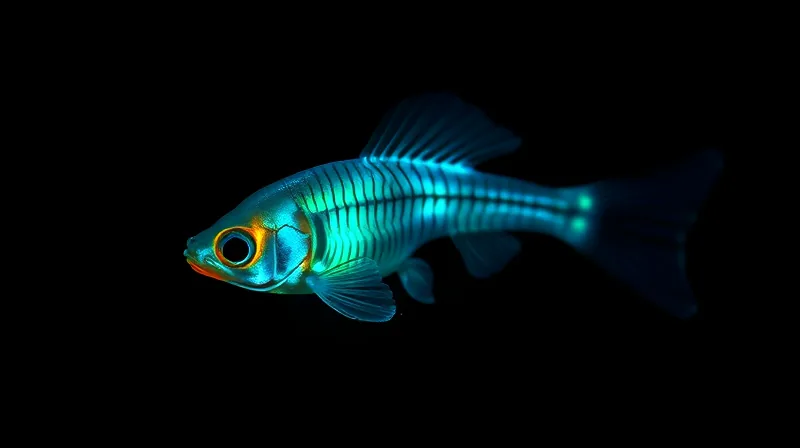
Researchers at the Hebrew University of Jerusalem, led by Dr. Lilah Avitan and PhD student Imri Lifshitz, have peered into this hidden world using a tiny, transparent fish. The zebrafish, no longer than your fingernail, offers a window into the living brain at work. Its see-through body allows scientists to watch individual brain cells flash with activity in real time, something impossible to do in humans. The team built a novel experimental setup where one fish in a small chamber with a clear wall watched another fish swim freely on the other side, isolating the decision to approach from physical contact or chemical signals As the observer fish decided whether to approach, a microscope captured the firing of neurons across its entire brain, moment by moment.
What they found challenges old assumptions. Social behavior does not begin with a single command center. Instead, a coordinated pattern spreads across multiple brain regions like ripples across a pond. This pattern starts several seconds before the fish moves toward its neighbor. The brain is not reacting in the moment; it is preparing, building a state that makes social action possible.
The Mystery of the Unseen Signal
For decades, scientists have debated what happens in the brain just before a decision becomes visible. Some believed social behavior emerged from a dedicated “social brain” region, a specific cluster of neurons that triggered approach or avoidance. Others suspected the process was more distributed, involving networks that stretched across the brain. But without the ability to watch entire brains at cellular resolution, the question remained unsolved.
The zebrafish changed this. Its brain contains about 100,000 neurons, compared to the human brain’s 86 billion. This smaller scale makes it possible to record activity from the whole organ simultaneously. Dr. Lilah Avitan and her PhD student Imri Lifshitz designed a system that placed one fish in a small chamber with a clear wall. On the other side, another fish swam freely. The observer fish could see its neighbor but could not touch it. This setup isolated the decision to approach from other factors like physical contact or chemical signals.
The team recorded brain activity while the observer fish either swam toward the other fish or stayed still. They compared the neural patterns before each type of behavior. The differences were striking. Before social approaches, but not before random movements, a specific signature appeared across the brain. Activity rose in some areas and fell in others, creating a distinct neural landscape that predicted what was about to happen.
This signature was not a single spark but a wave. It began in the pallium, a higher brain region that processes complex information. The pallium in fish is analogous to the cerebral cortex in mammals, the wrinkled outer layer involved in social cognition in humans. From the pallium, the signal spread to other regions, suppressing activity in some while exciting others. The entire brain shifted into a new state, one that favored social engagement.
The Pallium as a Social Engine
The pallium emerged as a central player in this process. Fish with stronger activity in this region showed more consistent social behavior. They approached other fish more often and more quickly. The pallium seemed to be associated with the motivation to connect, the internal drive that pushes an individual toward another.
This finding connects to a broader understanding of brain evolution. The pallium in fish shares genetic and structural features with the mammalian cortex. Both regions handle similar tasks: integrating sensory information, evaluating social cues, and initiating appropriate responses. By studying the fish pallium, researchers can gain insights into how the human cortex manages social decisions.
The study also revealed that not all fish are equally social. Some approached their neighbors eagerly, while others hung back. The strength of the neural signature predicted this difference. Fish with a more pronounced brain-wide pattern were more social overall. This suggests that social motivation is not just a personality trait but has a measurable biological basis, rooted in the activity patterns of the brain.
Other research teams have found similar patterns in different animals. At Stanford University, scientists studying mice observed that neurons in the prefrontal cortex fire in sequences before social interactions. At the Max Planck Institute for Biological Cybernetics in Germany, researchers recorded brain-wide activity in fruit flies during courtship behaviors. Each species shows its own version of this neural preparation, suggesting that the phenomenon is ancient and widespread across the animal kingdom.
Building the Tension: What Was Unknown
Before this study, the timeline of social decision-making remained fuzzy. Scientists knew that the brain processes social information, but they did not know when the decision to act actually crystallized. Some theories proposed that social behavior was reflexive, triggered instantly by the sight of another individual. Others argued that it required conscious deliberation, taking time to weigh options.
The zebrafish data settled this debate. The neural signature appeared two to four seconds before the fish began to swim. This delay rules out a purely reflexive mechanism. The brain is not responding automatically; it is preparing, building a state that enables social action. This preparation period may allow the brain to integrate multiple factors: the identity of the other fish, the current environment, the internal state of the observer.
This finding echoes work on human decision-making. In the 1980s, neuroscientist Benjamin Libet conducted experiments where participants watched a clock and decided when to move their hand, revealing that brain activity preceded conscious awareness of the decision. Libet found that brain activity began before participants reported feeling the decision to move. This raised profound questions about free will and consciousness. The zebrafish study extends this line of inquiry to social behavior, showing that even the decision to approach another individual has a neural preamble.
But the zebrafish study goes further. Libet’s experiments measured a single brain region related to movement. The Hebrew University team recorded the entire brain, revealing a distributed network. Social decisions involve not just motor preparation but also emotional, cognitive, and motivational systems. The brain-wide pattern reflects this complexity.
Revealing the Solution Step by Step
The researchers did not discover this pattern by accident. They designed their experiment to capture the full sequence of neural events. First, they trained a machine learning algorithm on the brain activity data. The algorithm learned to distinguish between patterns that preceded social approaches and patterns that preceded other behaviors. Then, they tested the algorithm on new data. It could predict, with high accuracy, whether the fish would swim toward its neighbor before the fish actually moved.
This predictive power confirms that the neural signature is not a side effect of movement but a genuine precursor. The brain enters a specific state that makes social action more likely. The algorithm essentially reads the brain’s intention before it becomes visible in behavior.
The team also manipulated the pallium to test its role. They used optogenetics, a technique that uses light to control neurons. By activating or silencing pallium cells, they could increase or decrease the likelihood of social approach. This causal evidence proved that the pallium is not just correlated with social behavior but actively drives it.
Other laboratories have used similar approaches. At the University of California, Berkeley, researchers used optogenetics to stimulate the medial prefrontal cortex in rats, increasing their willingness to interact with other rats. At the RIKEN Center for Brain Science in Japan, scientists manipulated the habenula, a region involved in processing negative outcomes, and changed how zebrafish responded to social threats. These studies, taken together, paint a picture of social behavior as a distributed process with multiple control points.
The Social Spectrum: From Fish to Humans
The implications of this research extend beyond zebrafish. The basic architecture of social decision-making appears conserved across species. The pallium in fish, the cortex in mammals, and similar structures in birds and reptiles all handle social information. This means that discoveries in fish can inform our understanding of human social behavior.
Consider autism spectrum disorder, where social motivation is often reduced. If the neural signature of social approach can be identified in humans, it might serve as a biomarker for social functioning. Clinicians could measure this signature to assess treatment effectiveness or to identify children who might benefit from early intervention. At the University of Cambridge, researchers have used fMRI to study brain activity in autistic individuals during social tasks. They found reduced connectivity between regions involved in social processing. The zebrafish study suggests that this reduced connectivity might reflect a weaker pre-decision state, a lower baseline of social preparation.
Similarly, conditions like social anxiety disorder involve heightened fear of social situations. The brain-wide pattern in zebrafish showed decreased activity in some regions during social approach. These suppressed areas might be involved in fear or avoidance. If the balance between excitation and inhibition shifts too far toward inhibition, social approach becomes less likely. Understanding this balance could lead to new treatments that target the neural preparation phase rather than the behavior itself.
At the National Institute of Mental Health in the United States, researchers are exploring transcranial magnetic stimulation as a way to modulate brain activity in social disorders. The zebrafish findings could guide where to apply stimulation and when, targeting the pre-decision state rather than the aftermath of social failure.
The Door That Just Opened
This study raises a new question: Can we influence the pre-decision state to change social behavior? If the brain’s preparation for social action can be detected, perhaps it can also be modified. Imagine a device that monitors brain activity and provides feedback when the social signature is weak. A person could learn to strengthen this signature through practice, much like training a muscle.
At the Hebrew University, Dr. Avitan’s team is already planning the next steps. They want to understand what triggers the neural signature in the first place. Is it the sight of another fish? A memory of previous social encounters? An internal drive like hunger or loneliness? By identifying the triggers, they might find ways to activate the signature deliberately.
Other groups are pursuing parallel questions. At Harvard University, researchers are mapping the neural circuits that connect the pallium to motor regions in zebrafish. They want to trace the exact path the signal takes from decision to action. At the Salk Institute for Biological Studies in California, scientists are studying how social experience shapes the development of these circuits. Fish raised in isolation show different neural patterns than fish raised in groups, suggesting that the pre-decision state is shaped by learning.
The zebrafish model offers a unique advantage for these investigations. Its transparency allows researchers to watch the same neurons over days or weeks, tracking how the neural signature changes with age, experience, or injury, providing a longitudinal view of social motivation development. This longitudinal view could reveal how social motivation develops and how it can be restored after damage.
A Bridge Between Worlds
The connection between fish and human social behavior might seem far-fetched, but the evolutionary links are strong. The last common ancestor of fish and humans lived about 450 million years ago. Yet the basic blueprint for social decision-making has been preserved. The pallium in fish and the cortex in humans both arise from the same embryonic tissue. They express many of the same genes and use similar neurotransmitters.
This conservation means that drugs developed to enhance social behavior in fish might work in humans, at least in principle. At the University of Oxford, researchers are screening compounds that affect social behavior in zebrafish, looking for candidates that might treat social withdrawal in humans. The Hebrew University study provides a neural target for these screens: compounds that strengthen the brain-wide pre-decision signature.
The study also bridges different fields of neuroscience. It connects cellular-level recordings to whole-brain dynamics, linking the activity of individual neurons to the emergence of behavior. It integrates techniques from optogenetics, machine learning, and behavioral analysis into a single experimental framework. This interdisciplinary approach is becoming the standard for modern neuroscience, and the zebrafish is an ideal platform for it.
The Next Scientific Question
Every discovery opens new doors. The Hebrew University study closes one chapter but begins another. The next question is: How does the brain sustain the pre-decision state over several seconds? The neural signature does not flicker on and off; it builds gradually, maintaining itself until the action occurs. This sustained activity requires mechanisms that keep neurons firing in a coordinated pattern.
One possibility involves recurrent connections within the pallium. Neurons in this region form loops that amplify and prolong signals. A small initial trigger can grow into a sustained wave through these feedback circuits. Another possibility involves neuromodulators like dopamine or serotonin, which can shift the overall excitability of the brain. These chemicals might set the stage for the pre-decision state, making it easier or harder to achieve.
At the University of Pittsburgh, researchers are studying how dopamine neurons in zebrafish respond during social interactions. They have found that dopamine release increases just before social approach, suggesting that this neurotransmitter helps maintain the pre-decision state. At the European Molecular Biology Laboratory in Heidelberg, scientists are using calcium imaging to track the activity of thousands of neurons simultaneously, searching for the specific patterns that sustain the social signature.
The Hebrew University team also wants to know if the pre-decision state is specific to social behavior or if it generalizes to other types of decisions. Does the brain prepare for feeding, escape, or exploration in similar ways? By comparing the neural patterns across different behaviors, they can determine whether social decisions have a unique signature or share a common preparatory mechanism.
A New Lens on Social Life
This research changes how we think about social behavior. It is not just something we do; it is something our brains prepare for in advance. The next time you walk toward a friend at a party, remember that your brain started that journey seconds before your legs did. The decision was already made in the neural landscape of your pallium, shaped by your history, your biology, and the moment.
For scientists, the challenge now is to map this landscape in detail. Which neurons fire first? How does the signal propagate? What stops it when we decide not to approach? The zebrafish will continue to offer answers, its transparent brain revealing the hidden architecture of social life.
The door that just opened leads to a deeper understanding of what connects us to others. It suggests that social motivation is not mysterious or arbitrary but rooted in measurable brain activity. And it offers hope that when this activity falters, we might find ways to restore it. The countdown to social connection begins long before we move, and now we know how to listen for it. Future research will focus on identifying the triggers of this neural signature and exploring interventions to modulate it in disorders of social function.
Sources
1. Hebrew University of Jerusalem
3. Max Planck Institute for Biological Cybernetics
4. RIKEN Center for Brain Science
6. National Institute of Mental Health