A Grand Tour That Was Never the Plan
The technology at the heart of this story was built for something else entirely. The radioisotope thermoelectric generator, or RTG, is not a solar panel and not a battery in the ordinary sense. It converts heat from decaying plutonium into electricity, steadily, which is exactly what a spacecraft needs once sunlight becomes too faint to harvest. Voyager 1 carries one of these units, and like its twin it loses about four watts of power each year as the plutonium decays. That steady loss is the clock that now governs the entire mission: mission engineers estimate that by the mid-2030s Voyager 1 will no longer have enough energy to run its instruments or keep talking to Earth.
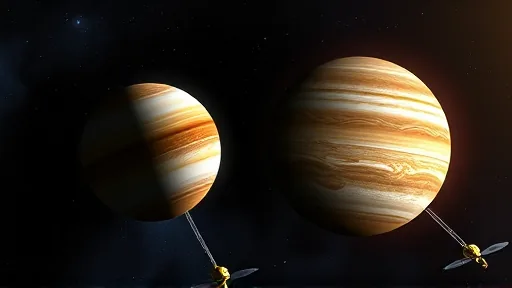
Voyager 1 left Cape Canaveral on September 5, 1977, riding a rare alignment of the giant planets that let a single probe slingshot from one world to the next using gravity assists. [1] The design brief was a planetary scout: fly past Jupiter, then Saturn, and report back. What the probe actually delivered reads like a different mission altogether. At Jupiter in 1979 it found storms, lightning, a ring system nobody had catalogued, active volcanoes on Io, and the fractured icy shell of Europa that hinted at oceans underneath. In 1980 it gave humanity its closest look at Saturn’s rings and at Titan, the moon wrapped in a thick atmosphere that hid its surface. That Titan flyby bent the trajectory away from the planets and out of the solar system — the tour ended, and a second career began by accident.
A spacecraft designed to look at planets became the first human-made object to sample the space between the stars. Then the cameras were switched off to save power, and the remaining resources were pointed at the outer boundary of the sun’s influence. The instruments that once photographed volcanoes were now measuring charged particles, magnetic fields, and plasma waves.
The Wall at the
Edge and the Update That Bought a Year
In August 2012, Voyager 1 crossed the heliopause and entered interstellar space — the first human-built object to do so. [1] The data from that crossing showed how the sun interacts with the surrounding galaxy and how cosmic radiation behaves once the solar wind no longer shields the spacecraft.
Its twin shows what the endgame looks like in practice. Voyager 2 launched on a Titan III rocket on August 20, 1977, and is now about 13.3 billion miles — almost 21.4 billion kilometers — from Earth, drifting at 34,000 mph. Its slower path let it visit all four giant planets — Jupiter, Saturn, Uranus, and Neptune — and it remains the only spacecraft ever to reach Uranus and Neptune.
The power problem is the same on both probes, and the solution is a kind of engineering triage. Voyager 2 started with 10 instruments and has been shedding them one at a time, each shutdown freeing a little power; only three remain — the Cosmic Ray Subsystem, the Magnetometer, and the Plasma Wave Subsystem. This year NASA sent the probe a software update nicknamed “Big Bang” from nearly 13.3 billion miles away. The update did two things at once: it switched off some powered devices and replaced them with lower-power alternatives, saving energy while keeping the spacecraft warm enough in the vacuum to keep working. Without it, another instrument would have had to go dark entirely. The savings should keep Voyager 2’s three remaining instruments operating for at least an extra year. The same update is planned for Voyager 1 — which, despite launching a few weeks later, is farther out because Jupiter and Saturn gave it a bigger gravitational boost and a higher speed sooner. Voyager 1 is now over 15 billion miles from Earth and still transmitting through NASA’s Deep Space Network.