A Ghost Story Written in Oxygen
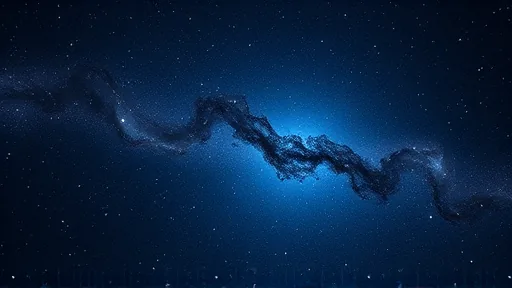
One hundred hours of observation through a special oxygen filter revealed what a familiar patch of sky had kept hidden. [1] The constellation Cassiopeia, long known as the home of two faint nebulas called IC 59 and IC 63 — the so-called Ghosts of Cassiopeia — now hosts a trio of previously uncatalogued blue apparitions, labeled simply Objects 1, 2, and 3. Three faint nebulas had been hiding in plain sight, visible only to a filter tuned to a single color of light.
The instrument that broke the silence was not a new telescope but a special oxygen filter, paired with 100 hours of accumulated observation. [1] A filter of this kind passes only a sliver of the spectrum — here, the wavelength emitted by oxygen atoms that have lost electrons, a state called ionized oxygen. Everything else is blocked. The result is a kind of photographic stencil: ordinary starlight and glowing hydrogen vanish, and only the ionized oxygen remains, appearing as blue phantoms against the dark. The three new objects surfaced precisely because the exposure was long enough and the filter selective enough to catch a signal far fainter than the surrounding nebulosity.
The two familiar ghosts glow by a mechanism that is now well understood. Energetic ultraviolet light streaming from Gamma Cassiopeiae — a multi-star system and one of the brightest stars in that part of the sky — strips electrons from the hydrogen gas in IC 59 and IC 63, causing it to glow red. The dust in those same clouds does something different: it reflects and scatters starlight, lending a blue-white tint to parts of the structure. Red from excited hydrogen, blue-white from scattered starlight — two colors, two physical processes, one region. The new objects point to a process that remains a mystery.
The Bow That Has Not Been Proven
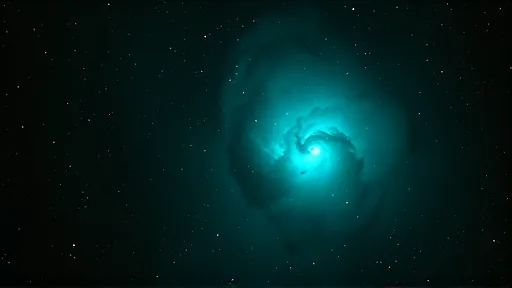
Here is the puzzle the image leaves open. Ionized oxygen needs an ionizing source, an engine hot enough to knock electrons loose. For the three blue phantoms, no such engine has been identified. A possible explanation is a bow shock: as Gamma Cassiopeiae plows through interstellar gas and dust, it may pile material up ahead of itself the way the front of a speeding boat pushes water into a crest. Gas compressed and heated in that crest could, in principle, ionize oxygen. Under this reading, Object 3 would be the compressed, heated oxygen of that bow shock — a wake made visible. [1] The word “may” carries the weight of the entire argument. A bow shock is a hypothesis that fits the geometry, not a measurement that confirms it. The same caution applies to Object 1. If a central white dwarf — the dense, cooling core left behind by a dying sun-like star — can be identified inside it, Object 1 would qualify as a planetary nebula, the shed outer layers of that dead star lit from within. No such central star has yet been pinned down. So one object waits on a bow shock that has not been directly detected, and another waits on a white dwarf that has not been found.
What makes the unresolved status instructive rather than disappointing is how narrow the evidence is. The case for a bow shock rests on position and color — where the blue light sits relative to Gamma Cassiopeiae, and what ionized oxygen looks like when it is hot. It does not rest on a measured shock front, a temperature profile, or a velocity.
A blue patch of ionized oxygen is a footprint; a bow shock would be the animal that left it.