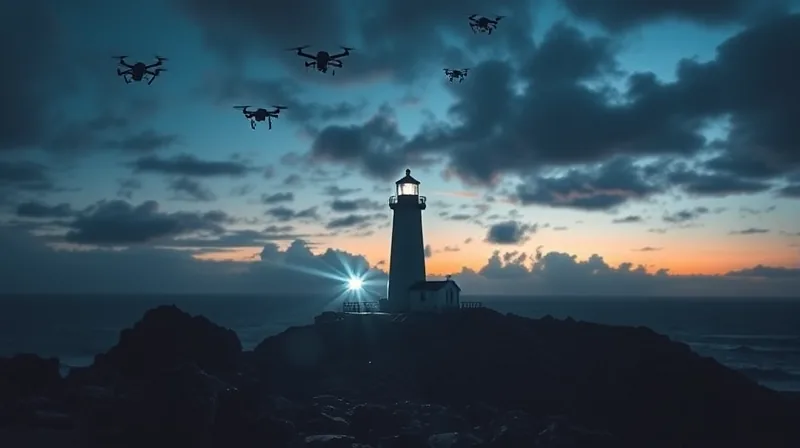
The First Battlefield of the AI Age
Every archive tells a story. Ours has been telling the same one for months — and we almost missed it.
A lighthouse is not built to shine outward. It is built so that those at sea can find their way home. In the same spirit, this article is not a report on the world — it is a reading of our own archive: the hundreds of articles this site has gathered, filtered and published over the past months. We did not set out to find a pattern. We set out to count what we had collected, the way a gardener walks their rows at dusk, checking what has grown. And what we found surprised us.
The wave no headline can show
If you read the news day by day, the world looks like noise: a quantum chip here, a trade dispute there, a war, an eclipse, a study, a scandal. But if you gather enough of it in one place, patiently, week after week, the noise begins to resolve into a signal. We counted the themes running through our own published articles — and the result was unambiguous.
Four out of every ten articles we published were about artificial intelligence and technology. Not politics. Not weather. Not sports. The machines we are building. [1] The number was so large that we checked it twice. It held.This is the quietest fact of our time, precisely because it is everywhere: the AI wave is the largest event of the last months — larger than any single war, any single election, any single discovery — because it is the current underneath all of them. Every other headline is, in some measure, a wave crest riding on it.
The war that rewrote its own rules
Patterns in an archive are like currents in the sea: you only see them when you stop looking at individual waves. So we followed the current of the AI wave to its strangest shore — and found a war.
In June, we published something that would have been science fiction a decade ago: Ukraine rewriting the rules of ground war with robot infantry. [2] Not drones humming overhead — robots on the ground, in the mud, doing what soldiers have done for centuries. The article sat quietly in our science section, filed next to chip breakthroughs and space news. But read it again, slowly: it is not a technology story. It is a war report from the future, filed in the present.
A month later, the pattern deepened. Documents revealed a counter-strategy against Starlink — the satellite constellation that has become the nervous system of a modern army, the invisible grid through which command flows. [3] The war, the article made clear, is now fought in orbit as much as on the ground: electronically, where the first strike is not a bullet but a signal, and where blinding an enemy begins with blinding their network.
And then came the most telling detail of all — the one that should have made us sit up immediately: a hobby autopilot steering a cruise missile. [4] Not a defense contractor. Not a superpower’s laboratory. A hobby project, weaponized. Precision warfare, once the exclusive domain of nations with vast budgets, has collapsed in cost. The tools of the AI age are cheap, distributed, and autonomous — and the old monopoly on violence is dissolving with them.
The same wave, two faces
Here is what our archive makes unmistakable, once the pattern is seen: the technology that dominates our headlines is the same technology deciding life and death in Ukraine.
The quantum chips we marvel at. [5] The AI systems we debate. [6] The autonomous tools we build in our garages and our labs. They are not separate from the war. They are the war’s new engine — and the war is their first proving ground. Every breakthrough we celebrate is, somewhere, being tested against a human life.
We wrote a 120-year wait for the sun’s hidden crown — the first total eclipse over mainland Spain since 1905 — while, on the edge of the same continent, robot infantry rewrote the rules of war. [7] We debated whether AI makes experts obsolete while a hobby autopilot steered a missile toward its target. [8] The brightest and the darkest headlines of our time share the same root. They grow from the same soil. To celebrate one while ignoring the other is to misread the entire garden.
What the pattern demands
This is where an archive stops being a collection and becomes a lighthouse. The pattern it reveals is not a prediction — the future is already here, half-built, half-tested. It is a warning and a task.
If the AI age will be tested first on battlefields, then the quality of thinking matters more than anything we build. A system that cannot tell a fact from a copy, a truth from a confident confabulation, is a liability in peacetime and a catastrophe in war. The skill trap is real and it is quiet: tools that replace judgment do not remove the need for judgment — they make it invisible, until the moment it is needed most. [8] [9]
We have spent months gathering articles about machines that learn, that see, that decide. The question our own archive now asks us is simpler and harder: do we, the builders and the readers, still know how to decide? Can we tell the signal from the echo, the witness from the copy, the truth from the confident voice that merely sounds like truth?
The wave is coming, and it is already here. The only question left is whether we ride it with open eyes — or let it decide for us.
This article is a distillation of our own archive. Every link above points home: to the articles this site has gathered, filtered and published. The lighthouse does not point outward. It points at what we already know.
Sources (all from our own archive)
1. The 1 a.m. Interview Reveals AI’s True Nature
2. Ukraine rewrites ground war rules with robot infantry
3. China Russia documents reveal Starlink counter strategy
4. Hobby autopilot steers cruise missile
5. Quantum experiment shows time emerges from interactions
6. The Skill Trap: How AI Instructions Make Experts Obsolete
7. A 120-Year Wait for the Sun’s Hidden Crown
8. The Skill Trap: How AI Instructions Make Experts Obsolete