
Two Lenses on the Same Silence
Two ways of asking why the sky is quiet have grown up side by side, and they arrive at the same place from opposite directions. One begins with a product of seven terms and asks how many voices the Milky Way should hold. The other begins with the absence of any voice at all and asks what that silence permits us to conclude. The first is the Drake equation, sketched in 1961 by the astrobiologist Frank Drake. The second is the Fermi paradox, the plain question of why, if the galaxy is so old and so wide, nobody has called.
A 2013 analysis by Nikos Prantzos, titled “A joint analysis of the Drake equation and the Fermi paradox,” proposes a unified framework that lets both be studied at once, quantitatively rather than rhetorically. [1] The move is economical: a simplified form of the Drake equation on one side, a fairly simple scheme for how the Milky Way would be colonised on the other. Put the two together and the arithmetic stops being a parlour game. It becomes a map with shaded regions.
The map has a name for its darkest zone. For sufficiently long-lived civilisations, the argument runs, colonising the galaxy is the only reasonable option for gaining knowledge about other life forms. That single premise carves out a region in the parameter space of the Drake equation where the Fermi paradox definitely holds. Prantzos calls it the Strong Fermi paradox.
The Drake equation and the Fermi paradox are usually taught as rivals — one optimistic, one grim. Prantzos treats them as two instruments reading the same signal. That is a different kind of science from measuring a star’s mass, and it is the kind the equation was built to make possible.
A Sketch That Outgrew Its Author
The equation’s origin is almost an accident of scheduling. Drake devised it in 1961, on the eve of convening the first scientific conference on the search for extraterrestrial intelligence, known as SETI. [1] By the account of his daughter, the science journalist Nadia Drake, he drew it up on a bit of a whim — a device to get the handful of attendees talking. [1] He remains, to this day, astonished at the weight it now carries. A conversation-starter became a cornerstone.
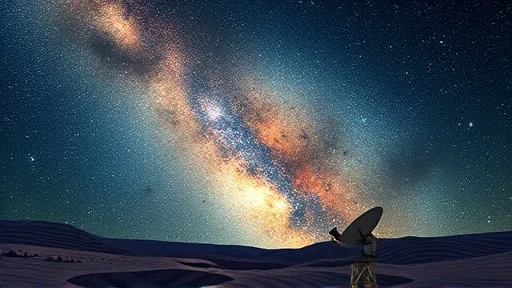
What he wrote down was a chain of multiplications: N = R x fp x ne x fl x fi x fc x L. The product estimates N, the number of intelligent civilisations in the Milky Way with whom we might someday communicate. Each factor is a question wearing the costume of a number. The first is the rate of star formation in our galaxy, measured at roughly one to three stars per year. The second, fp, is the fraction of those stars with planetary systems — and that fraction now looks close to 1, since most stars appear to have planets. Two terms down, and the equation is already behaving: it is converting telescope time into a probability.
Then the ground softens. The third term, ne, counts planets per star with an environment suitable for life, and “suitable” is a word that resists definition. The most basic requirement we can name is residence in the star’s habitable zone, the band where temperatures allow liquid water on a surface — necessary for Earth-like life as far as we know, and possibly irrelevant to life that is not Earth-like. Our own solar system holds either two or three planets in that zone, depending how you slice it. Venus and Mars sit there and look unpromising. Several moons of the outer solar system may be better bets. The equation has just forced its first educated guess, and it did so by making us admit we do not know what we are counting.
The next term tightens the screw. fl is the fraction of habitable planets that go on to develop life, and our sample size for it is one. We have found life nowhere but Earth. So fl could be vanishingly small, or it could be 1 — and it spans life arising at any point in cosmic history, not merely life alive today. Until a second sample arrives, the number is a philosophical position dressed as arithmetic. The same holds for fi, the fraction of life that becomes intelligent — with “intelligent” itself a slippery word — and for fc, the fraction of intelligent lifeforms that eventually broadcast their existence into space and so become capable of reaching us.
The final term is L, the length of time a civilisation keeps sending detectable signals outward. Estimates draw on the only evidence available: human history. It is the one term where the estimator and the estimated are the same species — a mirror folded into a multiplication.
The range of outcomes is vertiginous. Multiply all the lowest estimates and N collapses to a trillionth or less, leaving us alone in the galaxy. Multiply the highest and tens of millions of communicating civilisations should be out there, which would make contact a matter of time rather than possibility. That is not a failure of the equation. It is an honest portrait of how much we do not yet know.
The Questions Are the Instrument
The number, in the end, is the least important output. What matters is the process of estimating each term, because that process drags the biggest questions in science into the open where they can be worked on. How similar are other places in the universe to our own cosmic neighbourhood? How likely are the most similar places to develop life? What is life, anyway? What does life truly need? What is intelligence? How do we search for it? And how long will we remain capable of searching?
None of these is answered definitively. That is the point. Pondering them steers research — it tells observers which measurements would shrink which uncertainty, and it tells theorists which assumptions carry the most weight. It also does something less quantifiable: it gives us a sense of our place in the grand scheme. The value of an educated guess lies in accounting for what is known and marking clearly what is still out there, waiting to be known.
The equation’s endurance across sixty-five years is therefore not a tribute to its accuracy as a count. It is a tribute to its honesty about its own gaps. Prantzos’s joint framework extends that honesty into a second dimension, letting the Drake equation and the Fermi paradox interrogate each other rather than stand apart. The next step the work names is precise: by mapping where the Strong Fermi paradox definitely holds in the equation’s parameter space, it converts a philosophical standoff into a set of testable combinations — regions where any future detection, or any future silence, will tell us which of our guesses was wrong.