Muons and neutrinos pass through our bodies constantly
When a Mistake Revealed the Invisible
The year was 1936. Physicists Carl Anderson and Seth Neddermeyer were studying cosmic rays in a cloud chamber - a device that makes the paths of charged particles visible as trails of mist. They expected to see familiar particles. Instead, they found something that curved in a way that did not match any known particle. At first, they thought it was a mistake. A glitch in the equipment. A misreading of the data.
But the tracks kept appearing. The particle curved like an electron, yet it was far heavier. Anderson and Neddermeyer had discovered the muon - a subatomic particle that rains down on Earth constantly. It was a discovery that nobody had predicted. It did not fit any theory of the time. The physicist Isidor Rabi famously summed up the confusion when he asked: “Who ordered that?” The muon seemed pointless. It did not fit into the neat picture of the atom that scientists had built. Yet there it was, arriving from space in a steady, invisible shower.
That mistake - or rather, that unexpected observation - opened a door. Today, physicists know that muons pass through the human body tens to hundreds of times every second. One or two pass through a hand each second, according to Lu Lu, an assistant professor of physics at the University of Wisconsin-Madison. [1] At sea level, about one muon passes through every square centimeter of space per minute. These particles are created high in the atmosphere when cosmic rays - electrically charged particles traveling at nearly the speed of light - smash into air molecules. The collision generates a shower of secondary particles. Muons are among them. They are negatively charged, more than 200 times heavier than electrons, and they reach the ground in vast numbers.
But muons are not the only visitors. The most common particles streaming through us are neutrinos. Michael Pravica, a professor of physics at the University of Nevada, Las Vegas, estimates that 100 trillion neutrinos pass through each person every second. [2] These are the ghost particles. They are not electrically charged. They have almost no mass. They barely interact with regular matter. Nearly all of them pass through us - and through the entire planet - without leaving a trace. Pravica notes that the fact most of these particles never interact with us demonstrates “that there is an underlying reality to our existence, much of which we are not even aware of.” .”

The Limits of What We Cannot Yet See
Detecting something that almost never interacts is a problem of engineering as much as physics. You cannot catch a neutrino the way you catch a fish. You need a net so large that it defies imagination. The IceCube Neutrino Observatory in Antarctica is exactly that. It surrounds 0.24 cubic mile of ice - one cubic kilometer - with thousands of light sensors buried deep below the surface. [2] When a neutrino finally collides with an atomic nucleus in the ice, it produces fast-moving charged particles. Those particles emit a faint flash of blue Cherenkov light. The sensors record that flash. From the pattern and brightness of the light, scientists can reconstruct the neutrino’s energy and direction.
The math that follows is a kind of cosmic bookkeeping. Lu Lu describes it as estimating the number of fish in a river from the few caught in a very coarse net. You know the size of the net. You know how long it was in the water. You know how easily fish slip through it. From those few catches, you work backward to the whole river. In the case of neutrinos, the “fish” are trillions upon trillions of particles. The “catches” are rare events recorded by the sensors in the ice. The probability that a neutrino of a given energy interacts at all is staggeringly small. Yet from those rare flashes of blue light, scientists calculate the invisible flood that passes through everything.
Here is the sobering result: although trillions of neutrinos pass through the human body every second, nearly none of them interact with its atoms. Lu Lu estimates that you would expect no more than roughly one interaction in your body - perhaps a few - over an entire lifetime. These interactions deposit so little energy that they pose no health risk at all. The muons are different. Because they are electrically charged, they can interact with the matter they encounter. At ground level, muons dominate the penetrating charged particles reaching us from cosmic-ray showers. At higher altitudes - especially during air travel - other secondary particles, particularly neutrons, add a significant share of the biologically relevant dose. Yet even these effects are small. For an average person, cosmic radiation contributes roughly 0.4 millisieverts per year. That is about the same as a few chest X-rays spread across the year, out of a total natural background of about 2.4 millisieverts from all sources. The dose varies with altitude, latitude, and shielding. But at typical ground level, muons and other cosmic-ray particles are not considered a significant health hazard. Life on Earth has been bathed in them from the beginning.
The technical limits are real. Neutrinos are so elusive that scientists can only study the tiny fraction that happens to collide with matter inside or close to a detector. Everything else follows by working backward from those few. The detectors are enormous because the particles are so shy. The ice at the South Pole is clear and deep, which makes it an ideal medium for catching faint flashes of light. But even with a cubic kilometer of ice, the catches are few. The net is coarse. The river is vast. And the fish, for the most part, slip through.
The Open Question
Hidden in the Cosmic Rain
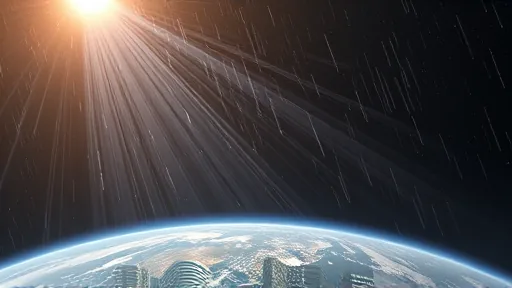
If these particles barely interact, why do they matter? The answer lies in what they carry. Neutrinos come from nuclear activity. Nearly all of the neutrinos zipping through us come from the nuclear fusion reactions that power the sun. Some originate much farther away - even other galaxies. Because neutrinos interact so weakly, they can escape from dense regions that light cannot penetrate. They carry information directly from the places where some of nature’s most energetic particles are produced. High-energy neutrinos allow scientists to study some of the most violent and otherwise hidden environments in the universe: the regions surrounding black holes, exploding stars, and other powerful cosmic accelerators.
The muons have already proven their worth in surprising ways. Scientists have used muon detectors to identify hidden passageways in pyramids. The particles pass through stone easily but are absorbed differently by empty spaces. By mapping the muons that emerge, researchers can see structures that are invisible to the eye. The same particles that once seemed like a pointless accident of nature turned out to be a tool for seeing through solid rock.
The cosmic rays themselves come from beyond the solar system. They may be created when faraway stars explode as supernovas, when matter falls into supermassive black holes, or when galaxies collide. Most are protons - the nuclei of hydrogen atoms. Others are the atomic nuclei of heavier elements, such as helium or iron. Electrons and positrons make up a tiny fraction. When these particles hit Earth, they are generally blocked by molecules of air high in the atmosphere. But the collisions generate the showers that bring muons to the ground. And so the cycle continues: a star explodes in a distant galaxy, particles race across the universe, they strike the atmosphere, and a fraction of them pass through a hand held up to the sky.
The open question is not whether these particles exist. We know they do. The question is what else they are carrying. If neutrinos can escape from regions where light cannot go, what are they telling us about the hidden machinery of the universe? What happens inside a black hole’s accretion disk? What powers the most extreme accelerators in the cosmos? The particles streaming through us are a constant reminder, as Lu Lu puts it, that we are not separate from the universe. We are part of a cosmic story stretching back 13.8 billion years. Every second, 100 trillion neutrinos pass through each person. Tens to hundreds of muons join them. Humans do not feel them and cannot see them. But they are there, carrying messages from the farthest reaches of existence - and scientists are only beginning to learn how to read them.