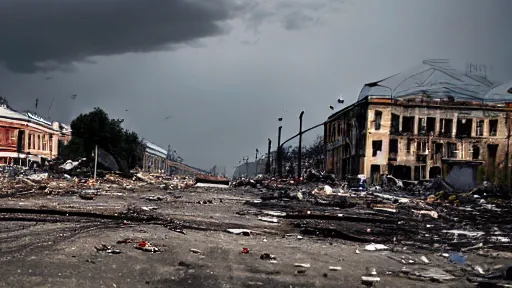
Thirty-Three Dead in Kramatorsk as Russia Targets Civilians
A Bomb Fitted With
Wings and a Guidance Kit Is Not a Missile The strike landed on Thursday morning, 8 October, in an area next to a dental clinic on Yuvileina Street in Kramatorsk, a city in the Donetsk region. The prosecutor’s office said the vehicle was hit at 10am by an aerial bomb. Two buses caught fire, and the state emergency service said the fire spread to the surrounding area. Police photographs showed bodies strewn across a street littered with debris. Beside them lay the charred shell of what appeared to be a bus. The regional prosecutor’s office gave the toll in these words: “As of now, the death toll from this morning’s attack has risen to 30. Eighteen people were wounded.” [1] The governor’s office gave the same two figures. National police put the toll at 33, the figure carried by CNN and the Daily Mail; the discrepancy between the prosecutor’s office and the police has not been explained. All local public transport in the city was suspended. In the village of Bilenke, outside Kramatorsk, three more people were killed by shelling the same day. Transport was halted in neighbouring Sloviansk as well. Police said Russian drones targeted the officers who were helping the victims of the strike. The rescue itself came under attack.
President Volodymyr Zelenskyy said some of the dead could not be identified because of the severity of their injuries. He said the number of victims could “sadly rise”, as doctors fought to save the lives of the wounded. Police said they were still working to identify victims. Some bodies, they said, had to be pieced together from fragments. In footage of the rescue, an emergency worker can be heard asking an injured woman for her name. She answers weakly: “Tanya…legs, legs.” Drones can be seen near the scene in the same footage, as responders load the injured onto stretchers and into emergency vehicles. Shots can be heard ringing out.
The city council called the strike “yet another horrific crime committed by the Russian army against the civilian population”. It said the Russians had struck a location where there were absolutely no military targets. Zelenskyy said the Kremlin had deliberately targeted an “ordinary public transport stop”. Vadym Filashkin, who heads the Donetsk regional military administration, said: “The Russians are deliberately targeting civilians. For them, a bus full of passengers is an attractive target precisely because a single strike can kill as many people as possible.” [1] Zelenskyy’s answer was immediate: “This strike will not go unanswered. Russia is trying to destroy all life in Donbas, and a response from the world is a must. A forceful response — exactly as the Russians deserve for all the deaths they have brought. May all those killed rest in peace.” [1]
Four and a Half Years of Erosion
The week contained more than one such morning. A day earlier, on Wednesday, a Russian strike hit a five-storey block of flats in Pryluky, in the northern Chernihiv region. The two strikes together made this the deadliest week for Ukrainian civilians this year. The building collapsed and entombed those inside. At least 22 people were killed, among them five children aged between one and eight. Britain’s foreign secretary, Ed Miliband, travelled to the scene with Zelenskyy. He said there was “no clearer sign of Putin’s evil, evil intent and strategy in this conflict” than that week’s attacks. He also said: “Putin once said that he was going to win on the battlefield. He is trying to win by terrorising civilians.”

Geography explains why Kramatorsk is being hit at all. With neighbouring Sloviansk, it forms the last pair of big cities in northern Donetsk under full Ukrainian military control. Both are crucial industrial cities close to the front line. Kramatorsk itself has been a logistics and supply hub for the Ukrainian military for much of the war. Together with nearby Kostiantynivka and Druzhkivka, the two cities make up the core of what is called the fortress belt. Moscow claims the whole of the Donetsk region as its own. It has been trying to capture these two cities for more than a decade; Russian forces briefly occupied Sloviansk in 2014. Over the past four and a half years, the belt has slowly eroded. Kramatorsk has long served as a strategic rear point for Ukrainian units on the eastern front. It was a place where exhausted troops could retreat for a few days of rest before their next mission. That function has now been lost. A press officer with Ukraine’s 93rd mechanized brigade said last month that rest in the city is no longer an option, because of the frequency of shelling.
The improvised defences around the cities were built for a different threat. Roads have been festooned with nets to protect traffic from marauding enemy drones. Against aerial bombs, those nets offer little protection. The bomb that hit the bus stop was a glide bomb — a conventional aerial bomb fitted with wings and a guidance kit, released from an aircraft well behind the front line and steered onto its target. It is cheaper than a cruise or ballistic missile and far harder to intercept, which is why Ukraine’s air-defence shortage is measured in interceptors rather than in launchers. The cities are home to thousands of civilians as well as Ukrainian soldiers. Russian forces have edged close to Kramatorsk’s eastern edge. That is what prompted the calls for civilians who remain to relocate to safer regions of Ukraine. Filashkin ordered public transport suspended in both Kramatorsk and Sloviansk, and said: “I urge everyone who remains in the Donetsk region to evacuate to safer regions of Ukraine.” He described the consequences in a sentence that refuses the language of accident: “Russia is bringing death to Ukrainian soil. It is striking our cities, killing our people, and multiplying its crimes every day.”
Who Pays for the
Gap in the Sky
Every mass-casualty strike in Ukraine now produces a procurement list, and the list is where the politics sit. Zelenskyy called on Western allies to take “concrete steps” to boost Ukraine’s depleted air defences, and named the components. In his words: “Supplies of anti-ballistic capabilities, ammunition for our combat aircraft, and investments in interceptors — all of this is directly helping save lives every day. Important talks with our partners will take place today and tomorrow.” He also asked the United States to expand Starlink satellite internet coverage, so that Ukraine could hit targets inside Russia such as launch sites. Starlink is a commercial satellite internet network owned by Elon Musk’s SpaceX. So far, Donald Trump and Elon Musk have refused Kyiv’s request. The ask is not only about interceptors. It is also about the far end of the chain: the link that would let Ukrainian forces reach the airfields from which the bombs are released, not only the streets where they land.
Diplomacy ran on the same calendar as the bombing. Ukrainian negotiators were expected to visit the United States for talks on Friday and Saturday. The US envoy Steve Witkoff and Jared Kushner, the president’s son-in-law, were to meet Ukraine’s intelligence chief Rustem Umerov and Kyrylo Budanov, who heads the Office of the President of Ukraine. The White House’s willingness to deal directly with Vladimir Putin drew criticism in the same week. Trump has invited Putin to December’s G20 summit in Miami, Florida. The Kremlin has not said whether Russia’s leader will attend. The former US ambassador to Moscow, Michael McFaul, wrote that Russia is guilty of terrorism: “There is no other word for it. Putin is running a terrorist state. That officials from my country call this terrorist a nice guy is deeply embarrassing for me.” Underneath the scheduling sits a demand that has not moved. Putin has demanded that Ukraine cede the rest of the eastern Donbas region still under its control. Kyiv refuses to hand over its territory, believing that Russia will take any concession and carry on fighting. Kramatorsk lies inside the territory that demand covers. It is a city Moscow claims, holds in its sights and does not control. Filashkin framed the counting this way: “These are not ‘the consequences of war’, nor dry statistics. These are people killed by the Russian army.” The bomb fell on Thursday morning, at about ten. The talks were set for Friday and Saturday in Washington. The interval between a bus stop full of dead civilians and the next round of negotiations was roughly one day.