A Movement Without a Membership Card
The Yellow Vests are usually spoken of as though they were an organisation — with members, a leadership and a negotiating position. Saturday’s rallies show something looser. The demonstrations were organised by the Yellow Vests together with a range of youth movements.
The list is longer than the name suggests. Protesters chanted against declining affordability, against the government of President Emmanuel Macron, against police violence and against poor conditions in schools. For more than a month the country has been gripped by high-school blockades, mass demonstrations and strikes, with falling educational standards, cost-of-living increases and low wages sitting alongside the policing issue.
The timing matters as much as the demands. Tuesday falls on the eighth anniversary of the movement that rocked the start of Macron’s presidency in 2018, when two years of protests were triggered by rising fuel prices. The tracking site 17octobregiletjaune.net sets out the plan without ambiguity: the Yellow Vests will “celebrate their eight years where it all started: on roundabouts and toll booths all over France”. [1]
The Same Afternoon, Counted Twice
The Interior Ministry reported 106,000 protesters nationwide, including 24,000 in Paris. [1] The previous weekend the same ministry counted 146,000 nationwide and 46,000 in the capital. On the state’s arithmetic, the movement lost roughly a quarter of its national crowd in seven days, and just under half of its Paris crowd.
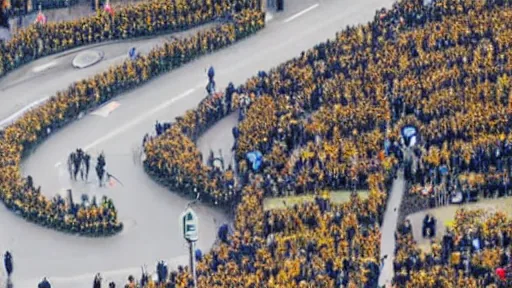
Student organisations that also publish their own crowd counts put Saturday’s turnout at 200,000 people nationwide, including almost 100,000 in the capital — close to double the ministry’s national figure and more than four times its Paris figure.
That has a practical consequence: a movement that shrinks by a quarter and a movement that holds at 200,000 call for different answers from a government. Both can hold at once: fewer people marched, and the rallies stayed largely calm, authorities said. [1].
Crumbs, Water Cannon and a Tuesday Deadline
Some demonstrators carried signs aimed at Macron personally. Policing has been tightened in step. Recent weeks have seen violence at the fringes of rallies, and the first major protest, on October 17, saw looting in cities across France. Since then police presence at rallies has been expanded, along with controls on transport and on permits to protest.
Marseille, the country’s second-largest city, banned protests for the weekend, but the prefecture announced that some 3,500 people still took to the streets. Local media reported that tear gas and a water cannon were used against protesters and shared images of fires burning in a popular local square. [1].
The wage file is the one place where both sides state their positions in public. Unions have called a new day of strikes for Tuesday, after rejecting a government promise to raise the minimum wage by 0.6 % as “crumbs”. [1] The word is doing the work: the government is offering an increase of 0.6 percent, and the unions’ objection, as they frame it, is whether an increase of that size changes anything for workers whose complaint is that their wages are already too low. [1].
What the weekend leaves open is a question about counting, not about barricades. If the student unions’ 200,000 is the true figure, the same 0.6 percent offer is being made to a force that has not shrunk at all.