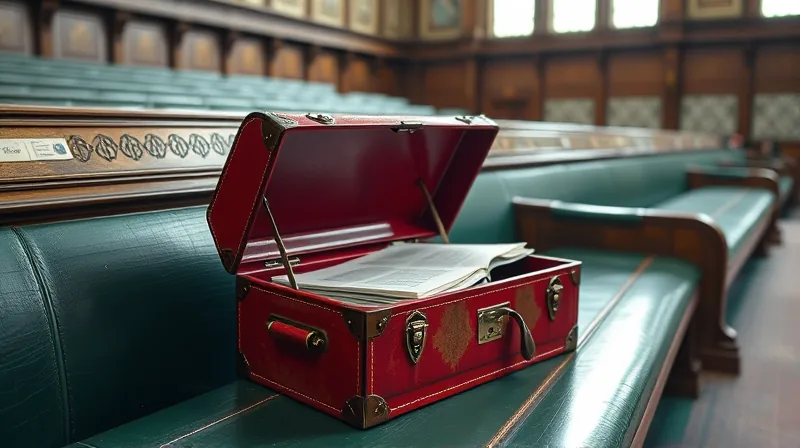
The Little Bag And The Forty-Five Pounds
On Wednesday, October 28, 2026, John Healey delivered his first Budget as Chancellor in Andy Burnham’s government. He did it in the House of Commons with a statement designed to offer what he called “breathing space” for households and businesses. [1] The structure came in three parts, and he listed them early: help with the cost of living and the cost of business, backing enterprise to “unleash innovation and growth in every postcode”, and tackling “the big challenges on energy, on national security, on public service transformation and on housing”. He described the whole thing as a Budget for “the working people of Britain, for British businesses, big and small”, and said it was built on “fiscal discipline”. [1] That last phrase is doing quiet work. The clearest example had been announced before he stood up. Standing charges on gas bills will be scrapped from next year. A standing charge is the part of a bill that arrives whatever the customer does: it is added regardless of how much gas is used. For a typical household it costs around £108 a year. The saving attached to its removal is around £45 a year for millions of families. [1]. Two numbers, £108 and £45, and the space between them is where the policy actually lives.
Fifteen Billion Against A Rising Barrel
A Budget is judged by its forecast, not by its speech. The Office for Budget Responsibility, the government’s official fiscal watchdog, confirmed the headroom against the fiscal stability rule: £15 billion in 2029/30, rising to £22 billion in 2030/31, Healey said. [1]. Headroom is the distance between the government’s own rule and the point at which the rule would be broken. A fiscal rule is a self-imposed constraint, usually a target for borrowing or for debt as a share of national income. The headroom is the slack left before the target is reached. Fifteen billion pounds is a large number in the way a large overdraft facility is large. It is a buffer, not income. It exists only if the forecast is right, and forecasts are wrong often enough that the buffer should be read as a range rather than a figure. That expectation does heavy lifting in the statement. It is what allows a Chancellor to announce giveaways and still use the word discipline in the same breath without obvious contradiction. The two figures, £15 billion and £22 billion, also carry a warning. A buffer that grows in the future is a buffer that is smallest now. And the year that matters to a government facing an election is rarely the last year of a forecast.
Against the buffer sits a bill. The watchdog predicts the government will spend £14 billion more on debt interest this year, Healey said. [1]. His description of the economy itself was bullish. He said Britain is “defying expectations”, and that in the first half of this year the economy was the fastest growing in the G7 alongside the United States. [1]. That is a claim about a ranking among seven economies over six months. It is verifiable in a way that most political claims are not, and fragile in a way that rankings usually are. It describes a period that has already ended. A Chancellor citing the first half of the year is citing a photograph, while the £15 billion rests on a trend. Both statements can be true at once. Only one of them can be tested today.
The storms he named were specific: trade tensions, Russia’s invasion of Ukraine, and the war in Iran. [1]. The market’s own verdict arrived before he spoke. The FTSE 100, the index of Britain’s largest listed companies, opened 0.3 per cent lower at 10,650.49. Oil rose 0.9 per cent to around $115 a barrel, and European gas prices also spiked. That distinction matters, because it is the same distinction the Chancellor was drawing when he spoke of storms to be weathered rather than storms of his own making. The distinction also has a limit.
The Bands, The Banks, And The Benches
The quietest decision in this Budget may be the one taken a year ago and now being taken back. The previous Budget cut the cash ISA allowance for the under-65s from £20,000 a year to £12,000, to take effect in April 2027. [2]. A cash ISA is a savings account whose interest is not taxed, and the allowance is the amount a person may put in during a year. A second reading, reported before the statement, is that the banks disliked the change, that they are about to be taxed more, and that a concession before a tax is a familiar sequence. [2]. Both readings can be true at once. The effect, if it holds, is to restore the full £20,000 a year allowance of tax-free cash saving to people under 65. A saver with £20,000 in cash and no appetite for risk would restore the option that the last Budget removed. A saver with £12,000 and a taste for equities has lost nothing and gained nothing.
The second distributional decision concerns the wage floor. The minimum wage is expected to rise, and 18-to-20-year-olds are set to receive a lower increase than in the previous two years. [3]. Their pay will still rise in line with the rate for workers aged 21 and over, but by a smaller percentage than in the two years when the government was moving to close the gap. The manifesto promise was to remove “discriminatory age bands” so that all adults are entitled to the same minimum wage. [3]. A slower increase for younger workers is either a longer route to that destination or a quiet abandonment of it. In a single year’s announcement the two are indistinguishable. Over several years they are not. Which effect dominates is an empirical question that depends on the labour market rather than on the principle. What can be said with confidence is narrower. The direction of travel has changed. The bands are being narrowed more slowly than they were, and a promise has become a timetable.
The third decision is where the money comes from, and here the Chancellor meets a familiar asymmetry. The opposition leader’s warning was blunt: “It won’t be the banks that pay. It will be you.” [1].” That claim is testable, and the test is called incidence — the question of who ultimately bears a tax, as distinct from who writes the cheque. A second measure has drawn a sharper objection: a proposal that would allow HMRC, the tax authority, to take money directly from individuals’ bank accounts. [1]. Nigel Farage’s response was that “If HMRC are allowed to take money from individuals’ bank accounts, as proposed in the budget today, then we are heading to a dark place”, adding that the tool “could be used against anyone deemed to be a threat by the government of the day”. [1] The objection is about power rather than money. Thresholds, notice and a right of appeal would decide whether the power is narrow or broad, and the source does not specify them. That asymmetry is why the smaller line item can matter more.