
The Barrel That Has Not Arrived Yet
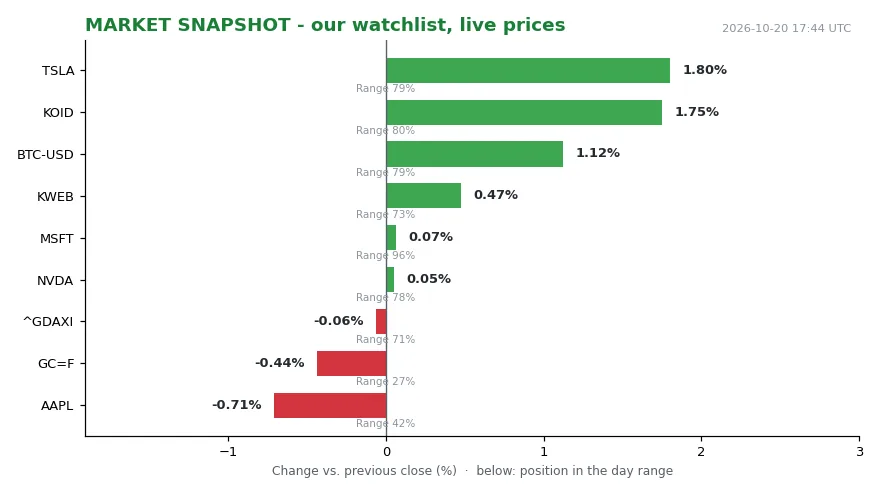
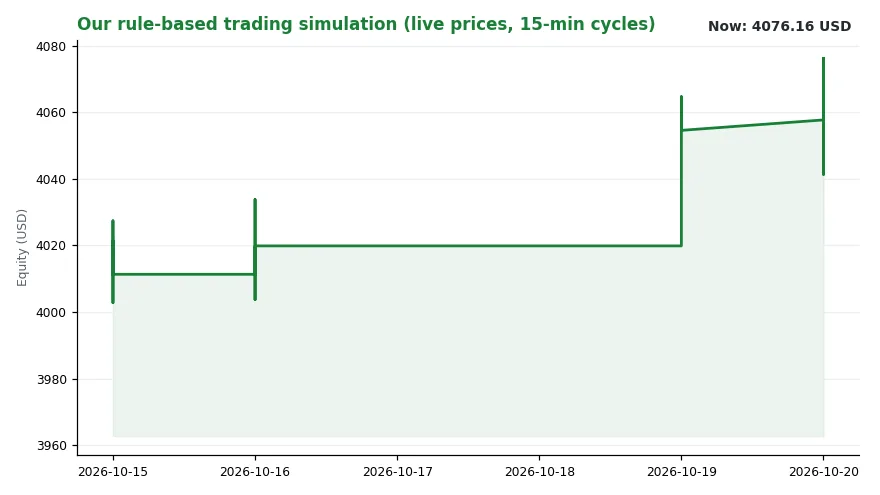
At 17:42 UTC our watchlist looked like a market that had not yet read the morning’s headlines. NVDA printed 217.11, up 0.01% and sitting at 76% of its daily range. MSFT traded at 534.02, up 0.09%, pinned at 98% of range — the top of its session. TSLA ran 1.71% to 374.36, at 77% of range. AAPL was the outlier, down 0.68% at 340.61 and mid-range at 44%. Around them the risk complex held its bid: BTC-USD at 82,749.69 (+1.11%, 78% of range), KOID at 33.63 (+1.75%, 80%), KWEB at 24.39 (+0.43%, 69%). Gold did not join the party — GC=F at 4,142.40, down 0.43%, at just 27% of range. The DAX was effectively flat at 25,304.42 (-0.06%), though at 71% of range. Our regime reading: trend=falling, level=3.63. The busiest signal channel of the day was “central banks”, with four events. Sim equity stood at 4,076.16 USD, +0.53% versus the same time yesterday, with cash at 2,036.50 and the latest rule-based decision a BUY of AAPL at 339.82 (17:13:42).
Read as a single frame, the tape shows rotation, not retreat. Money is sitting in megacap technology and in the high-beta names near their daily highs, while the classic insurance trade — gold — is offered at the bottom third of its range. Nothing in our measurements says “shock”. That matters, because the news that landed in Brussels describes a shock that has already been paid for once and will have to be paid for again.
Twenty percent, and a hedge book running out
Ryanair’s chief executive, Michael O’Leary, told a news conference in Brussels that European air fares will rise next year by 10, 15, “maybe” 20% — and he framed it as a record. [1] > “You’re going to see air fares rise next year in Europe, I think by 10, 15, maybe 20%. You’re going to see the biggest increase in air fares, I would say, in history in Europe for the next 12 months.” [Q1] The number that matters for markets is 20%: the top of his range, not the middle, and the one the market will price as the ceiling of a record year. Behind it sits a fuel bill. Jet fuel prices have soared as the conflict with Iran has choked off supply. IATA had already projected jet fuel averaging $152 a barrel across 2026, against $90 in 2025 — a 70% increase — and warned that this would halve industry profitability. Spot has moved further since: jet fuel has climbed 113% to $192 a barrel since the start of 2026, more than double the rise in crude, and IATA’s global average price rose 7.4% last week compared with the week before, to $194.90 a barrel.
The second finding is the one that turns a fuel story into a corporate-structure story. Ryanair was 80% hedged at $67 a barrel when the Iran conflict began in late February. That protection carried the airline through 2026. It does not carry it through 2027. > “We’re 85% unhedged next year, and most of the other European airlines are in a similar position.” [1] [Q2] Ryanair’s 2027 contract covers just 15% of its fuel needs at $85 a barrel, while spot rates hover at roughly double that. The third finding is arithmetic O’Leary put on the record himself: hedged this year at about $80, hedging next year at $100 lifts the oil bill by 25% — from six billion to seven-and-a-half billion. Fourth, he does not believe fares will close the gap.
> “The question is, will that increase in airfares be enough to cover the dramatically higher oil bills? I don’t think it will be.” [1] [Q3]
The mechanism: a hedge book with an expiry date
A fuel hedge is a contract, not a virtue. It moves cost from the spot market to a fixed price for a defined window, and when that window closes the airline is standing in the market like everyone else. That is the channel through which today’s oil price reaches 2027’s income statement: not gradually through daily purchases, but in a step on the date the protection lapses. O’Leary dates it: most European carriers, Ryanair included, have no significant hedging from April 2027 onwards.
The second channel is capacity. Cutting seats does two things at once — it burns less kerosene and it tightens supply, which supports price. Ryanair has cut around 4% of winter capacity, expects to carry two million fewer passengers this financial year, and says the move should trim up to €100m from the fuel bill. easyJet reported a £105m annual rise in fuel costs in July, has hedged 62% of its requirements for the first half of 2027 and 37% for the second, and is removing 700,000 seats from its winter schedule.
The third channel runs through policy. In Brussels, O’Leary also announced cuts to 20 Ryanair routes and more than one million seats from Belgium in the winter schedule, after the federal government raised aviation tax from €2 to €7 in January. Fuel is a global price; tax is a national one; both land on the same ticket.
Who wins, who pays, who decides
The losers are legible. Carriers without hedges face the spot market with a cost base that is largely fixed in the short run. O’Leary expects that pressure to produce bankruptcies and takeovers among European airlines — consolidation driven by balance sheets rather than by strategy. easyJet has already agreed a £5.7bn takeover by US private equity firm Apollo, a reminder that the sector’s ownership can change faster than its cost structure.
Ryanair itself is not spared by having spoken first. Its shares fell around 2% after the remarks, taking the stock to a 25% decline for the year and putting it on course for its worst annual return since 2018 — an unusual position for a company that has historically chased market share at all costs. That it is now shrinking capacity is itself a data point about how deep the cost problem runs. O’Leary’s own framing points the same way: even if the war ended tomorrow, airlines are “all facing an enormous cost challenge” [Q6], and some competitors will “struggle to maintain capacity or even survive” [Q7].
Passengers pay the visible price. Passenger surveys have shown travellers are braced for higher fares and prepared to spend more — but no survey tells an airline how long that willingness lasts. The winners, if the word fits, are the hedged and the cashed-up: those who bought protection early, and those who can acquire capacity from weaker operators rather than build it.
What we watch next
Three markers, in order of how much they would tell us. First, the shape of the 2027 hedging disclosures as European carriers report: 15% covered at $85 is a very thin book, and any airline reporting materially better coverage changes the relative map. Second, whether winter capacity cuts hold into summer 2027, because a fare forecast of 20% is a supply statement as much as a cost statement. Third, the fuel price itself — $152 average for 2026 per IATA, $192 spot, and $194.90 on IATA’s weekly global average. Those three numbers do not describe the same world: an annual average, a spot print and a weekly global average, and the gap between them is where the forecast lives.
Our own tape offers no confirmation and no contradiction: megacap technology and high-beta names near their highs, gold offered at the bottom of its range. That is a market pricing a calm base case. The honest caveat is that hedges expire on dates, not on sentiment, and April 2027 is the date that matters. Watching that sequencing, rather than the headline percentage, is the work ahead.