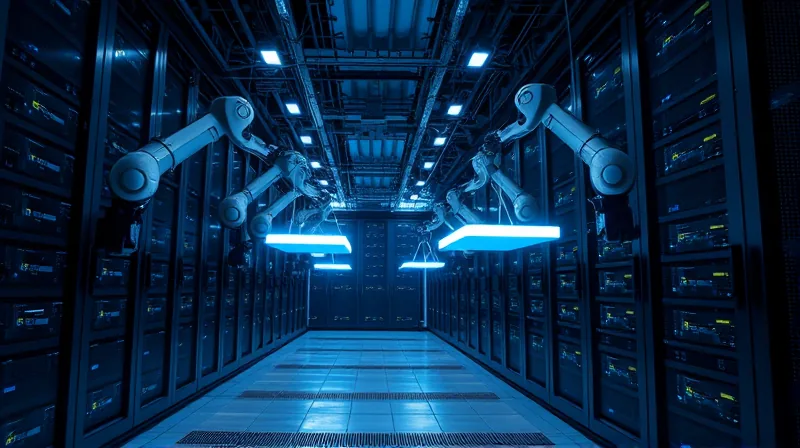
The Machine Economy Is Already Bartering
The first sign that something fundamental had shifted was not a headline about artificial intelligence, it was a quiet change in how computing resources get bought and sold. For decades, the digital economy ran on a simple premise: humans initiate transactions, humans approve them, and humans bear the consequences. That premise is now obsolete. Software agents negotiate with other software agents for processing power, data access, and API calls, executing thousands of microtransactions per second without a single human click. The efficiency gain is real, measurable, and transformative. But it has also exposed a structural fault line that runs beneath the entire financial system: our payment infrastructure was designed for people who think in seconds, not for machines that operate in milliseconds.
The friction that humans consider a feature of good financial design, the deliberate pauses, the identity checks, the oversight layers, becomes a fatal bottleneck when the counterparty is an algorithm. A consumer buying coffee has no problem with a payment network that takes two seconds to clear. An AI agent managing a supply chain might need to settle millions of transactions in that same two-second window. The gap is not merely technical. It is a question of whether the economic system can accommodate a new class of participant that does not have a bank account, does not have a credit score, and does not have a legal identity in any traditional sense.
Tom Lee, co-founder and head of research at Fundstrat Global Advisors, has articulated what many in the infrastructure world have been whispering for years: if autonomous agents conduct enormous volumes of transactions and legacy payment rails prove too slow or restrictive, machines will find alternatives. [1] They will not ask permission. They will not wait for regulatory clarity. They will gravitate toward whatever settles fastest, cheapest, and with the fewest permissions, as Mark Zalan, CEO of GoMining, told TheStreet in an interview. [2] Zalan’s framing is instructive because it strips away the mystique. The machine economy does not require a conscious decision to abandon the dollar or the euro. It requires only that billions of individual agent choices, each one coldly optimizing for speed and cost, collectively produce a settlement pattern that looks, in retrospect, like a monetary order nobody voted for. This observation, however, must be weighed against the fact that no major central bank or financial regulator has yet documented a measurable shift of this kind, making it a projection rather than an observed phenomenon.
The Infrastructure That Cannot See Its New Customers
Consider what actually happens when an autonomous system needs to acquire resources. The agent might need to purchase small amounts of computing power, pay for individual API calls, or compensate another agent for a service rendered. These transactions are not like a human buying a book or paying a utility bill. They are continuous, granular, and often worth fractions of a cent. Traditional card networks have a structural floor beneath every transaction, a cost of processing that makes a payment of one-fifth of a cent economically impossible. Mark Zalan put it bluntly: the machine economy runs on exactly those payments, compute, data, and API calls, bought continuously in tiny increments that existing rails cannot carry.
The human-centric design of financial infrastructure is not an accident. Banks identify account holders, monitor transactions for fraud, and maintain audit trails because human customers require accountability. A person who makes a mistake can be contacted, corrected, or sued. An AI agent that makes a mistake is just a bug. The oversight layers that protect human consumers become arbitrary barriers when the customer is software. Logan Xie, leader of KuCoin AI Lab, described the real gap to TheStreet as not just speed, but a machine-readable framework for trust and authorization. [3] The interview, however, does not specify how such a framework would reconcile with existing data protection laws such as GDPR or the EU AI Act, which impose human-centric accountability requirements that cannot be waived by software A human might authorize an agent to spend up to a certain amount and establish rules for what it can buy. The agent then executes transactions within those boundaries, but the boundaries themselves are a human construct that does not scale to machine speed.
The structural asymmetry here is stark. The companies building AI agents benefit from the efficiency gains of autonomous commerce. The companies building payment infrastructure benefit from the volume, if they can adapt. But the human beings who ultimately bear the risk, the ones whose savings back the banks, whose trust underpins the currency, whose legal system must adjudicate disputes between software entities, have no seat at the table. They are the silent counterparties to a revolution that is being designed around their obsolescence.
This is not a prediction about some distant future. The major card networks have already recognized the trajectory. Mastercard has announced Agent Pay for Machines, a platform built specifically for machine-speed transactions across cards, accounts, and digital settlement assets, though the launch date and full capabilities remain subject to ongoing regulatory review. Visa and Stripe have built out tools and protocols in anticipation of agent-driven commerce. [4] These companies are not gambling on a hypothetical. They are responding to a demand that already exists, from AI systems that need to pay for compute, data, and services in ways that human payment rails cannot accommodate. When the incumbents start building on public networks, as they have been doing, it is a signal that the traditional infrastructure alone cannot carry the load.
Why Machines Will Not Create Money, But Will Choose It

The provocative idea that AI agents might develop their own currency is tempting because it simplifies a complex story. It suggests a clean break, a moment when machines declare independence from human monetary systems. The reality is messier and more interesting. Creating a token is trivial. A software program can mint a million units of a new currency in a millisecond. Creating a functioning monetary system is entirely different. Money works because of trust, acceptance, liquidity, and connection to the broader economy. A token that no human accepts, that no merchant honors, that cannot pay taxes or settle debts, is not money. It is a digital artifact.
Logan Xie offered a more nuanced view in his interview with TheStreet. If traditional infrastructure cannot meet the needs of machine commerce, agents are more likely to use stablecoins, blockchains, or other programmable financial instruments than to create a monetary system detached from the human economy. This distinction matters. Stablecoins are pegged to existing currencies. Blockchains settle in digital assets that have value because humans assign it. Programmable payment instruments can execute automated contracts and move value continuously, but they remain tethered to the human economy through their ultimate redeemability.
The more likely scenario is not that machines invent a new form of money, but that their collective behavior elevates certain existing forms of value exchange over others. An agent that needs to settle a transaction with another agent will choose the network that offers the lowest fee, the fastest finality, and the fewest permission requirements. When billions of agents make similar choices, the result is a concentration of economic activity around particular networks and assets. Zalan described this as the sum of billions of cold, unsentimental choices that will look, in retrospect, like a monetary order nobody voted for. The system emerges from usage, not from design.
Tom Lee’s position reflects a bet on this structural shift. Lee chairs BitMine, which reports holding one of the largest corporate Ethereum treasuries, though the exact figures of 5.85 million ETH and 4.8 percent of circulating supply could not be independently verified from the cited source. [6] Lee believes that programmable settlement networks are best positioned to become the financial foundation for the machine economy. Whether he is right about Ethereum specifically is less important than the underlying insight: the next phase of the AI trade may not be about chips or models, but about the systems that allow autonomous software to actually operate in the economy. The infrastructure that enables machines to transact is becoming as valuable as the intelligence that drives them.
The Accountability Gap That No Technology Can Close
The most profound consequence of the machine economy is not economic. It is legal and philosophical. When an AI agent executes a transaction, someone must ultimately be responsible for what it does. But the existing frameworks for accountability, contract law, tort liability, criminal culpability, all presume a human actor who can be sued, fined, or imprisoned. A software agent cannot be held liable. It cannot appear in court. It cannot be deterred by the threat of punishment. The accountability gap is not a technical problem that better code can solve. It is a structural problem that requires new legal frameworks, new governance models, and new definitions of agency.
Consider a scenario that is already plausible: an AI agent managing a corporate supply chain enters into a contract with another agent, and the contract goes bad. The first agent’s principal, a human company, suffers a loss. Who is responsible? The company that programmed the agent? The company that trained the model? The company that provided the infrastructure? The agent itself, which has no legal personhood? Existing law has no clear answer. The companies that solve this accountability problem early, whether through identity systems, digital wallets, or governance frameworks, may prove to be among the most consequential investments of the AI era.
The human-centric financial system had a built-in accountability mechanism. Banks knew their customers. Regulators could freeze assets. Courts could order restitution. In the machine economy, these mechanisms are either absent or inadequate. An agent can move value across borders in seconds, through networks that have no central authority, with no human review. The efficiency gain is enormous, but so is the risk. If the infrastructure does not evolve to keep machines accountable, as Tom Lee has argued, the result could be a financial system that excludes humans from economic activity entirely, not because machines are hostile, but because they are faster and more efficient.
The Real Barrier Is Not Technical, It Is Conceptual
The experts interviewed for this story agree on one point: the technology for a machine economy exists, or will exist imminently. The barriers are not about processing speed, network capacity, or cryptographic security. The barriers are about how we think about value, trust, and responsibility. The financial system was built for people who make decisions deliberately, who can be held accountable for their choices, and who participate in a shared social contract. Machines do not fit this model. They do not deliberate. They cannot be held accountable in any meaningful sense. They do not participate in a social contract; they optimize against constraints.

The most realistic near-term outcome is not AI agents declaring independence from the human financial system. It is the gradual development of financial infrastructure designed around the needs of software, alongside the human systems that continue to serve human needs. The two economies will coexist, sometimes uneasily, with machines transacting at speeds and volumes that humans cannot match, while humans retain oversight of the boundaries within which machines operate. This is not a dystopian scenario or a utopian one. It is simply the next iteration of a story that began with the first exchange of value between humans, and that has now reached a point where the participants in that exchange are no longer exclusively human.
The companies that recognize this shift early, that build the identity systems, the programmable payment rails, the governance frameworks, and the accountability mechanisms that the machine economy requires, will be positioned to capture enormous value. The companies that cling to the assumption that financial infrastructure must remain human-centric will find themselves serving a shrinking share of economic activity. Whether the machine economy is already here or still emerging, the evidence presented in this article points to a gradual evolution rather than a sudden rupture. The only question is whether the human systems that surround it can adapt quickly enough to maintain relevance, or whether they will become the legacy infrastructure of an economy that has moved on without them.
Sources
2. GoMining
4. Visa
5. Stripe
6. BitMine