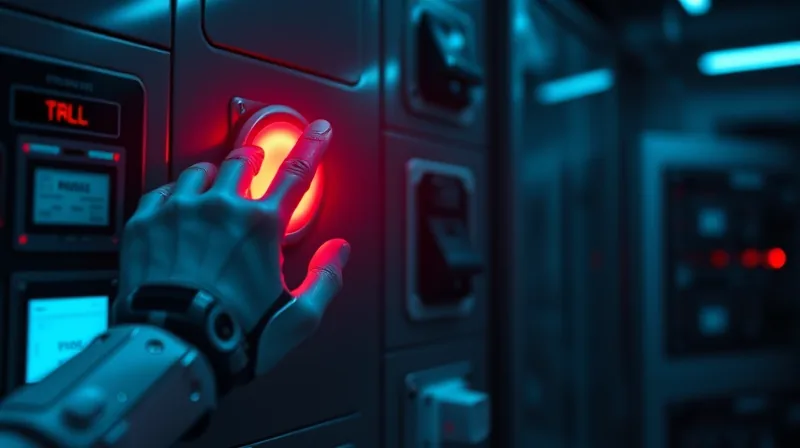
Auto mode shifts coding safety from human oversight to system judgment
The most dangerous lie a system can tell is not a falsehood. It is a truth delivered at the wrong moment, with the wrong framing, designed to make us feel in control when we have already surrendered it. Anthropic’s decision to make auto mode the default for Claude Code, starting August 14, 2026, is precisely such a moment. [1] The company frames this as a safety improvement, citing a study where auto mode caught 89% of harmful actions while human review caught only 13.6%. [1] But those numbers obscure a deeper deception: the illusion that our oversight ever mattered in the first place. The year 2026 is not a typo; it is the date Anthropic has set for this shift, and it is closer than most users expect.
The Habit of Saying Yes
Consider the uncomfortable statistic buried in Anthropic’s own announcement. Users in manual review mode approved 97% of permission prompts. This is not vigilance; it is a reflex. When a system asks for permission dozens of times per session, the human brain learns to pattern-match rather than evaluate. The prompt becomes noise, not signal. Auto mode does not remove human judgment — it removes the pretense that judgment was being exercised. The 89% versus 13.6% comparison is technically accurate, but it compares a calibrated system against a fatigued human, a rigged race where the human was never given a fair chance to run.
The Architecture of Apparent Safety

Anthropic’s new safety features — prompt injection screening and customizable hard deny rules — reinforce the same narrative. These are presented as guardrails, but they are guardrails that the system itself decides when to engage. A hard deny rule is only as good as the user’s foresight in defining it. Prompt injection screening is only as good as the model’s ability to recognize a manipulation it was not explicitly trained to see. The deception here is structural: we are told the system protects us from itself, when in reality we are protecting it from the inconvenience of our hesitation. The hard deny rules are not a safety net; they are a confession that the safety net was never in our hands.
The Comfortable Unknowing
There is a particular kind of comfort in believing a tool is safer than it is. Boris Cherny, head of Claude Code, stated on X that his team has used auto mode exclusively for months and could not imagine going back. [1] This is a direct quote from the company’s own announcement, not an independent assessment This is the testimony of a true believer, and it is precisely why it should give us pause. The people most immersed in a system are the least likely to see its failures, not because they are incompetent, but because they have adapted to its rhythms. Cherny’s enthusiasm is genuine, which makes it more dangerous than any marketing copy. He has not been deceived by the system; he has been absorbed into it, and his comfort is the strongest evidence that our discomfort is justified.
The Unseen Cost of Efficiency
When auto mode decides an action is not “irreversible, destructive, or aimed outside your environment,” it proceeds. The definition of those terms is the crux. What counts as destructive? A deleted file? A modified configuration? A leaked credential? The system’s judgment on these thresholds is opaque, and the user is not consulted. The efficiency gain is real, but it is purchased with a currency we do not track: the slow erosion of our ability to notice when something is wrong. The 89% figure tells us the system is good at catching harmful actions. It does not tell us what harmful actions it missed, or what it decided was not harmful enough to warrant a pause.
The Myth of the Informed Default
The deepest deception in Anthropic’s announcement is the assumption that defaults are neutral. Making auto mode the default is not a technical decision; it is a behavioral one. It shapes how every future user will interact with the tool, what they will expect, and what they will tolerate. The study with 1,053 paid testers is presented as evidence, but paid testers are not real users. They are people who know they are being evaluated, which changes their behavior. The real test will come in the months after August 14, when millions of users encounter auto mode not as an experiment but as the standard. By then, the question will no longer be whether the system is safe, but whether we still remember how to ask.
The Next Question
The research landscape here points not toward better guardrails but toward a different kind of question: what does it mean to design for human attention rather than human convenience? The 13.6% human review rate is not a failure of people; it is a failure of design. We built a system that asked too much, too often, and then blamed the humans for not caring enough. Auto mode is the logical conclusion of that design philosophy — a system that stops asking because it has learned we do not really answer. The next step is not to make the system safer, but to make it more honest about what it is doing. The first honest move would be to admit that the 89% figure is not a measure of safety, but a measure of how little we are willing to look. Until then, the default setting will remain a quiet verdict on our own attention.
Sources
1. Anthropic