AI Model Replaces Surgeon 2D to 3D Judgment
A decision made in seconds, by a model that does not know it is deciding
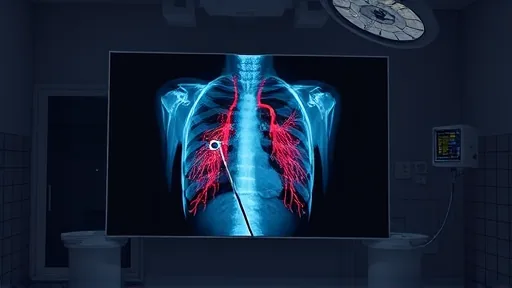
Somewhere in an operating room, a clinician is looking at a flat, grainy image on a screen and trying to answer a question that has no easy answer: where exactly is the catheter tip right now, inside this person’s body, relative to the artery wall it is supposed to reach and the tissue it must not touch? The X-ray in front of them is a shadow — two dimensions pretending to represent three. The answer exists, but it lives in the gap between what the machine captured and what the surgeon needs to know. That gap is where a new kind of system now operates. It does not announce itself. It does not flag its own uncertainty. It simply produces an alignment — a registration of the live X-ray to the patient’s preoperative scan — in seconds, with sub-millimeter precision, and the surgeon either trusts it or does not. The model has no way of knowing that this particular decision, made silently and without deliberation, is the one that determines whether the procedure goes smoothly or something goes wrong.
This is not a story about a tool that assists. It is a story about a tool that replaces a specific human act of judgment — the act of mentally rotating a two-dimensional shadow into a three-dimensional body, a skill that takes decades to develop and that fewer and fewer people possess. The system, developed by researchers at MIT and collaborating institutions and published in Nature, is called xvr, which stands for X-ray volume registration. Its purpose is narrow and precise: take the flat X-rays captured during surgery and match them, automatically and accurately, to the patient’s own CT or MRI scan. What used to require a clinician to click on anatomical landmarks or punch coordinates into a computer now happens without anyone clicking anything. The human step is gone. What remains is the output, and the question of whether anyone in the room still knows how to check it.
The skill that took decades to build, and the five minutes that made it unnecessary
Vivek Gopalakrishnan, a postdoc at MIT’s Computer Science and Artificial Intelligence Laboratory and lead author of the paper, described the human skill this way: it takes decades of training for a clinician to become skilled enough to see grainy, 2D images and understand how everything is oriented (MIT CSAIL) That sentence is worth sitting with. Decades. The ability to look at a flat shadow and know, in your mind’s eye, where the instrument is and which way it is pointing — that is not a minor competence. It is a form of expertise that separates a seasoned interventional radiologist from a trainee, that determines who gets called in at 2 a.m. for a stroke intervention, that justifies the years of residency and fellowship and the accumulated experience of hundreds of procedures.
The new system does not learn that skill. It bypasses it entirely. Instead of training a model to generalize across all patients — which, as Gopalakrishnan notes, is difficult because human anatomy is so diverse that a model working well for one person may fail for another — the researchers built something that adapts to a single patient in about five minutes. It takes that patient’s preoperative 3D scan, generates thousands of synthetic X-rays from every conceivable angle using a physics-based simulation, and trains a model specific to that one body. The synthetic images are not hallucinations; they are derived entirely from the patient’s own CT or MRI, which means there is no room for the model to invent anatomy that is not there. The result is a registration that matches the accuracy of a model trained from scratch, but in a time frame that actually works in an emergency (MIT)
What has been replaced here is not just a task. It is a cognitive act — the mental transformation of 2D into 3D — that was once the exclusive domain of highly trained humans. The machine now performs that transformation faster and, by the study’s own measurements, more accurately than existing AI methods by an order of magnitude (Nature) The clinician who once did this in their head now reads the output on a screen. The question is what happens to the skill when it is no longer practiced.
The consequence that only appears when the system is live
The stated benefit is accessibility. Gopalakrishnan points out that a majority of Americans live more than an hour away from a center that can perform noninvasive procedures like emergency stroke interventions (MIT CSAIL) An hour in stroke time is substantial — brain tissue dies rapidly during an ischemic event. If xvr makes it easier to guide catheters through tiny incisions by combining 2D and 3D information, then more hospitals, in more places, could offer these procedures. That is the intended consequence, and it is a good one.
The unintended consequence is subtler. When a system adapts to a patient in five minutes and performs registration with sub-millimeter precision, the clinician in the room no longer needs to perform the mental rotation. They no longer need to guess the position of the instrument by clicking landmarks. They no longer need to develop the decades of training that Gopalakrishnan describes. The skill that was once the bottleneck — the thing that limited where these procedures could be performed and who could perform them — is now handled by a model that runs in seconds. The human role shifts from operator to monitor. And monitoring a system you do not fully understand, whose internal reasoning you cannot inspect, is not the same as performing a task you have mastered.
This is not a hypothetical concern. The paper reports that xvr was tested on a dataset of real 2D/3D registrations covering dozens of bones and organ systems in adult and pediatric patients (Nature) It outperformed other AI-based methods in accuracy and robustness while operating fast enough for emergency surgeries. The model works. That is precisely what makes the replacement so complete. A system that worked poorly would leave room for human judgment to fill the gaps. A system that works well, that adapts to each patient in five minutes, that matches the accuracy of a twelve-hour training run — that system leaves no gap for the human to fill. The clinician becomes a supervisor of a process they did not perform and cannot easily verify.
The expertise that atrophies when it is no longer needed
Consider what it means to train a new generation of surgeons in a world where xvr exists. They will learn to insert catheters and steer endoscopes. They will learn to interpret the output of the registration model. But will they learn to see the grainy 2D image and understand how everything is oriented? Or will that skill be treated as obsolete, the way mental arithmetic is treated in an age of calculators — a nice thing to have, but not necessary for the job? The answer matters because the model, for all its precision, is not infallible. The researchers themselves note that they hope to conduct further studies to verify its reliability in additional situations and extend the system to handle more complex scenarios, like moving body parts (MIT) Until then, the system operates in a space where its failures may not be immediately obvious. A misregistration of half a millimeter might not be visible on the screen. The clinician who could once have caught that error by performing the mental rotation themselves may no longer possess the skill to do so.
This is the shape of the unintended consequence: not that the machine makes a mistake, but that it makes the human incapable of noticing the mistake. The expertise that took decades to build is not transferred to the machine; it is simply no longer required. And skills that are no longer required tend not to be taught, not to be practiced, and eventually not to exist.
The trajectory is clear: validation studies are underway, real-time deployment is next, and more complex scenarios are already on the roadmap. The system will become faster, more robust, more integrated into the workflow of the operating room. It will handle more complex cases. It will be deployed in more hospitals. And with each step, the human role will narrow further — from performing the registration, to supervising the registration, to simply trusting the registration. The machine will not announce when it has made a decision that a human would have made differently. It will simply produce an output, and the procedure will continue.
The next necessary question
The paper frames xvr as a tool that makes life-saving procedures more accessible to broader parts of the population. That framing is accurate as far as it goes. But it leaves open a question that the research itself cannot answer: what happens to the human expertise that the system replaces? Not in the abstract, but in the specific, practical sense of who will be in the room when the model fails, and whether they will have the skill to recognize the failure and the knowledge to correct it.
The technology will improve, and the validation work will continue. The question that remains is not whether the machine can do the job — it can, and the evidence is in the paper — but whether the humans who once did that job will still be able to do it when they are needed. The outlook is not a promise of better outcomes or a warning of worse ones. It is the next necessary question: when the skill is no longer practiced, what is left to catch the error that the model does not know it is making?
Sources
1. MIT
2. MIT’s Computer Science and Artificial Intelligence Laboratory
3. Nature