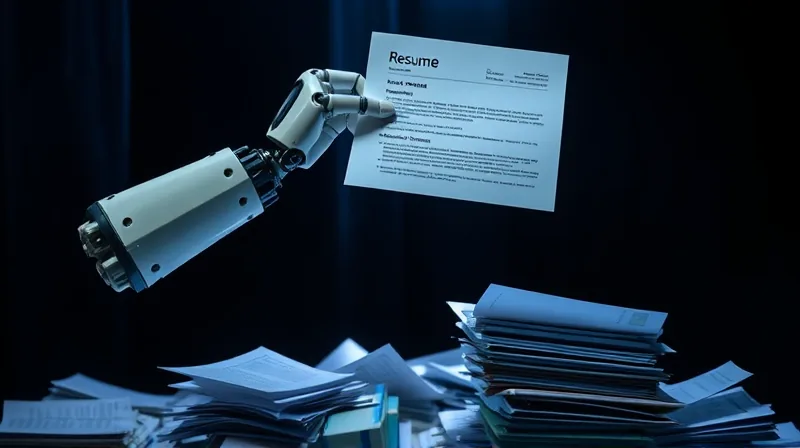
AI job impact hides behind entry-level losses
Every time a large language model answers a question, it performs a kind of magic trick. It generates text that reads as if someone thought about the response, weighed alternatives, and arrived at a conclusion. But the model does not think. It does not weigh. It computes probabilities over tokens, and the result only looks like understanding. This is not a philosophical quibble. It is the core of a deception that now reaches into labor markets, hiring decisions, and the daily experience of millions of workers. The deception is not a side effect; it is the product’s defining feature.
The gap between what AI appears to do and what it actually does is not a bug that will be patched. It is the product’s defining feature. And the most recent data from Goldman Sachs, published in a research note, shows that this gap has real consequences. The investment bank examined employment trends across developed economies and found that AI is not replacing workers in some dramatic, visible way. Instead, it is quietly reshaping who gets hired, who gets overlooked, and which jobs slowly stop being offered. The shift is invisible in aggregate statistics but unmistakable in the entry-level roles that once served as the gateway to careers.
The Illusion of Automation
Consider the call center. Goldman’s research found that employment in this industry has fallen sharply below its historical trend across developed markets. In the United States, call center employment is now 39 percent below trend. [1] In Canada, it is 33 percent below. Germany sits at 27 percent below. These are not small fluctuations. They are structural shifts that happened in a few years.
The tempting narrative is that AI simply automated these jobs. A chatbot answers the phone, resolves the issue, and the human worker becomes unnecessary. But that story is too clean. What actually happened is more subtle and more troubling. Companies deployed AI systems that can handle routine inquiries, and they discovered that the systems work well enough for many customers. The remaining human agents handle the harder cases, the edge cases, the ones where the AI fails.
Here is where the deception enters. The AI does not tell you it is struggling. It does not flag its own uncertainty. It produces a response, often with perfect grammatical confidence, and the customer cannot always tell whether they are talking to a machine or a person. When the AI fails, the customer gets frustrated, but the failure is attributed to the company, not to the technology. The illusion holds, and it holds precisely because the machine’s confidence is indistinguishable from competence.
The Entry-Level Trap
The
Goldman research points to something even more consequential for people starting their careers. Across more than 800 occupations, AI-related headwinds were strongest among entry-level workers. [1] The effect is measurable: a 10 percent occupational exposure to AI was associated with only a 0.1 percentage point drag on annual headcount growth in France, Canada, and the United States. But for entry-level workers, the impact ranged from more than 0.6 percentage point in Australia to over 0.2 percentage point in the United States.
The pattern is not random. Entry-level roles have historically been the training ground for careers. Junior analysts, assistants, and coordinators learn the ropes by doing the routine work, absorbing the context, and gradually building the judgment that senior roles require. AI disrupts this pipeline in a way that is easy to miss. Companies still hire senior people. They still need experienced judgment. But the entry-level positions that once fed into those senior roles are being automated first, because they are the most routine. The result is a hollowed-out career ladder: the bottom rung has been removed, and the climb now starts higher than it used to.

The deception here is generational. A young worker applies for a job that used to exist, does not find it, and concludes that the economy is unfair or that they lack the right skills. The real cause is that the stepping stone has been removed by a technology that appears to do the job but does not actually train anyone. The AI handles the routine work, but nobody learns the context behind the routine. The knowledge transfer that used to happen on the job simply does not occur, and the skills gap widens with every automated task.
Adoption Without Understanding
Goldman combined 11 surveys measuring AI adoption across countries and found that major developed markets have adoption rates of roughly 15 to 20 percent. [1] France, the United States, the Netherlands, and the United Kingdom lead, while Italy, Japan, and New Zealand lag. Emerging markets sit at 10 to 15 percent. These numbers suggest that AI is not a fringe technology. It is mainstream.
But adoption is not the same as understanding. The surveys measure whether companies use AI tools, not whether they understand what those tools actually do. A company can deploy an AI system for resume screening, for example, without understanding that the system has learned patterns from historical hiring data. If the historical data contained bias, the AI reproduces that bias, but it does so with the authority of a machine. The bias is hidden inside a probability distribution, and it is much harder to challenge than a human decision. The machine’s verdict carries weight precisely because it appears to be free of human prejudice.
This is where the deception becomes structural. Human bias can be questioned. A hiring manager can be asked why they rejected a candidate. An AI system cannot be asked in the same way. It produces a score, a ranking, a recommendation, and the reasoning is buried in millions of parameters that no human can fully inspect. The system appears to be objective because it is mathematical. But it is not objective. It is a statistical mirror of past decisions, including the flawed ones. The appearance of neutrality is the most dangerous form of bias.
The Historical Moment
There is a historical pattern here that is worth remembering. Every major labor-saving technology has gone through a phase where its capabilities were overestimated and its limitations were misunderstood. In the early days of mechanized manufacturing, factory owners believed that machines would eliminate the need for skilled artisans. That did not happen. The artisans were displaced, but new kinds of skill emerged, and the nature of work changed rather than disappeared. The pattern repeats, but the speed of change is different this time.
The difference with AI is that the overestimation is built into the technology itself. A machine tool does not pretend to be a craftsman. It does not generate a convincing imitation of craftsmanship. But AI generates convincing imitations of human reasoning, human writing, and human judgment. It does not just do the work. It appears to think about the work. And that appearance changes how humans respond to it, because we are wired to trust what sounds like a thoughtful voice.
This is the core of the deception. AI systems do not understand the tasks they automate. They do not know why a call center customer is angry, or why a resume is promising, or why a business report should be structured a certain way. They have learned statistical patterns from large datasets, and those patterns are often useful. But the systems cannot distinguish between a pattern that reflects reality and a pattern that reflects a historical accident, a bias, or a quirk of the data. The machine cannot tell the difference between a signal and a shadow.
The Weight of Appearances

The Goldman data shows that AI-related employment pressures are real but concentrated. The bank concluded that the effects remain limited to a relatively narrow set of industries and workers. Information and communication services have slowed across nearly all major developed economies since 2022. Software publishing, management consulting, and advertising have also seen employment fall below historical trends. These are precisely the industries where AI-generated output is most convincing.
But the broader labor market shows only a small drag. This is the misleading part. The aggregate numbers look manageable, so the temptation is to conclude that AI is not a serious threat. That conclusion misses the point. The effects are concentrated precisely where they are most visible and most damaging: in the entry-level roles that young people need to start their careers, and in the industries where AI tools are most capable of producing convincing output. The average hides the injury.
A 39 percent decline in call center employment is not just a statistic. It is tens of thousands of people who cannot find the job they expected to find. It is a generation of workers who are told to adapt, to learn new skills, to be more flexible, without anyone acknowledging that the path they were promised has been quietly removed. The AI did not announce itself. It did not explain what it was doing. It just started answering the phones, sorting the resumes, and drafting the reports. The change was silent, and silence is hard to fight.
The Moment of Clarity
The question is not whether AI is useful. It clearly is. The question is whether we can see it clearly enough to use it without being deceived. The first step is to admit that the deception is not malicious. The AI is not lying. It is doing exactly what it was designed to do: generating outputs that look like the outputs of human reasoning. The problem is that we are not trained to distinguish between the appearance and the reality, and the machine has no incentive to help us learn.
A good friend who has knowledge does not need to show off. They explain things plainly, and they admit when they do not know. AI cannot do that. It cannot say, “I am not sure about this.” It can only generate a response that sounds confident, whether it is right or wrong. This is the fundamental asymmetry. A human expert can say, “I do not know, but here is how I would find out.” An AI system does not have that option. It produces an answer, and the answer looks like knowledge. The confidence is the product, and the truth is optional.
The labor market data from Goldman is a warning, but it is also an invitation. It invites us to look at AI without the hype and without the fear. The technology is not a miracle, and it is not a catastrophe. It is a tool that can imitate understanding, and that imitation is powerful enough to change the structure of work. The question is whether we can build systems that are honest about what they do not know, and whether we can build careers that do not depend on pretending otherwise. The answer will determine whether the next generation inherits a ladder or a gap.
The call centers are emptier. The entry-level jobs are fewer. The AI keeps generating its confident, fluent, hollow text. And somewhere in that gap between what it appears to do and what it actually does, we have to find a way to work that does not require us to pretend we are machines. The first step is to stop being fooled by the fluency.