A Conversion
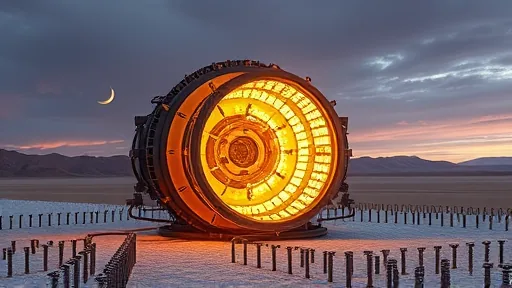
Measured in the Desert China’s experimental reactor in the Gobi Desert converted thorium into uranium fuel in 2025. [1] The Chinese Academy of Sciences reported the thorium-to-uranium fuel conversion, a measurement that for the first time directly observed what had previously been calculated only in design studies and test loops. [1] The conversion itself is the observation: thorium-232, which cannot power a reactor on its own, became uranium-233, the fissile material that can. [1].
Natural thorium-232 cannot power a nuclear reactor on its own and must first be converted into uranium-233, according to the International Atomic Energy Agency. [1] That means a thorium reactor needs another nuclear fuel to get the reaction started while the thorium is converted into usable uranium-233 fuel, Taek K. Kim, manager for the Nuclear Systems Analysis Group, told the Daily Caller News Foundation. [1].
The question that opens is not whether thorium can be converted — that is now demonstrated — but whether the conversion can be sustained in a commercial reactor with the fuel streams, shielding, and licensing that entails. [1].
The American precedent is older than most people realize. Oak Ridge National Laboratory’s Molten Salt Reactor Experiment achieved its first self-sustaining nuclear chain reaction in 1965 and became the first reactor to run on uranium-233 in 1968, logging more than 13,000 hours at full power before shutting down in 1969. [1] The United States did not fail to understand thorium. It understood it, ran it, and then stopped.
The Reactor Is Not the Fuel
John Kutsch, executive director of the Thorium Energy Alliance, draws a distinction that the public conversation routinely blurs. “There is fuel and there are reactors — people often say ‘Thorium Reactor,’ but there is no such thing; all reactors can be made to run all fuels,” he told the Daily Caller News Foundation. [1]. The phrase “thorium reactor” is a category error. The fuel is thorium. The reactor is a machine that can accept many fuels, including thorium.
That distinction matters because the safety case for thorium is often overstated. Thorium oxide has higher thermal conductivity and a higher melting temperature than uranium oxide, the chemical form used in commercial reactors. Those properties are favorable for resistance to fuel failure. But Taek K. Kim, manager for the Nuclear Systems Analysis Group, cautions that the favorable safety characteristics mainly relate to reactor designs, not thorium itself. [1]. Molten salt reactors and high-temperature gas-cooled reactors have safety features that would exist whether they burned thorium or uranium.
What thorium does offer is a different waste profile. Conventional uranium fuel produces plutonium and other long-lived radioactive materials as it is used. Thorium is primarily converted into uranium-233, producing far smaller amounts of those materials. “Since plutonium and minor actinides are highly radioactive and radiotoxic with long half-lives, the thorium fuel cycle has much lower long-lived radioactive hazards compared to the uranium fuel cycle,” Kim told the Daily Caller News Foundation. [1].
The element itself is more abundant in the Earth’s crust than uranium. It is commonly found in monazite, a phosphate mineral that contains rare earth elements and serves as the world’s primary source of thorium, according to the U.S. Geological Survey. [1] Monazite is primarily valuable for its rare-earth content and contains only small amounts of uranium, making thorium recovery a potential byproduct of mining material already sought for other minerals. Kutsch calls thorium “a by-product of rare earth and critical materials processing.” [1] The fuel is already coming out of the ground. The question is whether anyone will catch it. [1].
Inertia, Infrastructure, and the Missing Supply Chain
The primary obstacle to a thorium fuel cycle is not physics. It is the weight of an industry built around uranium. Kutsch points to inertia: “Power producers use U235 and that is what they use and what they want to continue to use — once and no recycling.” [1] He also points to the funding loop: “We use uranium, therefore we fund uranium, we do NOT use thorium, therefore we do NOT fund any work in thorium.” [1].” The two-fuel problem is the quiet obstacle. Reactors can pair thorium with enriched uranium, requiring both uranium and thorium fuel streams. “Because U-233 recovery is complex and both thorium and uranium fuel streams are required, the nuclear community has focused on the single uranium fuel cycle rather than maintaining both streams,” Kim told the Daily Caller News Foundation. [1] “Thorium fuel requires a sizeable investment, which is the major regulatory and economic obstacle.” [1].” A single fuel cycle is simpler to license, simpler to supply, and simpler to operate. Two streams double the infrastructure.
History confirms the pattern. Colorado’s 330-megawatt Fort St. Vrain reactor used thorium and uranium to generate electricity from 1979 to 1989, according to federal records. [1] Germany’s 300-megawatt Thorium High Temperature Reactor also used thorium and uranium in the 1980s. [1] Neither led to a commercially competitive thorium fuel industry. Fort St. Vrain was terminated because it was economically unviable, with poor availability and high operating costs, while Germany’s reactor shut down in 1989 for similar reasons and poor government support, according to Kim. [1] Other concepts using thorium fuels, including molten-salt, heavy-water and fast gas reactors, have been designed but have not been commercially deployed, Kim said. [1].