The Year the Sky Ran Out of Water
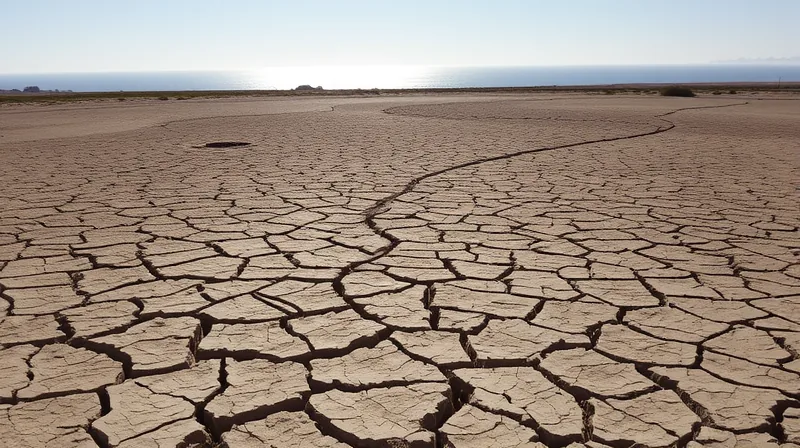
In 1877, the rain stopped in places that had no word for “global.” Northern China endured its worst drought in three centuries. Northeastern Brazil, India, South Africa, and northern Africa all withered under the same dry spell. The rain gauges told a simple story: no water, no crops, no food. What the instruments could not tell was that a single ocean, half a world away, had exhaled enough heat into the atmosphere to starve continents. The root cause was a supersized El Niño, which released vast amounts of heat from the ocean into the atmosphere and disrupted weather patterns across the globe.
This is the paradox: a famine that looked like a hundred separate local failures was, in fact, one planetary event. The scale changes everything. The magnet was the tropical Pacific.
Scientists in 1877 had no name for what was happening. They had rudimentary meteorological data collection — sea-surface temperatures collated, rain gauges monitored, barometric pressure observed — but the cause remained opaque. Many researchers blamed sunspots. “As a scientific topic, this was the Stone Ages for El Niño,” says Michael McPhaden at the US National Oceanic and Atmospheric Administration (NOAA). [1] “No one in the scientific community knew about this problem. The only ones who probably knew about it were Peruvian fishermen.” The fishermen had noticed warm water appearing off their coast around Christmas, year after unpredictable year. They called it El Niño, the Christ child. They had no idea they were naming a phenomenon that could kill millions on the other side of the planet.
The total death toll across India, China and Brazil between 1876 and 1879 is estimated at 20 million to 30 million. Globally, there may have been 50 million deaths. Historian Mike Davis calls it a disaster of “truly planetary magnitude.” People knowingly ate diseased animals, tree roots, mud, pets and strips of leather in desperate bids to stay alive. Children were sold or sacrificed for a meal. Corpses were bricked into their homes by family members to stop them being pillaged and eaten by hungry neighbours. When winter came and there was no money for fuel, people burned their own houses. The desperate then crowded together in underground pits for warmth. Once the poor had died in a region, the wealthy succumbed.
The Seesaw Nobody Could See
For half a century after the famine, the scientific community remained blind to the mechanism. The breakthrough came in stages. In the 1920s, physicist Gilbert Walker identified a seesaw of atmospheric pressure across the tropics — a pattern he called the Southern Oscillation. He could describe it. He could not explain it. The connection to ocean temperatures remained hidden for another four decades.
Then, in 1969, meteorologist Jacob Bjerknes linked changing sea-surface temperatures in the Pacific to Walker’s Southern Oscillation and mapped the global dynamics of an El Niño. McPhaden calls this the “big bang” for El Niño research. The idea that an El Niño could be identified in real time — and even predicted in advance — was born. A phenomenon that had once been invisible became, at least in principle, forecastable. It was a global climate engine.
The 1877/78 event itself had to be reconstructed from scraps. Boyin Huang, also at NOAA, and his colleagues used modern data analysis methods to estimate its strength. Their analysis draws on sea-surface data from ships, buoys and modern floats, organised to reconstruct a temperature record stretching back to 1850. “From our data reconstruction, we did find the El Niño signature, and it is a very strong El Niño,” Huang says. [1] El Niño strength is measured by how far sea-surface temperatures in a specific region of the tropical Pacific deviate from normal. After accounting for the background ocean warming trend observed since then, temperatures in the Nino3 index were 2.88 degrees C above average. [1] This suggests it was among the strongest — if not the strongest — event in modern history.
The result was three or more years of very little rain, and repeated crop failures. In some locations, drought had begun even before El Niño hit, triggered in part by unusually cool conditions in the tropical Pacific immediately before its arrival.
When Warning Is Not Enough
For more than a century, the 1877/78 El Niño has stood as the strongest in history. But this year, a super El Niño has once again erupted in the tropical Pacific, and on current forecasts it looks set to outstrip even 1877/78 in its intensity. Current predictions forecast sea-surface temperatures in the El Niño region of the Pacific Ocean peaking 4°C above normal in November. The big difference this time is that we already know the event is occurring. “Being forewarned is being forearmed,” McPhaden says. “If you know something is coming and it can have really damaging impacts, you have some choices to make.” “The longer you have to prepare, the more options you have,” McPhaden says. “And the better off you may be in the end.” But the capacity to foresee is not the same as the capacity to act. Scientists have been able to forecast El Niño events months in advance since the 1990s. Models began to hint at a coming El Niño in February 2026, and by April there were clear signs that a strong event was looming. That gave governments a three-month head start before the El Niño even began, and at least six months of warning before impacts would be felt. The impact of the 1877/78 droughts was made far worse by the ineptitude of official responses. In India, colonial rulers continued to collect taxes, hoard grain, and enforce food exports to England despite widespread starvation. In China, corrupt officials raided grain supplies, and poor transport links made it difficult to get food to those who needed it. Water levels on the Grand Canal, a vital transport link into the hardest-hit Shanxi province, dropped so low that it was unnavigable. There were no railways, and mountain roads into Shanxi thronged with bandits who killed the livestock being used to transport grain before they could reach the starving. “Because of the workings of the imperial economy at that time, those droughts translated into colossal famines with millions of dead in India and China,” says Richard Seager at Columbia University in New York.
This El Niño “is happening at a very bad time,” says Seager. In January 2025, US President Donald Trump issued an executive order shutting down a US-funded famine early warning system. Six months later it was reinstated, but data reporting since then has been patchy, news reports suggest. The US has also severely cut funding to the World Food Programme, which provides emergency food relief. Other high-income countries, including the UK, have also scaled back their overseas aid budgets in recent years. “We have much better public health systems,” says McPhaden. “We have much better understanding of disease and disease controls. And we have humanitarian organisations, and we have social safety nets, that will not let 50 million people die like happened in 1877-78.” Improvements in El Niño forecasting, with the help of AI, mean it could soon be possible to predict a coming El Niño two years in advance, he says.”