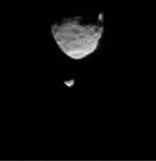
Martian Moons Sample Return Mission MMX
The Wrong Question That Became the Right One
For more than a hundred years, researchers have argued about where the two Martian moons came from. The debate has been framed as a binary: either Phobos and Deimos are captured asteroids, wandering rocks that Mars grabbed from the belt between Jupiter and the inner planets, or they are debris from a giant impact on Mars itself, born the same way Earth’s moon was born. The shapes of the moons — lumpy, irregular, potato-like — point toward the captured-asteroid answer. Their orbits tell the opposite story. Both moons circle Mars above its equator in nearly perfect circles, a geometry that captured objects almost never achieve. A captured asteroid arrives on whatever trajectory brought it, and that trajectory is rarely equatorial and rarely circular. An impact-generated disk, by contrast, settles into a flat, circular ring before it clumps into moons. So the surface says one thing and the orbit says another, and the contradiction has sat unresolved since the era of the first Mars flybys.
The mistake, in retrospect, was treating the question as answerable from a distance. Every probe that has photographed Phobos and Deimos — and there have been many, from the Viking orbiters in the 1970s through Europe’s recent Hera flyby — has added detail without resolving the origin. A moon’s shape, albedo, crater count and thermal signature can all be measured. None of those measurements discriminates cleanly between the two hypotheses, because a captured asteroid and an impact fragment can end up looking similar after billions of years of bombardment. The only way to settle it is to bring a piece of the moon back to a laboratory. That is what Japan’s Martian Moons eXploration spacecraft, MMX, is built to do.
The mission’s itinerary is precise. If the launch goes as planned, MMX arrives at Mars in August 2027 and enters an orbit that keeps it flying alongside Phobos, the larger of the two moons, so its instruments can build a detailed map of the surface. Along the way it will also observe Deimos. Once the map is complete enough, operators at the Japan Aerospace Exploration Agency will use it to choose a landing site on Phobos. During one or two brief landings, MMX will perform two tasks: it will drop off a small rover called IDEFIX, and it will collect samples. The rover is the first wheeled vehicle anyone has ever placed on such a small cosmic body. Part of its job, beyond scientific observation, is simply to confirm that a wheeled rover works at all on an object with gravity so weak that a rolling wheel may not behave the way engineers expect. The samples are the point of the mission. MMX carries two sampling devices. One shoots a puff of gas onto the surface, blowing dust and pebbles upward into a collection container. The other fires a hollow cylinder into the ground to extract material from several centimetres deep. After collection, the samples are stowed inside the spacecraft, which then heads back toward Earth, arriving home in 2031.
The Instrument That Reads Fire and Ice
The question MMX is built to answer has a parallel in a different sample-return mission, and that parallel is instructive. NASA’s OSIRIS-REx spacecraft parachuted 120 grams of regolith from the asteroid Bennu down to Earth on 23 September 2023 Half a gram of that material reached the lab of Maria Schönbächler, a professor of isotope geochemistry at ETH Zurich in Switzerland. Her team analyzed isotopes — versions of the same element with different numbers of neutrons in the nucleus — of iron, titanium and chromium in the Bennu sample. Iron and titanium turned out to be thoroughly mixed throughout the material. That evenness is the tell. Coarse, clumpy material tends to preserve isotopic differences between its components; fine dust that has been stirred together tends to homogenize. The Bennu sample looked like the product of fine dust grains, not rubble.
Bennu’s isotopic composition also turned out to be remarkably similar to that of Ryugu, the asteroid from which Japan’s Hayabusa2 mission returned a sample, and to a rare class of meteorites called CI chondrites. Three separate objects, sampled by two different space agencies and by the natural delivery system of meteorite falls, share a common isotopic fingerprint. That points to a shared birthplace. The conventional view had placed Bennu’s and Ryugu’s parent bodies far from the sun, in the cold outer solar system, possibly forming alongside comets and forming later than the planets, because processes that far out run slowly. The isotopic evidence pushed the other way.
Schönbächler’s team proposed a specific setting: the snow line, the boundary in the planet-forming disk beyond which water vapour froze into ice and inside which ice melted or sublimated into gas. That line sat roughly where Jupiter orbits today. Material from both sides of the boundary — hot and cold, rocky and icy — flowed together to assemble the parent bodies of Bennu, Ryugu and the CI chondrites. This is the same class of question MMX is chasing at Mars: not merely what a small body is made of, but where in the solar system it was made, and what that location tells us about the conditions that prevailed there billions of years ago.
The instrument that makes such a reading possible is not a camera or a spectrometer but the mass spectrometer, which separates atoms by mass and reveals the isotopic ratios locked inside a sample. Those ratios are fingerprints that survive the journey from a forming disk to a spacecraft’s collection container to a laboratory on Earth. A photograph of Phobos can tell you its shape. An isotopic analysis of Phobos dust can tell you the temperature and location of its birth.
When Impact Physics Meets Sample Return
A separate line of work has produced a concrete prediction that MMX can test, and it comes from the physics of collisions rather than from geochemistry. Deimos, the outer and smaller of the two Martian moons, is about 12 kilometres across and sits roughly 24,000 kilometres from the Martian surface. It is smoother than the heavily cratered Phobos and is covered in a perplexing layer of dust and rubble called regolith. It also carries a distinctive feature: a 10-kilometre-wide impact basin at its southern pole, a dramatic dip resembling the bowls carved into mountain ranges. What created that crater, and what produced the global dust layer, has been an open question.
Sabina Raducan, science program manager at the International Space Science Institute and a senior fellow at the Free University of Brussels, led a team that ran about a hundred impact simulations using a computer code called the Bern Smoothed Particle Hydrodynamics code, developed at the University of Bern in Switzerland over two decades The code models collisions between asteroids, comets and planets by tracking millions of individual particles, which allows researchers to vary density, gravity, compositional strength and internal structure. Each simulation took roughly a week. The team varied the size, velocity and angle of the impacting asteroid and the internal structure of Deimos, then compared the outcomes against the close-up images of Deimos returned by the European Space Agency’s Hera mission during its March 2025 flyby of the moon. Hera is on its way to study the aftermath of NASA’s DART mission, which deliberately crashed a spacecraft into a small moon orbiting a larger asteroid.
The scenario that best matched the observations involved a single asteroid about 320 metres across striking Deimos at a 45-degree angle. That impact would have excavated the south polar crater and thrown debris across the moon’s surface, producing the global dust layer. The result is a prediction, not a closed case, and it is a prediction MMX can check. Raducan put it plainly: the study gives MMX a clearer picture of what its instruments, and ultimately the sample collection, can expect Here the two disciplines meet. Impact physics predicts what the surface should look like and what the subsurface should contain. Isotope geochemistry, the tool that read the Bennu sample, will read whatever MMX brings back. If the returned Phobos material carries the isotopic signature of Mars itself, the impact hypothesis gains direct support, because debris blasted off Mars would have collected on the moon’s surface and been preserved there for billions of years. That possibility is the bonus the mission was designed around. Impacts on Mars could have launched Martian material into space, where it would have settled onto Phobos and waited. A sample from Phobos might therefore illuminate not only the history of the moons but the history of Mars — its water, its organic compounds, the early era when the inner planets may have been acquiring the raw materials of habitability. As Tom Statler, part of the NASA team collaborating on MMX, put it, having the answer will help illuminate that early era. The moons have been a puzzle for more than a century. The sample container is now being built to close it.
Sources
Mentioned organisations (context, not sources)
- European Space Agency — Organisation (homepage)
- Japan Aerospace Exploration Agency — Organisation (homepage)
- ETH Zurich — Organisation (homepage)
- NASA — Organisation (homepage)
- International Space Science Institute — Organisation (homepage)
- Free University of Brussels — Organisation (homepage)
- University of Bern — Organisation (homepage)