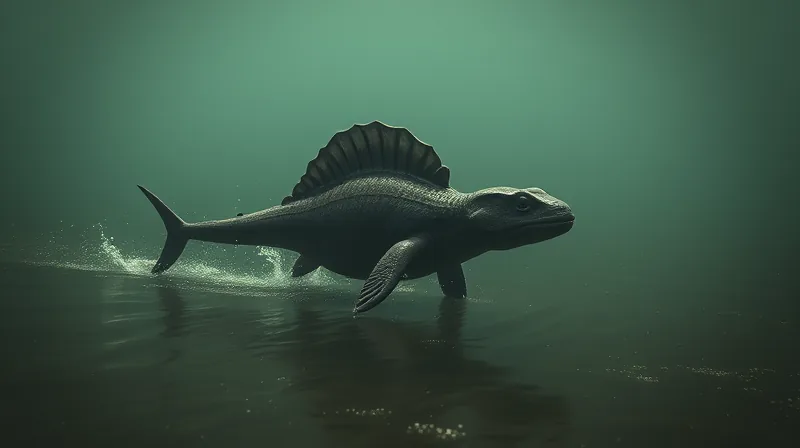
Jurassic Swimmer Fossil Rewrites Mammal Suckling Origins
The Fossil That Was Not Supposed to Be There
The surprise was not in the digging. It was in the assumption about what a Jurassic mammaliaform could be. For decades, the small, shrew-like creatures that scurried beneath the feet of dinosaurs were filed under a single mental category: generalized, terrestrial, unremarkable. Then a well-preserved specimen from the Middle Jurassic of China arrived with a pelvis and hindlimb anatomy that had no business being in that category. The animal was built for water. Its bones told a story of paddling, not scurrying. The discovery, published in Nature by Li, Y. et al., describes a mammaliaform with a wealth of features specialized for swimming — a finding that fills a major gap in anatomical knowledge of the pelvis and hindlimb for early mammals. [1] The surprise was not that researchers misread the fossil. It was that the field had grown comfortable with a picture that this fossil quietly dismantles.
This species is the largest of all Jurassic mammaliaforms. [1] That single fact expands the known body size range of docodontans — a group of early evolutionary predecessors to modern Mammalia — and it adds to a growing body of evidence that multiple docodontans exploited diverse niches. Some were semiaquatic. Others were not. The Mesozoic ecosystem, dominated by dinosaurs, was not a monoculture of small, interchangeable insect-eaters. It was a crowded marketplace of body plans and lifestyles, and this animal was one of its larger aquatic traders. The lifestyle is interpreted as analogous to the extant platypus: swimming and foraging in water, using a body that had committed to that mode of life. The fossil does not suggest a creature dabbling at the water’s edge. It suggests one that lived there.
What makes the find more than a single curiosity is the pattern it exposes. Docodontans are an early example of replicated evolution of the semiaquatic and other ecomorphotypes — a phenomenon that occurred long before the diversification of extant mammals. In plain terms: nature ran the same experiment more than once, independently, across different branches of the same family tree. The semiaquatic body plan was not a one-off mutation. It was a solution that evolution reached for repeatedly, in a world where the dominant land animals were reptiles and the mammals were still finding their footing. The fossil is not an anomaly. It is a data point in a broader pattern.
The teeth complete the portrait. This mammaliaform is characterized by highly distinctive canines and pseudo-carnassial sectorial teeth — slicing teeth, built for a faunivorous diet. [1] It was not grinding plant matter or straining tiny invertebrates from mud. It was eating flesh. The combination of a swimmer’s skeleton and a carnivore’s dentition places this animal in a niche that few Jurassic mammaliaforms are known to have occupied. The fossil does not just add a species to a list. It adds a way of life to the range of possibilities that early mammals explored.
The Throat That Changed the Definition of Mammal
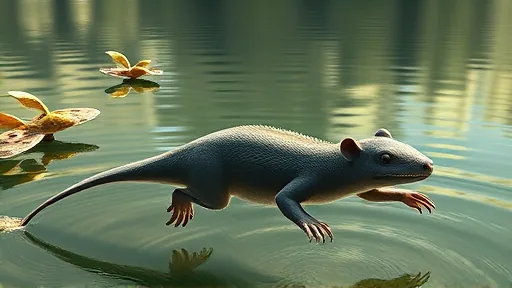
This fossil preserves a therian-like pharyngeal vault — a throat passage — and hyoid skeletal anatomy, the bones of the throat. The preservation is rare. Soft-tissue anatomy almost never survives in fossils of this age. When it does, it carries information that bones alone cannot. The pharynx is the crossroads of breathing, swallowing, and — in mammals — suckling. Its architecture is not a minor detail. It may be a structural signature of how an animal feeds its young.
That is a precise claim, and it deserves to be read precisely. It does not say the animal suckled. It says the anatomical equipment for suckling had evolved. The distinction matters because it pushes the origin of these behaviors back in time — long before the rise of modern mammals, and into the common ancestors of Docodonta and Mammalia.
Here is where the fossil becomes a hinge in the story of mammals. The ability to suckle is not a trivial trait. It is a feeding strategy that allows a mother to provision a helpless infant with a liquid diet. The pharynx is the gate through which a whole suite of mammalian possibilities passes. This animal, swimming in Jurassic waters, carried the gate.
The discovery suggests that suckling emerged in a common ancestor of modern mammals that lived in the Jurassic period. [2] It relocates a defining mammalian behavior from the familiar territory of Cretaceous and Cenozoic mammals into the Middle Jurassic, into a creature that also happened to be a swimmer, a carnivore, and the largest of its kind. The animal is not a proto-mammal waiting to become something else. It is a fully realized experiment in being mammal-like, running in parallel with other experiments, in an ecosystem that was, without knowing it, a nursery for the future.
The Gap Between Bones and Behavior
The unresolved tension sits exactly where the evidence is strongest and the interpretation is hardest. The fossil preserves the anatomy for suckling. It does not preserve the act. No fossil can. The inference from throat bones to infant feeding is an inference, and it rests on a comparison with living therians — the group that includes marsupials and placental mammals. The animal had the equipment. Whether it used that equipment the way a platypus uses its own — the source’s chosen modern analogue — is a question the bones cannot answer on their own.
The platypus comparison cuts both ways. The platypus is a semiaquatic, egg-laying mammal that suckles without nipples — milk is secreted onto the skin and licked up by the young If this Jurassic mammaliaform was platypus-like in lifestyle, it may also have been platypus-like in its suckling mechanism, which is not therian-like at all. Those two comparisons pull in different directions. The fossil sits at the intersection, and the intersection is not fully mapped.
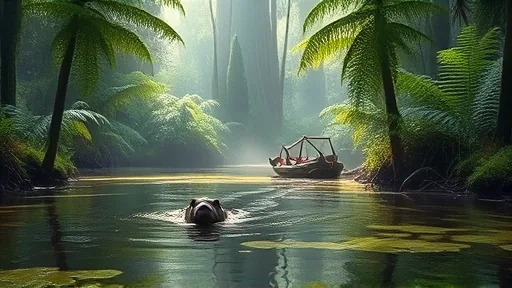
What remains is a creature that was large for its time, built for water, armed with slicing teeth, and equipped with a throat that could have supported the kind of feeding that defines mammals today. It lived in the Middle Jurassic of China, in an ecosystem ruled by dinosaurs, and it belonged to a group — the docodontans — that repeatedly evolved semiaquatic forms. The contradiction is not a flaw in the research. It is the shape of the evidence. The gap between the two is where the next discovery will have to go.
Sources
- DOI: 10.1038/s41586-026-11107-0
- DOI: 10.1038/d41586-026-03069-0
- Nature — Quote source (original article)