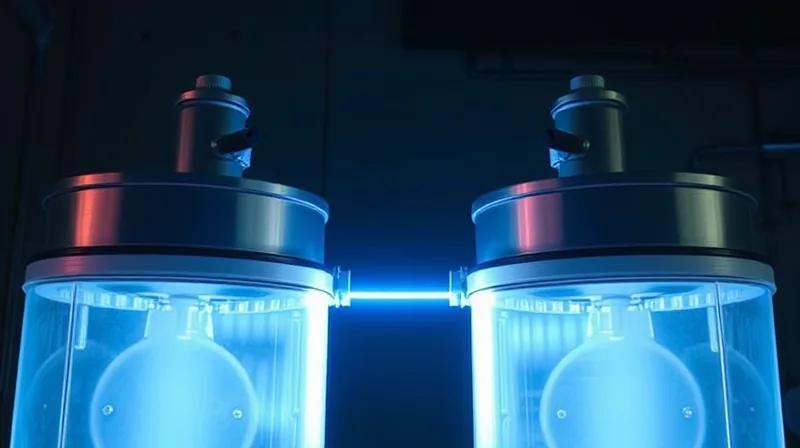
IBM Cools Two Quantum Systems Together in Breakthrough
For decades, the biggest obstacle in quantum computing was not the logic - it was the cold. A quantum chip must be cooled to near absolute zero, just a whisper above minus 273 degrees Celsius, to keep its fragile quantum states stable. But a single cooling system can only hold so many chips. Scientists knew that scaling up would require connecting multiple cooling units, yet no one had proven it could be done. The question of how to link separate ultra-cold environments into one seamless system remained unresolved for years, blocking every serious attempt to build a quantum computer with hundreds of chips.
The challenge was not merely technical but physical. Cryogenic systems are built to isolate their contents from the outside world, and any connection between them risks leaking heat. Even a tiny temperature rise can destroy the quantum states that make the machine useful. Researchers had theorized about modular designs, but the engineering required to join two cryogenic units while maintaining the extreme cold seemed almost contradictory - how do you connect two sealed boxes without breaking the seal? This tension between connection and isolation defined the problem for years, and it is why the field watched closely when IBM announced its latest achievement.
IBM’s breakthrough, announced on Aug. 19, 2026, was the successful joining and cooling of two modular cryogenic systems into a single ultra-cold environment. [1] The combined system reached temperatures below 15 millikelvin - that is less than 0.015 degrees above absolute zero. [1] This is not a small step. It is the first proof that the modular approach can work, and it clears a path toward connecting hundreds of quantum chips in the future. The architecture is designed to scale, which means the infrastructure challenge that once seemed insurmountable now has a concrete solution.
From Punch Cards to Quantum Dreams
IBM’s journey to this milestone began more than a century ago. The company was founded in 1911 as the Computing-Tabulating-Recording Company and rebranded as International Business Machines in 1924. For most of its history, IBM built machines that processed information using classical physics - switches, circuits, and transistors. But the company has always looked ahead, and its pivot toward quantum computing is the latest chapter in a story of constant reinvention. The company now operates in more than 170 countries and holds a market capitalization of $222 billion, giving it the resources to pursue research that will not pay off for years.
The quantum program has been a decade in the making, with IBM publishing roadmaps and hitting milestone after milestone. But the Aug. 19 announcement was different. It was not about a single chip or a clever algorithm - it was about the physical infrastructure that will determine whether quantum computers can ever become practical. The company has committed more than $10 billion over the next five years to quantum computing through research, manufacturing, capital spending, acquisitions, and ecosystem expansion. That commitment shows how seriously IBM takes the long game, even as its traditional businesses face pressure.
The company’s quantum roadmap targets a system called Quantum Starling for 2029. This is the machine that would use the modular cryogenic architecture announced this month. The idea is to link many quantum chips into a single, powerful system that can solve problems beyond the reach of any classical computer. The Aug. 19 milestone is a necessary step toward that goal, and it validates the engineering approach IBM has chosen. Without this proof point, the 2029 target would have been little more than a hope.

IBM’s stock has not rewarded the company for this progress - at least not yet. Shares closed at $235.68 on Aug. 21, down 21.43 percent year-to-date and 30 percent below the 52-week high of $332.46 reached on June 2. The stock hit a 52-week low of $199.19 on July 23, following concerns over slowing growth and a softer outlook. The quantum announcement on Aug. 19 lifted shares just 1.9 percent, and the stock fell about 1.5 percent the next day. Investors are clearly focused on near-term financials, not a machine scheduled for 2029.
The Hidden Cost of Artificial Intelligence
The reason for the stock’s weakness lies in IBM’s second-quarter 2026 results, released on July 22. Revenue increased just 1 percent year-over-year to $17.2 billion, while net income declined 1 percent to $2.2 billion, or $2.27 per share. The slowdown was driven by customers redirecting technology budgets toward artificial intelligence infrastructure. This shift hit IBM’s mainframe business particularly hard - IBM Z mainframe revenue plunged 42 percent in the quarter. Companies are buying AI servers instead of upgrading their traditional computing systems, and IBM feels the pinch.
The pain is not evenly distributed across the company. Software revenue rose 5 percent year-over-year to $7.8 billion, supported by an 11 percent increase in Hybrid Cloud/Red Hat and 19 percent growth in Data. Consulting revenue was essentially flat at $5.3 billion. But Infrastructure revenue fell 7 percent to $3.8 billion, and within that segment, the mainframe collapse was stark. The silver lining was Distributed Infrastructure, which jumped 37 percent - a sign that some hardware lines are benefiting from the AI wave even as others suffer.
Cash generation provided a brighter spot. IBM generated $2.6 billion in operating cash flow in the second quarter, up from $1.7 billion in the same period of 2025. For the first six months of 2026, operating cash flow increased to $7.8 billion from $6.1 billion. Free cash flow was broadly flat at $4.8 billion. IBM also returned $1.6 billion to shareholders through dividends during the quarter. These numbers show a company that can still generate cash, even when growth stalls.
The biggest disappointment for investors was the revised full-year outlook. Management now expects constant-currency revenue growth of 4 to 5 percent for 2026, down from a previous expectation of growth above 5 percent. That revision, combined with the mainframe weakness, triggered the July sell-off. Analysts still expect earnings per share of around $12.33 for fiscal 2026, up 6.4 percent year-over-year, and $13.23 in fiscal 2027, another 7.3 percent increase. But the market is clearly skeptical about whether those numbers will hold.
Who Believes the Quantum Story
Wall
Street is split on IBM’s prospects. CITIC Securities maintained a “Buy” rating on July 29, raising its price target modestly to $297 from $294. [2] The call came shortly after the earnings report and stands against a broader wave of caution. Susquehanna, by contrast, maintained a “Neutral” rating on July 24 but slashed its price target to $225 from $303 - a dramatic cut that reflects the weaker near-term outlook. [3] The divergence between these two firms shows how uncertain the path forward looks.

The broader consensus is a “Moderate Buy.” Of the 24 analysts covering the stock, 11 advise a “Strong Buy,” two suggest a “Moderate Buy,” 10 are on the sidelines with a “Hold” rating, and one has a “Strong Sell.” The average analyst price target is $251.87, implying an upside of 8.4 percent from the current price. The Street-high target is $365, suggesting the stock could rally as much as 57.1 percent if the bulls are right. These targets were set before the quantum announcement, so they may not yet reflect the full implications of the cryogenic breakthrough.
The stock currently trades at 19.13 times forward price-to-earnings, which looks discounted compared to industry peers. That valuation suggests the market is pricing in continued weakness, not the long-term quantum opportunity. For investors who believe the quantum roadmap is real, the current price may look attractive. For those focused on the next few quarters, the mainframe decline and the lowered guidance are harder to ignore.
IBM’s quantum milestone does not change the near-term financial picture. But it does change the long-term calculus. The company has now proven that its modular approach to cryogenic cooling works, which means the path to Quantum Starling in 2029 is more credible than it was a month ago. The $10 billion commitment to quantum research and development shows that IBM is not treating this as a side project. The question for investors is whether they can look past the current earnings slump to see the machine that might be coming.
Sources
1. IBM