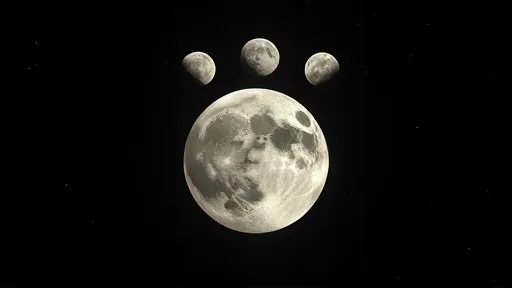
Five Moons in One Frame
On a night in early October 2026, skywatchers across the northeastern United States faced a question that sounds like a riddle: how many moons can be seen at once? [1] The best answer is five: four orbiting Jupiter and Luna orbiting Earth. Earth’s Moon moved directly in front of Jupiter, and for a brief window the two lunar systems shared the same narrow patch of sky.
The picture was possible because Earth’s Moon moved directly in front of Jupiter. The featured image is a series of exposures near alignment taken from Westchester, New York, USA, by Chirag Upreti. [1] What made the image unusual was the visibility of both lunar families at once. The sunlit crescent of Earth’s Moon, on the lower left, is overexposed, while the Moon’s night side, on the upper right, is faintly illuminated by Earthshine.
Three Worlds Larger Than Ours
The
Galilean satellites lined up nearly vertically above our Moon, listed from bottom to top: Ganymede, Io, Callisto, and Europa. Three of them — Ganymede, Callisto, and Io — are larger than Earth’s Moon. Europa is only slightly smaller. That size comparison matters because it reframes what “moon” means: our companion is not the standard, merely the one we happen to orbit.
These four bodies are the Galilean satellites, named for Galileo Galilei, who turned an early telescope toward Jupiter and saw what he took to be stars that moved. Their existence helped dismantle the assumption that everything circles Earth.
NASA’s robotic spacecraft Juno is currently orbiting Jupiter and has made close passes near three of these moons. [1] The result is a portrait of a planetary system in miniature, observed from inside rather than across millions of kilometers.