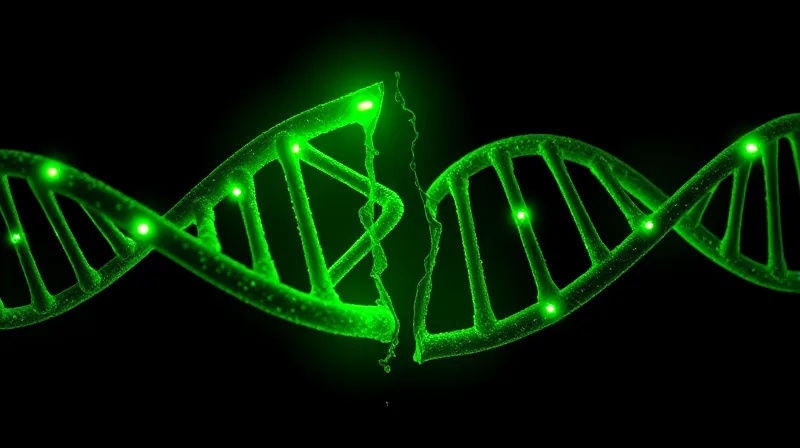
Epigenetics reveals 7 percent inheritance rule exceptions
For over a century, the story of inheritance has followed a simple script. You get half your DNA from your mother. You get half from your father. The code is fixed. The traits are predictable. Gregor Mendel proved this with pea plants in the 1860s, and his laws became the bedrock of modern biology.
But a new wave of research is cracking that foundation. In a 2026 study from Johns Hopkins Medicine, led by epigenetics researcher Andrew Feinberg, scientists discovered that about 7% of inherited epigenetic patterns in mice do not follow Mendel’s classic rules at all. [1] These chemical marks on DNA — which can turn genes on or off without changing the genetic code itself — are being passed down in ways that break the old framework. Some marks seem to appear from nowhere. Others cannot be traced to either parent.
This is not a small statistical blip. It is a signal that inheritance is more fluid, more responsive to environment, and more mysterious than textbooks have taught.
What Mendel got right — and what he missed
Gregor Mendel was a monk who spent years crossbreeding pea plants in a monastery garden. He tracked traits like seed shape, flower color, and plant height. From his experiments, he derived two core principles.
First, each parent contributes one version of a gene, called an allele. Second, some alleles are dominant — they express their trait even when paired with a recessive one. Recessive traits only show when both alleles are the same.
These laws held true for many traits in many species. They explained why brown eyes can dominate over blue, and why a recessive disease like cystic fibrosis can skip generations. For decades, genetics was built on this framework.
But even Mendel knew his rules had limits. He observed that some traits did not segregate cleanly. He did not have the tools to explain why. Now, scientists do.
The chemical layer above the code
DNA is often compared to a blueprint. But that metaphor is incomplete. A blueprint tells a builder where walls go. DNA tells a cell which proteins to make. Yet the same blueprint can produce different buildings if some instructions are highlighted and others are ignored.
That highlighting is epigenetics. The term comes from Greek: “epi” means above or beyond. Epigenetic marks sit on top of the DNA sequence. They do not change the letters of the genetic code. Instead, they change how that code is read.
The most common epigenetic mark is DNA methylation. A small chemical group — made of carbon and hydrogen atoms — attaches to a specific region of the DNA. That region often controls whether a nearby gene is active. When the mark is present, the gene can be silenced. When it is absent, the gene can be expressed.
This process is essential for life. It allows a single fertilized egg to develop into a body with hundreds of different cell types. A skin cell and a brain cell carry the same DNA. But they have different epigenetic marks. Those marks tell each cell which genes to use and which to ignore.
When inheritance breaks the rulesThe Johns Hopkins study, led by Andrew Feinberg, a professor of epigenetics at the Johns Hopkins University School of Medicine, tracked DNA methylation across three generations of mice. [1] [1] The first generation had 26 mice. The second had 34. The third had 19. Researchers examined tissue samples from each animal.
What they found was unexpected. About 7% of the inherited methylation patterns did not follow Mendelian rules. Some marks appeared to be passed down from only one parent, but not in the dominant-recessive pattern Mendel described. Others seemed to emerge without any clear parent of origin.
The study also identified the first known naturally occurring paramutation in a mammal. Paramutation is a rare form of inheritance where one allele can alter the epigenetic state of another allele in the same organism. That changed state can then be passed to offspring. This phenomenon was previously known only in plants and flies.
Feinberg described these non-Mendelian patterns as potentially a faster way for organisms to acquire diverse traits than changes to the DNA sequence itself. Environmental pressures could drive these shifts.
What this means for the old rules
Mendel’s laws are not wrong. They describe many forms of inheritance accurately. But they are incomplete. They describe the transmission of DNA sequences. They do not account for the transmission of epigenetic marks.
Scientists had already identified one exception: genomic imprinting. In this case, whether a gene is active depends on which parent it came from. For example, a gene from the mother might be silenced while the same gene from the father is active. This breaks the simple dominant-recessive framework.
The new study adds more exceptions. It found imprinting in five additional genes. It also showed that non-Mendelian epigenetic inheritance may be more common than previously recognized.
The key difference is speed. DNA mutations are rare and random. They take many generations to spread through a population. Epigenetic changes can occur in response to environment and can be passed to offspring within a single generation.
A parallel discovery: trauma in sperm cells
The implications of this research In a 2025 study published in the journal Molecular Psychiatry, a team led by Dr. Jetro Tuulari of the University of Turku examined the sperm cells of 58 men in their late 30s and early 40s. [1] late 30s and early 40s. [1] The researchers used a standard questionnaire called the Trauma and Distress Scale to assess each man’s history of childhood trauma.
They discovered that the sperm of men who reported high levels of childhood trauma had different epigenetic marks than the sperm of men with less trauma. These differences persisted even after controlling for factors like smoking and drinking.
The study did not prove that trauma is passed to children. That part remains speculative. But it showed that emotional experiences can leave molecular imprints on sperm cells. Those imprints are epigenetic.
This finding echoes the mouse study. Both suggest that life experiences — including stress and trauma — can alter the epigenetic landscape of reproductive cells. Those alterations could potentially influence the next generation.
The ladder from old to new
Before these studies, inheritance was seen as a one-way street. DNA was the fixed map. Environment could affect the organism, but those effects ended with that organism’s death. Children started fresh.
The new view is different. Inheritance is a two-way street. DNA provides the stable foundation. Epigenetics provides the flexible overlay. That overlay can be shaped by experience. And that shaping can be passed down.
This does not mean that trauma is inevitably inherited. It does not mean that a father’s stress becomes a child’s destiny. It means that the boundary between environment and inheritance is more porous than we thought.
What is now certain
Several facts are now clear. Epigenetic marks can be inherited across generations in mammals. Some of those marks do not follow Mendelian rules. The frequency of non-Mendelian inheritance is measurable — at least 7% in mice. The first natural paramutation in a mammal has been identified. Human sperm cells carry epigenetic marks that correlate with childhood trauma.
What remains uncertain is the extent of this inheritance in humans. Animal studies show clear evidence of epigenetic transmission. Human studies are less conclusive. More research is needed to determine whether the marks found in sperm actually influence offspring development.
But the direction of the science is clear. Inheritance is not just about the code. It is about the reading of the code. And that reading can be changed.
A historical echo
In 1866, Gregor Mendel published his paper “Experiments on Plant Hybrids.” It was largely ignored. The scientific community was not ready for a mathematical model of inheritance. It took 34 years for his work to be rediscovered and appreciated.
Now, 160 years later, scientists are discovering that Mendel’s laws are only part of the story. The chemical marks above the DNA add a new layer of complexity. They add a new layer of possibility.
The echo is this: every time science expands its understanding of inheritance, the implications are profound. Mendel’s work led to modern genetics, to gene therapy, to the Human Genome Project. The discovery of non-Mendelian epigenetic inheritance may lead to new understanding of disease, of development, of the long shadow of experience.
The rules are being rewritten. The story is not finished, and future research will determine how these findings translate to human health and disease