
A Test Built From Child’s Play
For a quarter century, researchers have used a simple game with nonsense words to map how the human mind ties sound to sight. Show someone a rounded blob and a jagged star, then ask which one is called “bouba” and which “kiki.” People almost always pair the soft word with the soft shape and the sharp word with the sharp shape.
In the first experiment, 51 owners sat with their adult dogs, holding them steady, while a rounded shape appeared on a panel at one side of the room and a spiky shape on the other. When the word “bouba” played, 56 per cent of the dogs lingered on the round shape. [3] When “kiki” played, 63 per cent fixed their gaze on the spiky one. [3] The dogs were not told the rules. They simply looked.
The pattern echoes what humans do across cultures, a universality that has been documented in people from widely different backgrounds.
When the Owner Stops Being a Cue
The owners wore headphones playing music, so they could not hear which word was spoken. They could not nod, tense, or glance toward the matching shape. The dogs had only the sound and the panels.
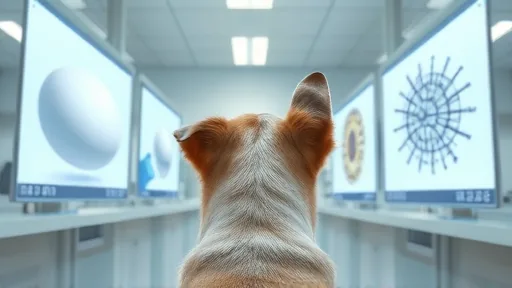
The result held. The bias toward the round shape for “bouba” came back slightly stronger than before, confirming that the dogs were not simply reading their owners’ reactions.
If animals without human-like language spontaneously tie sounds to shapes, then at least some of the machinery behind sound symbolism may not belong to language at all. It may instead reflect general principles of how a brain stitches information from different senses into one picture.
The finding also lands next to work in other species. Chicks have shown the same tendency, and macaques may as well.
The Puppies, the Foxes, and the Cats
What the dog study cannot yet separate is experience from inheritance. A pet dog has spent years listening to human voices. It has also evolved alongside humans for thousands of years. Biffi says the team is now collecting data on puppies and wild canids, including foxes, to pull those threads apart. [3] The team also wants to test cats. That choice is deliberate. If cats show the bouba-kiki effect, the case for a general perceptual mechanism grows stronger. A positive result in cats would undercut the idea that the effect is a special adaptation for dog-human communication.
Attila Andics at Eötvös Loránd University in Hungary says the study suggests the matching of speech sounds to shapes relies on general mechanisms rather than complex linguistic representations. [3] The question he wants answered next is how much of the link in dogs comes from statistical learning — picking up patterns from a lifetime of sound — and how much is a hardwired expectation present from birth. [3].
Sources
- DOI: 10.64898/2026.07.31.741992v1.full
- DOI: 10.1098/rspb.2026.1209
- Newscientist — Quote source (original article)