CRISPR Records Mouse Embryo Development Cell by Cell
From Cutting Tool to Cell Recorder
It was built to cut DNA. The CRISPR systems that laboratories now use to disable genes, to correct mutations, to break sequences at chosen addresses were repurposed here into something closer to a black box recorder: every time a cell divides, it leaves a mark, and the marks accumulate into a readable history. What was a tool for destruction became a tool for memory.
Two independent teams report today that they have used this principle to follow a mouse from a single fertilised egg to a late-stage embryo. [1] One team traced the cell-by-cell development of a single fertilised mouse egg to a late-stage embryo. The other captured most of the cell divisions in embryos as organs formed. The findings appear in Science and in Cell.
Until now, the only complete map of animal development came from a worm. [1] In the early 1980s, UK biologist John Sulston sat at a microscope and watched every single cell of the nematode Caenorhabditis elegans as it grew from an egg into an adult with exactly 959 somatic cells — cells that are fully differentiated, locked into their final identity. [1] He did it by eye. No editing, no sequencing, no recorder. Just patience and a transparent animal.
That method does not travel. Jay Shendure, a genome scientist at the University of Washington in Seattle who led the Science study, points out why: C. elegans is see-through, and every worm develops identically, the same 959 cells following an unvarying pattern of divisions. A mouse is neither transparent nor predictable. Its development is hidden, its cells number in the billions, and external cues such as growth factors influence a cell’s fate — for instance, whether it will end up in the lungs or the liver. The worm is a clockwork mechanism. The mouse is a weather system.
The Worm Was the Exception
The
Sulston lineage was long treated as the template for how development works. These two studies recast it as the special case. What made the worm tractable — transparency, invariance, a small fixed cell count — is precisely what almost no other animal offers.
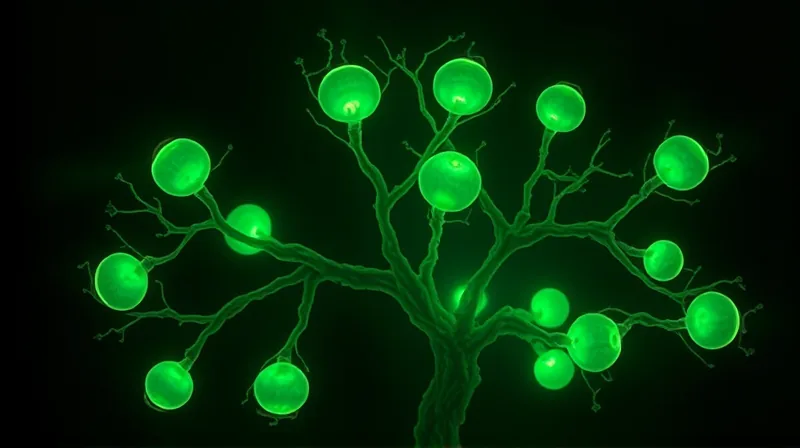
The logic of the replacement is elegant. If a cell carries a record of its own divisions, then no one needs to watch. The embryo writes its own biography, and the researchers read it afterwards. That is the shift: from observation to inscription.
Both studies were inspired by a landmark early-1980s effort: the first — and still only — full map of animal development. That effort, using only a microscope, mapped an entire animal cell by cell, and the question became whether any mammal could be mapped the same way.
A record of divisions is not the same as a record of fate. The worm map told you not only where each cell came from but where it ended up. The mouse recorders trace lineage — ancestry, the branching tree of who divided into whom. What a cell becomes is still influenced by signals from outside itself, and those signals leave no CRISPR scar. The map is real, and it is also incomplete in a way the worm map was not.