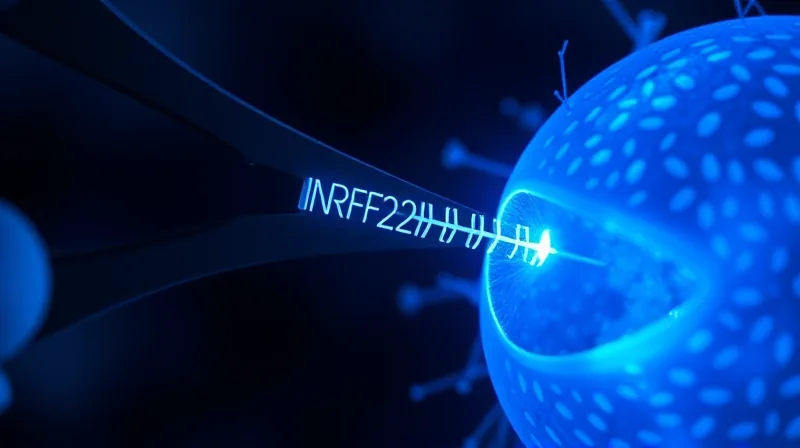
CRISPR disables NRF2 to overcome chemotherapy resistance
The word “resistance” comes from the Latin resistere — to stand back, to stop, to remain still. For decades, this is exactly what cancer has done when faced with chemotherapy. It stands back. It stops the drugs. It remains still while the patient’s hope drains away. But a team of researchers at the ChristianaCare Gene Editing Institute in Newark, Delaware, has now shown that this standing-still can be broken. They used CRISPR — a molecular tool that cuts DNA like scissors — to disable a single gene called NRF2. When they did, chemotherapy started working again.
The story of NRF2 begins not in cancer, but in protection. Every cell in your body carries this gene. Its job is noble: when a cell is stressed — by toxins, by radiation, by the simple wear of living — NRF2 activates a shield. It tells the cell to produce antioxidants, to repair damage, to survive. This is why you can breathe polluted air and still live. This is why your liver processes alcohol and doesn’t immediately die. NRF2 is the cellular bodyguard.
But cancer hijacks this guard.
The Human Story: A Decade of Watching
In 2014, a small team at the Gene Editing Institute began watching NRF2 closely. They had noticed something strange in patient samples: in some lung tumors, NRF2 was not just active — it was screaming. It was stuck in the “on” position. The bodyguard had turned Kelly Banas, Ph.D., now the lead author of the study published in Molecular Therapy Oncology, joined this watching earlyined this watching early. She spent years mapping how NRF2 mutates in lung cancer. She saw the same pattern again and again: a tiny spelling error in the DNA — a single letter change called R34G — made NRF2 unable to turn off. The shield stayed up permanently. Chemotherapy drugs like carboplatin and paclitaxel could not get through.
For patients with lung squamous cell carcinoma, this is devastating. This cancer makes up 20% to 30% of all lung cancers. The American Cancer Society estimates that more than 190,000 people in the United States will be diagnosed with lung cancer in 2025. For many, the first round of chemotherapy works. Then the cancer learns. It mutates. It stands back. It resists.
“The evidence at every stage has been compelling,” Banas said. “It’s a strong foundation for taking the next step toward clinical trials.”
The Scientific Story: Cutting the Switch
To understand what Banas and her team did, imagine a light switch that is stuck in the “on” position. The room is too bright. You cannot sleep. You try to dim. The team used CRISPR/Cas9 to reach inside the cell and cut the switch, disabling the NRF2 gene They engineered lung cancer cells to carry the R34G mutation — the stuck switch — and then delivered CRISPR directly to those cells. The scissors sBut here is the surprise: they did not need to break every switch. They found that disabling NRF2 in just 20% to 40% of tumor cells was enough. The chemotherapy could then work effectively. Tumors shrank, and the cancer stopped resistingcould suddenly work. Tumors shrank. The cancer stopped resisting.
This threshold discovery is critical because in the human body, editing every cancer cell is impractical. Tumors are messy, dense, and hidden. However, if only one in five cells requires editing, the approach becomes clinically realistic.
The Delivery: Lipid Nanoparticles
Getting CRISPR into tumor cells is like mailing a letter to a house with no address. The cells are inside the body, surrounded by other cells, protected by membranes. The team used lipid nanoparticles — tiny fat bubbles — to carry the CRISPR scissors. This method is non-viral, meaning it does not use a disabled virus to deliver the cargo. Viruses can trigger immune reactions. Fat bubbles are gentler.
The researchers injected these bubbles into mice with lung tumors. The bubbles traveled through the bloodstream, found the tumor, and released the CRISPR scissors inside the cancer cells. Sequencing confirmed that the cuts were precise. The scissors hit only the mutated NRF2 gene. They left the rest of the genome untouched.
“The power of this CRISPR therapy lies in its precision,” Banas said. “It’s like an arrow that hits only the bullseye.”
Beyond Lungs: The Wider Web
The R34G mutation is not unique to lung cancer. Overactive NRF2 contributes to chemotherapy resistance in liver cancer, esophageal cancer, and head and neck cancers. The mechanism is the same: the shield stays up. The drugs cannot enter.
This means the ChristianaCare discovery could apply to many solid tumors. If CRISPR can disable NRF2 in lung cancer, it can likely do the same in other cancers where the gene is stuck on. The team is now planning Phase I cliniEric Kmiec, Ph.D., the senior author and executive director of the Gene Editing Institute, framed the shift:thor and executive director of the Gene Editing Institute, framed the shift: “Instead of developing entirely new drugs, we are using gene editing to make existing ones effective again.”
A Parallel Track: Bacteria Learn the Same Trick
While the ChristianaCare team worked on human cancer, another group at the UniverEthan Bier, Ph.D., and Justin Meyer, Ph.D., were watching bacteria evolve to defeat antibiotics , and Justin Meyer, Ph.D.** , were watching bacteria evolve to defeat antibiotics. The pattern was eerily similar: a shield goes up, the drug stops working, the patient gets sicker.
Antibiotic resistance is a global crisis. The World Health Organization warns that by 2050, more than 10 million people per year could die from resistant infections [2]. Bacteria share resistance genes through plasmids — small circles of DNA that move between cells like trading cards. Once one bacterium learns resistance, it teaches the whole colony.Bier and Meyer developed a tool called Pro-Active Genetics (Pro-AG) . It uses CRISPR to cut the resistance genes out of bacteria. But they went further. They engineered the CRISPR system to spread itself. Using a process called conjugal transIn 2019, Bier’s lab collaborated with Victor Nizet, M.D., at UC San Diego School of Medicine to develop the first version [3]. In 2025, they published a new version called pPro-MobV in the journal npj Antimicrobials and Resistancep the first version [3]. In 2025, they published a new version called pPro-MobV in the journal npj Antimicrobials and Resistance. This version works inside biofilms** — the slimy communities where bacteria hide from antibiotics. Biofilms coat hospital surfaces, fish farms, and sewage pipes. They are nearly impossible to clean. But the new CRISPR system can penetrate them.
“If you could reduce the spread from animals to humans, you could have a significant impact on the antibiotic resistance problem,” Bier said.
The Bridge Between Two Worlds
The cancer team and the bacteria team never met. They work in different buildings, different states, different fields. But they are building the same bridge.
On one side: a gene that refuses to turn off. NRF2 in cancer. Resistance genes in bacteria. On the other side: a drug that should work. Chemotherapy. Antibiotics. In the middle: CRISPR, cutting the switch.
Both teams discovered the same truth: you do not need to destroy every resistant cell. You only need to disable enough of them to let the treatment through. In cancer, 20% to 40% editing was enough. In bacteria, a few edited cells can spread the fix through the entire population.
Both teams also chose non-viral delivery. The cancer team used lipid nanoparticles. The bacteria team used mating tunnels. Neither relies on viruses, which can trigger immune responses or insert DNA in the wrong place.
The Deeper Roots: Where NRF2 Came From
NRF2 is ancient. It exists in almost every animal, from flies to fish to humans. It evolved 600 million years ago , when early life needed to survive oxygen. Oxygen is corrosive. It damages DNA. NRF2 evolved to protect against this damage.
In healthy cells, NRF2 is kept on a short leash. A protein called KEAP1 holds it in the cytoplasm, ready to destroy it. When stress arrives, KEAP1 lets go. NRF2 rushes to the nucleus and activates 200 different genes that repair damage, produce antioxidants, and pump out toxins. This is a beautiful system — until cancer steals it.
The R34G mutation is in the part of NRF2 that KEAP1 grabs. When R34G is present, KEAP1 cannot hold on. NRF2 runs free. The shield stays up forever.
Researchers at the University of Tokyo and the National Cancer Institute in Bethesda, Maryland, have studied this mutation for years. They found it in 10% of lung squamous cell carcinomas and in smaller percentages of liver and head and neck cancers [4][5]. The ChristianaCare team is the first to show that CRISPR can reverse it.
The Mechanism: How CRISPR Finds the Bullseye
CRISPR is short for Clustered Regularly Interspaced Short Palindromic Repeats. It was discovered in bacteria, where it acts as an immune system. Bacteria capture pieces of virus DNA and store them in their own genome. When the same virus attacks again, the bacteria use these stored pieces to guide scissors — Cas9 — to cut the virus DNA.
Scientists borrowed this system. They design a guide RNA that matches a specific DNA sequence. In this case, the guide matches the R34G mutation. The Cas9 scissors follow the guide, find the mutation, and cut both strands of DNA. The cell tries to repair the cut, but it makes mistakes. The gene is disabled.
The ChristianaCare team confirmed that the cuts were specific. They sequenced the entire genome of edited cells and found minimal off-target effects. The scissors hit the bullseye almost every time.
The Patient: Who Will Benefit
Lung cancer is the leading cause of cancer death worldwide. The World Health Organization reports 2.2 million new cases each year [2]. Non-small cell lung cancer makes up 85% of these. Squamous cell carcinoma is one subtype.
Standard treatment for advanced squamous cell carcinoma is carboplatin plus paclitaxel. These drugs work by poisoning rapidly dividing cells. But cancer cells with overactive NRF2 pump the drugs out before they can do damage. The drugs bounce off the shield.
If clinical trials succeed, patients would receive the CRISPR therapy followed by chemotherapy. The chemotherapy would now work. The team estimates that clinical trials could begin within two to three years, contingent on funding and regulatory approval from the U.S. Food and Drug Administration [6].
The team estimates that clinical trials could begin within two to three years. The timeline depends on funding and regulatory approval from the U.S. Food and Drug Administration [6].
The Economics: Old Drugs Made New
Developing a new cancer drug costs an average of $2.6 billion and takes 10 to 15 years. Most fail. The ChristianaCare approach is different. It does not invent a new drug. It makes an old drug work again.
Carboplatin and paclitaxel are generic. They are cheap. They are available everywhere. If CRISPR can restore their effectiveness, patients could avoid the expensive, often toxic second-line therapies that follow resistance.
Kmiec put it simply: “We are using gene editing to make existing drugs effective again.”
The Risk: What Could Go Wrong
CRISPR is powerful, but it is not perfect. The scissors can cut the wrong place in the genome. This could cause new mutations, potentially triggering other cancers. The ChristianaCare team saw minimal off-target effects in their study, but animal models are not humans.
Lipid nanoparticles are also new. They have been used successfully for mRNA vaccines — the COVID-19 vaccines from Pfizer and Moderna use them [7][8]. But delivering them to a solid tumor is harder than delivering to muscle cells. The nanoparticles must survive the bloodstream, avoid the liver, and penetrate the tumor’s dense tissue.
The team is working on improving the nanoparticles. They are testing different lipid compositions and surface coatings to improve tumor targeting.
The Philosophy: What Resistance Reveals
Resistance is not a flaw but a feature of life. Cells resist toxins, bacteria resist antibiotics, and cancer resists chemotherapy. Resistance is a survival mechanism.
But when resistance becomes permanent — when the switch gets stuck — it becomes disease. The system that was meant to protect now destroys.
CRISPR offers a way to reset the switch. It does not cure cancer by itself. It does not kill every cell. It just breaks the shield. Then the old tools — chemotherapy, antibiotics — can do their work.
The ChristianaCare team demonstrated that editing every cell is unnecessary; editing a sufficient fraction allows the body’s systems and drugs to manage the rest.
The Next Frontier: Clinical Trials
The Gene Editing Institute is now preparing for Phase I clinical trials. These trials will test safety first. A small group of patients with advanced lung squamous cell carcinoma will receive the CRISPR therapy. The team will monitor for side effects, off-target edits, and immune reactions.
If Phase I is safe, Phase II will test effectiveness. Patients will receive CRISPR plus chemotherapy. The team will measure tumor shrinkage, progression-free survival, and overall survival.
Banas is cautious but hopeful: “We’re hopeful that in clinical trials and beyond, this is what will allow chemotherapy to improve outcomes for patients.”
The Global Context: Who Else Is Working on This
Several other groups are targeting NRF2. Researchers at the University of Texas MD Anderson Cancer Center are developing small molecules that inhibit NRF2 directly [9]. These drugs would block the protein, not the gene. They are in early animal testing.
Scientists at the Broad Institute of MIT and Harvard are using a different gene-editing tool called base editing [10]. Base editing changes one DNA letter to another without cutting the double strand. This could be safer than CRISPR. They have shown it works in lung cancer cells in a dish.
The University of Cambridge in the United Kingdom is studying how NRF2 interacts with the immune system. They found that overactive NRF2 helps cancer hide from immune cells. Disabling NRF2 might also make immunotherapy work better.
The ChristianaCare team is the first to demonstrate that CRISPR can reverse NRF2-driven resistance in animal models, positioning them at the forefront of this research.
The Parallel: Antibiotic Resistance and Gene Drives
The UC San Diego team working on antibiotic resistance is using a similar strategy. Their Pro-AG system is a gene drive — a genetic element that spreads through a population. Gene drives were first developed to control mosquitoes that carry malIn lab tests, it restored sensitivity to antibiotics in E. coli and Klebsiella pneumoniae, two common hospital pathogensacteria. Their pPro-MobV system spreads through bacterial populations, cutting antibiotic resistance genes as it goes. In lab tests, it restored sensitivity to antibiotics in E. coli and Klebsiella pneumoniae , two common hospital pathogens.
The parallel to cancer is striking: in both cases, aThe ChristianaCare team began watching NRF2 in 2014. They published their first paper on the mutation in 2017. They showed it caused resistance in cell lines in 2019. They showed it in animal models in 2022. The current paper, published in 2025, is the culmination of 11 years of worktianaCare team began watching NRF2 in 2014. They published their first paper on the mutation in 2017. They showed it caused resistance in cell lines in 2019. They showed it in animal models in 2022. The current paper, published in 2025 , is the culmination of 11 years of work.
Clinical trials will take another 3 to 5 years. If successful, the treatment could be available by 2030. This is fast for cancer research, but slow for patients who are sick now.
Banas acknowledges the tension: “We’ve seen compelling evidence at every stage. It’s a strong foundation for taking the next step.”
The Bigger Picture: What This Means for Medicine
Medicine has long relied on finding new drugs. When a cancer becomes resistant, you switch to a different drug. When bacteria become resistant, you develop a new antibiotic. This is an arms race. The pathogens evolve faster than we can invent.
CRISPR changes the game. Instead of developing new weapons, you repair the old ones. You break the shield. You restore the vulnerability.
This is a fundamental shift. It moves medicine from constant innovation to strategic restoration. It says: the tools we have are good enough. We just need to make them work again.
The Philosophical Statement
Resistance is not a wall but a locked door. For decades, we tried to break it down with increasingly potent drugs, but the door held. Now we have learned to pick the lock.
The lock is a single gene, and the pick is CRISPR. The door swings open.
This research reveals that life’s defenses are not absolute but precise, depending on a few key switches. Understanding these switches allows us to flip them back.
Cancer is not invincible; it is merely clever. But we are clever too, and now we have the tools to match its cleverness.
The shield can be broken. The standing-still can end. The word “resistance” can be rewritten.
Sources
1. University of California San Diego
3. UC San Diego School of Medicine
6. U.S. Food and Drug Administration
7. Pfizer
8. Moderna