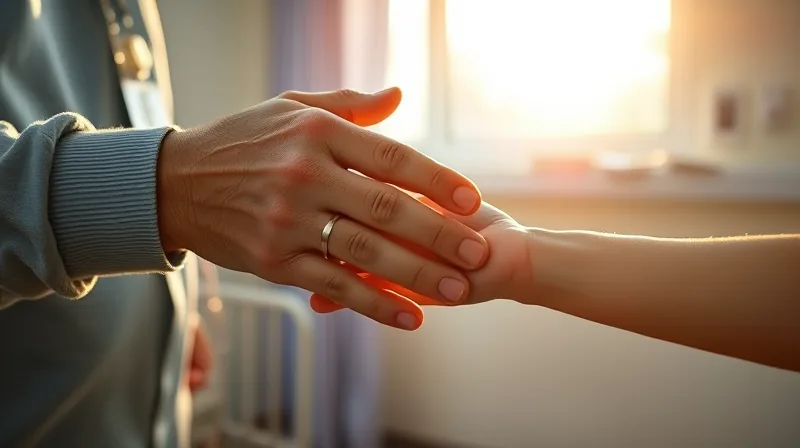
Caregiving Does Not Kill Study Overturns Mortality Warning
The Assumption That Collapsed Under Its Own Numbers
For nearly thirty years, the most-cited warning about caring for a sick family member carried a number that sounded like a death sentence. Distressed caregivers were 63 percent more likely to die within four years than people who were not caregivers. [2] Psychiatrists Richard Schulz and Scott Beach, both then at the University of Pittsburgh, published that result in 1999 in the Journal of the American Medical Association. [2] It has since been cited almost 5,300 times, including almost 300 times in just the past two years. The phrase that grew out of it — caregiving kills — became the kind of fact that travels faster than the study behind it.
Then researchers tried to reproduce it, and the number refused to come back. A growing body of work instead links caregiving to living longer, according to a report by Naomi Eisenberger of UCLA and colleagues in Biopsychosocial Science and Medicine. [1] That problem was buried inside the original data. Schulz and Beach followed more than 800 people over four years, during which 103 died. Roughly half had disabled spouses — some serving as caregivers, others not — and the other half had nondisabled spouses and acted as the control group. Caregiving spouses filled out self-reports describing how much mental strain they felt. The researchers then zoomed in on one subgroup: spousal caregivers reporting considerable strain. Among those distressed caregivers, 17 percent died during the study period, compared with 9 percent of the control group. [2] But the same dataset held a second result that never made the headline. People who were not providing care to their disabled spouses died at the same rate as the caregivers who reported distress. In other words, the elevated mortality tracked the presence of a sick spouse, not the act of caring for one. Having a sick or disabled spouse — and not caregiving status — appears to raise the likelihood of dying.
The scale of the reversal is hard to overstate. The 1999 paper has been cited roughly 5,300 times. One of the original authors walked the finding back, and the field mostly kept quoting the original. Stephanie Brown, an evolutionary and social psychologist at the Renaissance School of Medicine at Stony Brook University in New York, assumed the field would have taken notice. It did not. ‘Slam pieces on caregiving’ still hang in doctors’ offices and other medical settings, she says.
What the Blood Samples Revealed

If caregiving is a chronically stressful undertaking, the body should show it in the standard way. Work-related burnout, for instance, links with chronic inflammation. Stressed caregivers, by that logic, should be inflamed. They are not.
The evidence came from blood. Researchers drew on data from more than 30,000 U.S. adults surveyed in the early 2000s and again in the 2010s. Participants reported their caregiver status, the type and intensity of care they provided, and how much strain they felt. They also gave blood samples. The team isolated roughly 250 people who became regular caregivers and analyzed their blood for six inflammation-related biomarkers. On average, those biomarkers did not rise when people transitioned into caregiving. They also did not rise relative to a matched control group of non-caregivers drawn from the larger sample. The result held even for the most stressed caregivers, including spouses caring for a partner with dementia. That study appeared in 2020 in the Proceedings of the National Academy of Sciences.
So the body of a caregiver under chronic stress is not doing what a body under chronic stress is supposed to do. William Haley, a gerontologist and clinical psychologist at the University of South Florida in Tampa, put the state of knowledge plainly: we don’t really know why. There is a lot of mystery here.
Eisenberger and colleagues propose an answer rooted in evolution. Mammals evolved a biological system to protect offspring that remain helpless long after birth — a “mammalian caregiving system” that encourages caring and dampens the normal stress response that tells a person to flee danger, at least when their baby is involved. It appears when someone holds onto a partner in pain, and when someone gives money to family.
The picture that emerges is not a simple one. More than 6,000 caregivers were asked to weigh the sense of purpose and the emotional stress of the role. Their answers capture a duality: the same task can be draining and meaningful at once. Eisenberger lived this herself. When her father developed dementia, she knew the popular wisdom — that caring for him could shave years off her life. She was skeptical. Caring for him, she says, was stressful but also meaningful. ‘It gave me a lot of joy to bring him some happiness.’ He died in January. ‘I’m not suggesting everyone go out and engage in informal caregiving,’ she says. ‘I’m trying to make informal caregiving feel a little less scary.
Sources

Mentioned organisations (context, not sources)
- University of Pittsburgh — Organisation (homepage)
- Journal of the American Medical Association — Organisation (homepage)
- UCLA — Organisation (homepage)
- Renaissance School of Medicine at Stony Brook University — Organisation (homepage)
- University of South Florida — Organisation (homepage)
- Proceedings of the National Academy of Sciences — Organisation (homepage)