
Reading Rock in the Glow of a Furnace
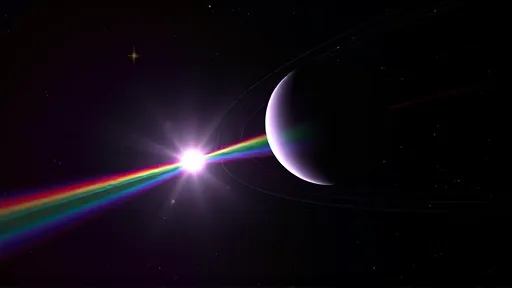
The instrument that made this measurement possible was not built to hunt planets. The Immersion GRating INfrared Spectrograph, or IGRINS, splits infrared light into its component wavelengths at very high resolution — the same basic job as a prism, but sharp enough to pick out individual chemical signatures in a beam that has traveled for centuries. It was built to serve infrared astronomy broadly, and it has now been pointed at a planet to answer a question about how worlds are assembled.
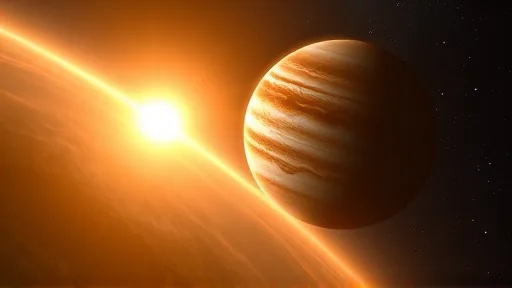
WASP-189b is the target. It sits nearly 320 light-years away in the constellation Libra and belongs to a class called ultra-hot Jupiters. [1] These are enormous planets whose temperatures are so extreme that materials normally locked in solid rock — magnesium, silicon, iron — turn into gas. In a planet like this, the atmosphere is a furnace that vaporizes the very ingredients of stone, which is exactly what makes it useful: the building blocks of rocky worlds become visible in the air.
Astronomers read those ingredients through spectroscopy, a method that separates light into different wavelengths so the chemicals present can be identified. An international team led by Jorge Antonio Sanchez, a graduate student at Arizona State University, used IGRINS on the Gemini South telescope in Chile to apply that method to WASP-189b. [1] What they pulled out was the first simultaneous measurement of gaseous magnesium and silicon in the atmosphere of a planet beyond our Solar System.
The result is a ratio. The proportion of magnesium to silicon on WASP-189b closely matches the ratio found in its parent star. That single number is the payload of the whole study — a measurable quantity that ties a planet’s chemistry to the chemistry of the star it orbits.
The Anchor That Was Missing
For decades, the assumption has been that stars and the disks of gas and dust they are born with share the same material. A young star and its surrounding disk condense from one cloud, so the reasoning goes, and the proportions of rock-forming elements in the disk should resemble those measured in the star at its center. Giant planets form inside those disks, and the outer layers of a giant planet’s atmosphere are thought to keep a record of the environment where it formed.
That assumption has been a working tool. But the tool rested mainly on evidence from our own Solar System. Astronomers had not directly measured the same star-to-planet relationship for a world orbiting another star. The assumption was inherited, not confirmed.
WASP-189b supplies the missing confirmation. “WASP-189b gives us a much-needed observational anchor in our understanding of terrestrial planet formation since it offers a measurable quantity that validates the presumed resemblance of stellar composition and the proportion of rocky material around host stars used to form planets,” Sanchez says. [1] Chris Davis, NSF Program Director for NOIRLab, frames the result as a demonstration of capability: “These discoveries show Gemini’s ability to help us understand the characteristics of the remarkable zoo of exoplanets in our solar neighborhood,” he says. “Such discoveries are only possible because of Gemini’s cutting-edge instruments.”
Where Geology Meets the Search for Life
The ratio matters because it reaches into a planet’s interior. The elements that make up a planet help determine processes such as plate tectonics, the generation of its protective magnetic field, and the movement of essential chemicals into the atmosphere, oceans, and soil. Together these processes shape the environment in which life can thrive.
That is the intersection now opening: astrobiology, the study of the conditions that could support life beyond Earth, meets stellar spectroscopy. If a star’s composition reliably predicts the rocky material around it, then reading a star’s light becomes a way to estimate what its planets are built from — and whether the ingredients for a habitable environment are present. The connection is not evidence of life; it is a bridge between two disciplines that previously measured different things.
Michael Line, Associate Professor at ASU and a co-author of the study, points to the instrument side of that bridge. “Our study demonstrates the capability of ground-based, high-resolution spectrographs to constrain critical species like magnesium and silicon, which are two elemental building blocks from which rocky planets form,” he says. “This advancing capability opens an entirely new dimension in our study of exoplanet atmospheres.”
The next step the team names is to push that capability wider — future observations using multiple wavelengths and similarly precise instruments, aimed at uncovering a wider range of elements in exoplanet atmospheres. A fuller chemical picture could reveal more about how planets form, how they change over time, and which conditions might favor habitability. And as researchers work toward studying smaller, rocky exoplanets in greater detail, the star-to-planet link WASP-189b has now anchored becomes the calibration that makes those harder measurements possible.