A Teaching Machine, Not a Research Workhorse
When a school district announces it will install a quantum computer, the easy assumption is that students will use it to solve problems no ordinary machine can touch. The truth is almost the opposite. In January, Skyview High School in Virginia will become the first high school in the United States to have a quantum computer on its premises, but the device is a teaching instrument, not a research workhorse. [1] Its purpose is to build intuition, not to break computational records.
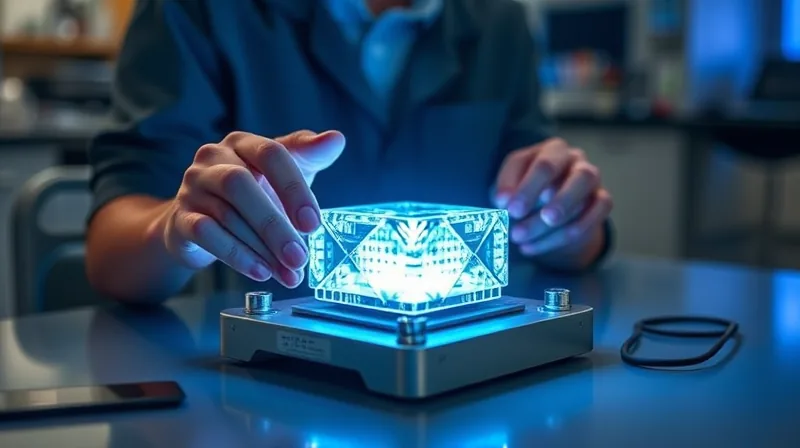
The machine is called XQ1. It is built by XeedQ, a firm that works in both quantum computing and quantum sensing. [1]. The unit holds four qubits — the basic building blocks of quantum computation. Each qubit is based on a diamond imprinted with specifically designed defects. This design choice matters because these qubits can operate at room temperature. No dilution refrigerator, no exotic cooling plant. That single property is what makes a classroom deployment conceivable at all, and it is the detail that separates this machine from the superconducting processors that dominate headlines.
Gopalakrishnan Balasubramanian at XeedQ says the firm designed XQ1 to be robust enough to withstand the conditions of a classroom and to run continuously for several years. [1] The device is about the size of a small refrigerator. He says it will cost about $900,000. Fairfax County Public Schools Superintendent Michelle Reid says this still works out cheaper for the district than, for instance, a new programme to teach students welding skills. That comparison is worth pausing on. A quantum computer priced against a welding programme is not a laboratory instrument being weighed against another laboratory instrument. It is a career-path investment being weighed against another career-path investment.
The computational power of a quantum computer is related to its number of qubits, so XQ1 will not let students run sophisticated programs. Balasubramanian is direct about this. What XQ1 offers instead is something subtler: the chance to develop intuition for the probabilistic nature of qubits. Students will be able to test how repeatedly preparing a qubit in one quantum state — equivalent to giving the quantum computer the same inputs over and over — does not necessarily always lead to the same result, or the same output, when the qubit is read out later. That is the lesson. Four qubits are enough to make that difference visceral.
A Workforce Bet on an Exploding Pathway
The quantum computing industry is in a period of expansion. Governments and private investors are increasing their focus on the field. Yet many of the industry’s leaders agree that investing in quantum technology is not enough on its own. There also ought to be a concerted effort to grow the quantum workforce. This is the gap Fairfax County Public Schools aims to address by giving its high school students hands-on access to a working quantum computer.
Reid calls this a bet on a career pathway that is “globally exploding” and says it could set students up for one of the 800,000 quantum-related jobs projected to be created within the next decade. [1] That projection is the societal dimension of the XQ1 installation. A machine with four qubits cannot run a useful algorithm.
The ethical and societal weight here is not about the machine. It is about who gets to touch it first. A technology that is expanding rapidly will need people who understand it. If the only students who encounter quantum hardware are those who reach a university laboratory, the pipeline narrows early. Placing a room-temperature diamond-based device in a high school — even a modest one — widens the mouth of that pipeline. Reid says students from other schools in Fairfax county will also have a chance to interact with the machine through weekend programmes. “Our young people are so excited about it,” she says.
Balasubramanian makes the pedagogical case in terms of timing. Some of the most fundamental ways in which quantum computers behave differently from conventional computers will become intuitive to students well before they enroll in college and undergo a rigorous formal education in quantum physics. That is the argument for hardware in a classroom rather than a textbook. Students will also be able to change the electromagnetic pulses that control the qubits and study how environmental noise affects their operation. They will work in teams of two or three and learn the coding language Python along the way. Reid says XQ1 will initially be part of mathematics and physics classes for students in their last or second-to-last year of high school, and that the curriculum might expand in future years.