Diesel, Brine and a Flotilla
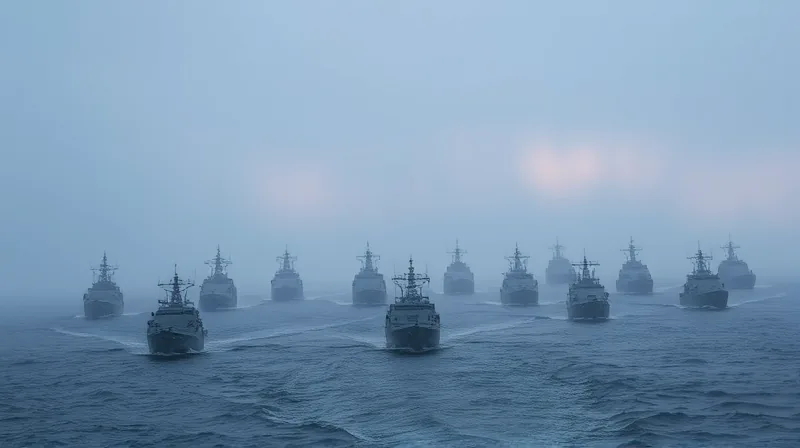
The Taiwan Strait is where fishing is a livelihood and a legal argument at the same time. On 18 October 2026, sixteen hulls arrived that Taipei says did not come to fish. Taiwan’s coast guard reported that it confronted and drove away sixteen Chinese coast guard, research and fishing vessels. The number matters less than the coordination. The vessels were not strung out on separate errands. They moved in what the coast guard called simultaneous operations around Taiwan’s main island and around Pratas, the island in the northern South China Sea that Taiwan controls and Beijing also claims.
The coast guard described the number of Chinese vessels involved as “unusually large”. [1] Four of the sixteen were fishing boats — civilian hulls, the kind that normally appear in these waters with nets and a licence. Those four took part in what the statement called “simultaneous operations at multiple locations”. [1] The locations were off Taiwan’s eastern, southern and south-western coastlines, and around Pratas. Three stretches of coast and one island group, in the same hours: that geography is the claim. Some of the vessels entered waters Taiwan designates as restricted.
Taipei reached for a specific vocabulary. The coast guard labelled the operations “maritime harassment” and, for the four fishing boats, “hybrid warfare”. [1] Taiwan’s coast guard said its own vessels took “forceful action immediately to effectively neutralise the threats”. It accused Beijing of “attempting to unilaterally alter the status quo” across the strait and of creating the “false impression of jurisdiction”.
What is certain after 18 October is narrow. Sixteen vessels of three types operated together at four locations, some of them inside waters Taipei claims to control. Taipei’s coast guard answered them and says it pushed them out. What is not in doubt is that the encounter happened, that fishing boats were part of it, and that Taipei read the combination as a message rather than an accident.
The Arithmetic of a Record Summer
Numbers do what adjectives cannot: they can be compared across months. In July 2026, Taiwanese official data recorded 244 Chinese coast guard, scientific research and other ships around Taiwan’s main island. In July 2025 the same count was 58. That is more than four times as many hulls in twelve months, and it is the most useful single figure in this dispute. A count that multiplies by four in twelve months is not weather.
Two hundred and forty-four in July. In the first 21 days of August alone, another 152, most of them Chinese Coast Guard ships, with research vessels and other government boats making up the rest.
The sequence has a starting point in the record: China began law enforcement patrols east of Taiwan in June, which Taipei called provocative.
The obvious objection to this arithmetic is that the counts measure presence, not intention. A cutter on routine patrol and a cutter making a point look identical on a spreadsheet. The second objection is technical: Chinese warships are counted separately. China’s military deploys warships around Taiwan on a near-daily basis, and none of those appear in the 244 or in the 152.
Competing Claims to the Same Water
The legal dispute is simpler than the maritime one, and harder to solve. Beijing claims Taiwan as part of its territory and asserts jurisdiction over the waters around the island. Taipei rejects both propositions. Beijing also claims Pratas, which Taiwan controls, along with most of the strategic waterway around it. China has long threatened to use force to regain control of Taiwan. Every vessel count above sits on top of that structure: two governments, one body of water, and no agreed line.
The immediate antecedent of the 18 October operation has a date. On 1 October 2026, Taiwan’s coast guard fired a water cannon at a Chinese recreational fishing vessel near Pratas. The incident drew an angry response from Beijing. Seventeen days later, sixteen vessels appeared at four locations at once. Sequence is not causation; what the record shows is the order of events.
Read the two episodes together and a pattern emerges. A water cannon is what a coast guard uses when it wants to enforce a line without firing at anyone. It is a claim of jurisdiction made in water rather than in words. Taipei’s complaint on 18 October was precisely that Beijing was doing the same thing in reverse — creating the “false impression of jurisdiction” by behaving as though the water were Chinese. Both sides are using enforcement to press a jurisdictional claim, because neither accepts the other’s authority to make law. That is why the fishing boats matter more than their tonnage: presence, repeated often enough, becomes an argument about who governs.
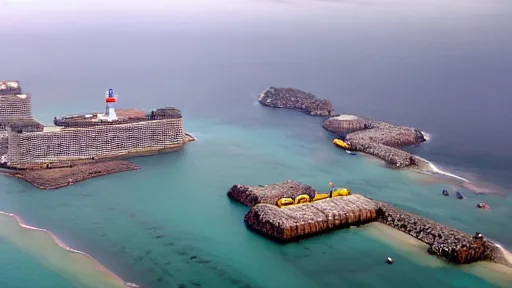
The sound that carries across the strait is not a warship’s horn but the thump of a water cannon discharging — the noise a coast guard makes when it wants to be heard and not to be lethal. That sound was recorded near Pratas on 1 October 2026. On 18 October the answer came back as sixteen hulls at four locations, some of them inside the lines Taipei draws, and a coast guard statement that reached for the words hybrid warfare. The water off Taiwan has become a place where the ordinary tools of law enforcement now carry the weight of a border being argued, hull by hull.