The Cost of Outlasting a Regulator
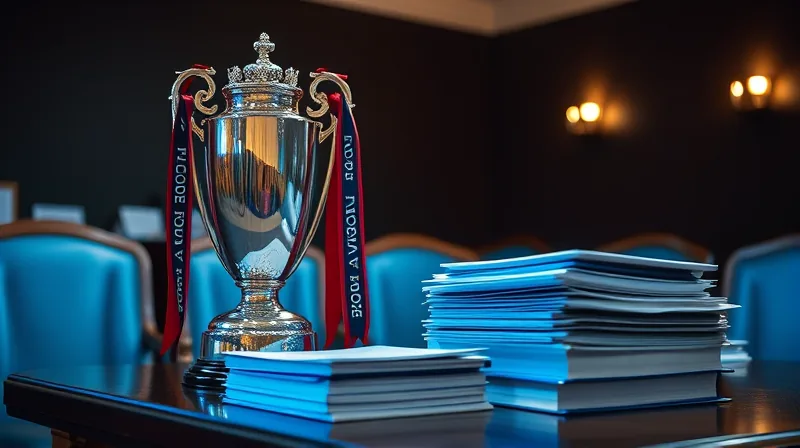
At the bottom sits a cache of emails and documents published in 2018, at a time when European football’s governing body was already pursuing Manchester City over alleged financial irregularities. That tranche led to the crisis in which the club is now embroiled. In the middle sits a list of more than 100 charges of financial irregularity, brought by the Premier League and announced in 2023. On top sits one figure — around 900 million pounds — attached to payments the league has labelled “sham”. In late September 2026, one of the most successful clubs in English football was found guilty of more than 100 charges of financial irregularity, including “sham” payments totalling around 900 million pounds.
A single charge is an allegation that one rule was broken, in one way, at one time. More than 100 of them amount to a claim about a system rather than an incident: a decade of contracts, transactions and arrangements examined one by one. The word “sham” carries the weight of the finding, because it asserts that the form of a payment and its substance diverged, and that the divergence was deliberate. Findings of that kind are rarely demonstrable from a single document; they are assembled from patterns. That is one reason such cases consume years rather than weeks.
Two rulebooks sit behind the story, and they belong to two different bodies. One is European: Uefa, which was pursuing the club over alleged financial irregularities when the emails were published. The other is domestic, which is where the more than 100 charges and the September 2026 finding sit. Separating the two matters, because they are separate regimes, with separate enforcers, separate sanctions and separate appeal routes. Both were written by associations rather than by parliaments. Across both, the club’s response has followed a single line: contest the regulator rather than the rulebook.
The club denies wrongdoing, and the case is not closed. Appeals upon appeals are expected, and the road may end in the high court many years from now. In the statement it released in response to the verdict, the club obliquely questioned the Premier League’s ability “to behave as an independent, impartial and fair-minded regulator, free from partisan influence”. [1] It does not dispute a valuation, a balance or a date. It disputes the standing of the body that produced them. The wording matters, because a regulator’s authority rests on the perception that it has no interests of its own at stake. That is a posture rather than a slip, and it has a lineage.
The lineage runs back to the leaked material of 2018, where the tone was as startling as the content. It was said that the club’s chairman, Khaldoon al-Mubarak — a trusted adviser to the royal family of the United Arab Emirates — would “rather spend 30 million on the 50 best lawyers in the world to sue Uefa for the next 10 years” than accept a fine. [1] If the sentiment is genuine, it describes a strategy of duration, in which the years themselves are treated as a resource. In the same tranche of documents, the club’s lawyer, Simon Cliff, asserts that “Uefa doesn’t respond to anything other than aggression”. [1] Aggression is presented there as the only channel that produces an answer.
All of which feels like a rather extreme way of ensuring that the club had the right to sign Jack Rodwell from Everton. In this affair the grave and the trivial keep swapping places, and the universal keeps arriving dressed as the parochial. From a safe distance, a dispute over accounting entries looks like sporting arcana that even devoted fans struggle to parse.
Up close, the process is plainer than the vocabulary. A regulator writes rules. A club with unusual resources treats those rules as an obstacle rather than a constraint. The argument stops being about entries and becomes a question of who is entitled to regulate whom. Financial fair play, in outline, ties what a club may spend to what it earns, on the theory that owners should not be able to buy success with unlimited cash. Charging a payment as a “sham” is not an allegation that money never moved; it is an allegation that the transaction was dressed for appearance rather than substance. The club’s own reading is that the rules were built to shield incumbents, and that reading is contested. The regulator’s structural problem is that it must stay credible to members who also vote on the rules it applies. The sharper charge is narrower: that the club’s approach consists, in part, of discrediting the very idea that anyone is fit to regulate it. Whether that strategy works is not only a football question. It is also a question about how long a regulator can afford to keep pursuing a case.
When a Tribunal Sits Beside a Sovereign Portfolio
Ownership is not a detail in this file; it is the backdrop. This is not merely a football club but a beloved cultural asset that happens to be majority-owned by the billionaire Sheikh Mansour bin Zayed al-Nahyan, deputy prime minister of the United Arab Emirates and brother of that country’s president. A majority owner with a seat in a government gives a sporting charge a second audience, and a second set of instruments. Ownership of that kind is also why a domestic rulebook can turn into a subject of foreign policy. Since the Premier League announced the charges in 2023, the case has been discussed not merely at boardroom level but at a diplomatic level.
The numbers arrived in public. In August 2026, Bloomberg reported that Emirati officials had warned that an adverse verdict against the club could threaten billions in Emirati investment in the United Kingdom. Bilateral trade between the two countries nudged above 25 billion pounds in 2025. Place the two figures side by side: a trade relationship worth more than 25 billion pounds a year, and an investment pipeline that officials chose to describe in public, weeks before a ruling. Trade of that size is not leverage by itself. The Bloomberg report does not establish that it was used as leverage. It establishes that a warning was delivered, and it leaves open what was asked for in return. The figures have limits that should be stated plainly: the investment number was not itemised into sectors, companies or timelines, and the trade number measures goods and services moving in both directions across a year, not a promise whose value depends on a verdict. What connects the two is political salience, not an accounting identity.

A tribunal is not a court. It applies the rules of a private association rather than the law of a state, and its jurisdiction comes from membership rather than from sovereignty. That is exactly why the case has an outside audience: a private body is attempting to hold an entity with sovereign resources to a rulebook the entity signed up to. And a state is precisely the kind of party a private rulebook cannot reach on its own.
Begin with the strangeness of the arrangement. A country’s foreign relations are effectively being negotiated inside a football tribunal. On the argument’s own logic, the United Kingdom’s clean-energy transition somehow hangs on whether a panel decides that Roberto Mancini’s coaching contract was fair or not. That is one reason it was a bad idea for the Premier League to allow entire states to invest in football clubs. Once states own clubs, sporting merit and integrity become entangled with diplomacy and hard power, and footballing warfare starts to resemble the real thing.
There is an honest way to describe the pressure and a dishonest one. The dishonest version treats a warning reported in the press as a completed transaction between a government and a regulator. The honest version records a sequence — charges in 2023, an investment warning in August 2026, a verdict in late September 2026 — and says plainly that the causal link is unproven. Naming that gap is not the same as dismissing the warning. Independence, as a procedural idea, is narrow: the size of an investor’s portfolio is not a fact a tribunal weighs. Whether that idea survives contact with a state is now a live question, and not only in Manchester. What a sovereign owner wants from a football club is not documented in this file; what the file shows is an asset treated as something to be defended.
The Rulebook Against the Rulers
The club’s legal posture reaches beyond the current file. In 2024, in a separate case against the Premier League, it tried to discredit the league’s basic governance model, arguing that the two-thirds majority required for motions to pass represented “the tyranny of the majority”. A supermajority rule is a minority protection: it says that some decisions need more than half the room. Calling that arrangement tyrannical is an argument about majority rule itself, advanced by one member against the body it plays in. It is also, read coldly, a claim that the rules of a club competition should not be changeable by the clubs.
On the other side sits a genuine grievance, and it deserves to be stated in full. Football’s financial regulations were largely nonexistent in the decade after the Premier League’s foundation in 1992. The club’s position is that the rules arrived later, and that they were designed to protect elite wealth while extinguishing new-money challengers such as City and the Chelsea of Roman Abramovich. That is a claim about who wrote the rules, and for whom. It is not obviously false. Both readings can hold at once: a rulebook can have been written to protect incumbents and still bind them. But follow the thread to its logical conclusion and you arrive at a world in which there are no legitimate checks on power. A world in which you can do what you want, however you want, for as long as you want, for whatever purpose you want. A world in which the only meaningful rules are power and leverage, and in which destroying an opponent is preferable to accepting even the slightest curb on your volition.
None of this is unique to one club or one emirate. Newcastle United is run from Saudi Arabia. Opaque private-equity funds now run most of the rivals at the top of the English game; a private-equity fund is a pooled vehicle that buys stakes, often with borrowed money, and discloses little about who ultimately stands behind it. Jeff Bezos is part of a consortium that now owns almost 40% of Liverpool FC. The characterization offered is of an entire class of men who recognise no authority beyond their own, for whom politics and business and sport and culture are essentially the same basic substance — a game to be brought to heel by any means necessary. The parallel is extended further: in place of Abu Dhabi and Saudi Arabia, one might read Jeff Bezos, Meta, Elon Musk, Benjamin Netanyahu or Donald Trump.
The state at the centre of this particular file carries a record that outlasts the football argument. United Nations reports describe the United Arab Emirates as defying arms embargoes in Sudan and in Libya; an arms embargo is a ban on supplying weapons into a conflict, and its breach is a matter for the Security Council rather than for a tribunal in England. Human Rights Watch holds the same state responsible for widespread acts of political repression and rights abuses. Those findings concern a member state of the United Nations, not a member club of a league. None of that appears in the verdict. It is the background against which the question of who may regulate whom is argued, and the reason the juxtaposition is jurisdictional rather than moral: a body that writes rules for clubs has no writ over a state’s conduct, which is exactly what sits outside its reach.
The broader significance of the verdict sits past the long argument over relegation, stripped titles and trophies. The world it lands in is one where the United Nations is neutered and transnational alliances have scarcely been weaker. Against that background, the verdict articulates an increasingly outmoded idea: that there is a shared set of values and rules by which all must abide. It offers an alternative vision to a world increasingly aligned along axes of brute power and wealth. That vision is procedural rather than moral — a panel applies written rules to a member, and the member’s resources buy lawyers rather than exemption — and it is a modest proposition on which a great deal rests. In a system of weak transnational authority, such a tribunal is one of the few rooms where the question can be asked at all. The case is not over. Appeals and counter-appeals are expected; diplomatic representations will be made; deals will be brokered; realpolitik will be waged. In geopolitics, as in football, results are what count. In the columnist’s view, it is in the interests not just of the club’s rivals and not just of football itself, but of everyone with an interest in the rule of law that they do not succeed.
Zoom out, and the ordinary business of a season — a title, a transfer, a place in Europe — shrinks at that distance to footnotes. What stays legible is a single question, and it is not about football at all: whether rules can bind the people who can afford to outlast them.
Sources
Mentioned organisations (context, not sources)
- Manchester City — Organisation (homepage)
- Everton — Organisation (homepage)
- Chelsea — Organisation (homepage)
- Newcastle United — Organisation (homepage)
- Liverpool FC — Organisation (homepage)
- Meta — Organisation (homepage)
- United Nations — Organisation (homepage)
- Security Council — Organisation (homepage)
- Human Rights Watch — Organisation (homepage)