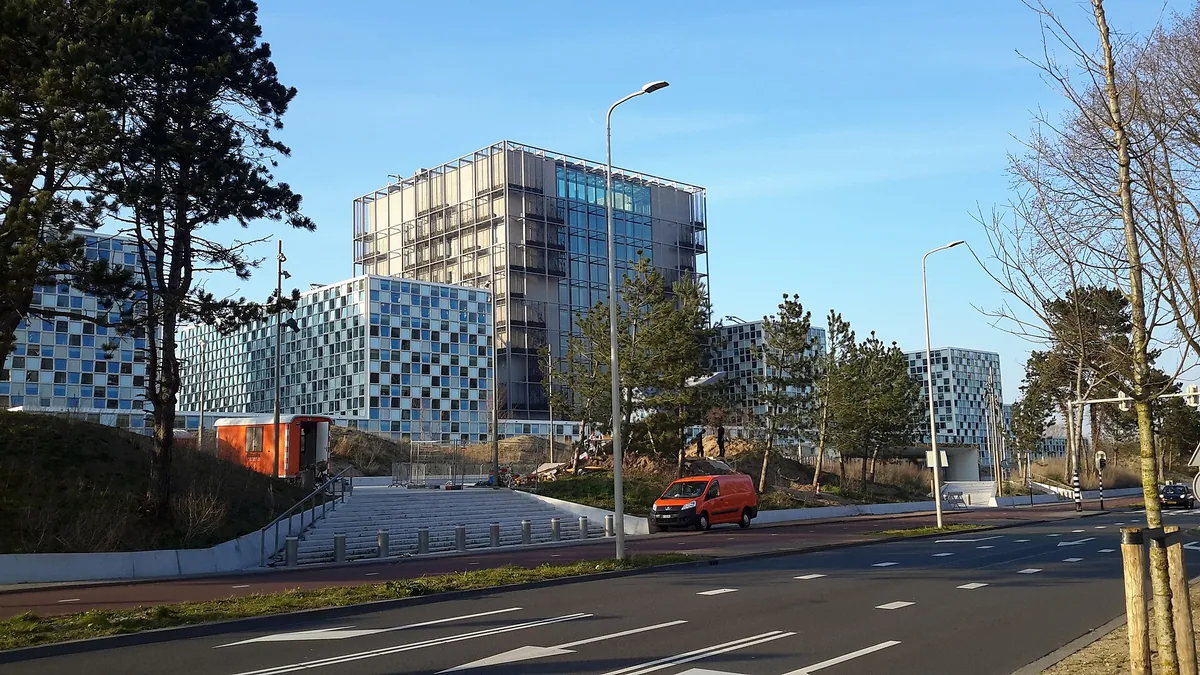
The International Criminal Court Sanctioned Brick by Brick
The Friday a Nobel Preceded the Sanctions
Navi Pillay, a former judge of the International Criminal Court, was awarded the Nobel Peace Prize on Friday, 10 October 2026. Hours later, Washington announced sweeping sanctions — penalties such as asset freezes and travel bans imposed by one government on foreign people or entities — against the court itself. The court had been punished before, but never as a whole — earlier rounds hit individual prosecutors and individual judges. This time the target was the institution, and the stated aim was to cripple its operations. Secretary of State Marco Rubio put the position in one sentence, using supranational to mean above national governments, with authority that can bind states, and mandate to mean official authority: “The Trump Administration has been clear: the International Criminal Court is a corrupt and fatally politicized supranational court that has maliciously abused its authority and exceeded its mandate.” [1] He added, using sovereignty to mean a state’s authority to govern itself without outside interference: “We will not tolerate its assault on state sovereignty.” [1].” The court’s immediate answer was that the measures were an assault on the rule of law — the principle that all people and institutions are subject to the law. [1]. The timing put a peace prize and a sanctions package into the same news cycle.
The State Department published the first names of this round on a Tuesday. [2]. They are Tomoko Akane, the court’s president and a Japanese national, and Abdoulaye Seye, a senior trial lawyer from Senegal. The sanctions — penalties such as asset freezes and travel bans — freeze any property, money, or investments they hold in places under US legal authority or that come into contact with the network of banks and institutions that move money in the United States. [2]. The administration’s objection is that the court pursues Americans and Israelis who never accepted the court’s legal authority to hear a case. [2]. It accuses the tribunal of trying to prosecute US and Israeli soldiers unfairly for alleged crimes in Afghanistan, Iraq and Gaza. [2]. Neither the United States nor Israel has joined the court.
The court was established in 2002 under the Rome Statute — the 1998 treaty that established the International Criminal Court — and now counts 125 members. [3]. It prosecutes individuals, not states, for war crimes, crimes against humanity and genocide — categories of international crimes prosecuted by the ICC. Around 900 staff from 100 nationalities work in its glass building on the outskirts of the city. [3]. Its governing rule is “complementarity”: a case becomes the court’s business only when a suspect’s home country is unwilling or unable to try it. [3]. The treaty itself was negotiated at a conference in Rome in 1998. Among the participants was the international human rights lawyer Reed Brody, a member of the International Commission of Jurists, who has helped prosecute high-profile defendants.
The court has issued arrest warrants — formal orders for police to arrest someone — against more than 70 people, among them Israel’s Benjamin Netanyahu and Russia’s Vladimir Putin. [1]. It has convicted 15 people and acquitted four. [3]. Its most prominent live case concerns Rodrigo Duterte, the former president of the Philippines and the first former Asian head of state to stand in its dock. [3]. The warrants against Israeli officials drew the sharpest American reaction of all. The United States, Russia, China and India have never joined the court. [3].
The Prosecutor Who Cannot Book a Hotel
His office decides which investigations the court pursues.
The dependency the court worries about most is technological. “We have been extremely dependent on US technology solutions, Microsoft or systems related to Microsoft,” acting chief prosecutor Mame Mandiaye Niang told AFP in a recent interview. [3]. Around that dependency sit the other pressure points: banking, the ability to process card payments, insurance. Each is, to some degree, routed through or cleared in the United States. “We are trying to find alternative means, maybe not as effective as the US technology, but at least to be able to maintain our independence, to be able to continue to work,” said Niang. [3].
Extending the sanctions — penalties such as asset freezes and travel bans — from named officials to the whole institution raises questions the court has to answer one by one. [3]. Can it still pay its staff? Can it conduct investigations abroad? Can it protect witnesses? Can it operate its detention facilities — places where people are held in custody?
This is a test of our resilience,” admitted Niang. [3].”
The Hague, Brussels and a Federal Court
Under a Headquarters Agreement — a treaty between an international organization and its host country setting out privileges and protections — signed in 2008, the host state must protect the court’s facilities and staff. [3]. It must provide “any means of communication”. It must ensure “freedom of financial assets from restrictions”.
Responding to the announcement from Washington, Dutch Prime Minister Rob Jetten said the Dutch would do “whatever we need” to ensure the ICC could continue to function. [3]. The instrument Europe can deploy is a blocking mechanism. [3]. It prohibits European firms from obeying the US sanctions “actively or by deliberate omission”. [3]. Dutch Foreign Minister Tom Berendsen called it the “nuclear option”, and the Netherlands has asked Brussels to prepare it. [3]. A blocking mechanism does not lift the sanctions. It compels European companies to choose which legal order they will obey. Preparing it is a decision for Brussels, not for The Hague.
The resistance is not only European. Two American nonprofits have sued the administration over the sanctions: Democracy for the Arab World Now, known as DAWN, and the Taxpayers Alliance Against Genocide. [4]. DAWN’s executive director is Omar Shakir. The suit was filed in Manhattan federal court. [4]. It seeks to bar the administration from using an executive order to prevent US citizens from supporting investigations into US and Israeli abuses. The organizations say the measures “muzzle Palestine advocacy”. [4]. They argue the sanctions “unconstitutionally restrict Americans from seeking justice on Palestine at the ICC”. The executive order at the centre of the case was issued in February 2025. [4].
That order authorizes punitive measures against ICC staffers — sanctions and bans on entering the United States — over what the administration called “illegitimate and baseless actions targeting America and our close ally Israel”. [4]. Several challenges to the ICC sanctions have been filed; this is the first aimed at stopping the sanctions law from barring Americans from supporting the court’s investigations or from working with the UN human rights envoy Francesca Albanese and the sanctioned Palestinian NGOs. In September 2025, the State Department sanctioned three Palestinian human rights groups — al-Haq, the al-Mezan Center for Human Rights and the Palestinian Center for Human Rights — that had asked the court to investigate and arrest Israeli leaders. [4]. Sanctions had already been placed on Albanese, on the court’s chief prosecutor Karim Khan and on four other judges. [4]. In an earlier round, the court was targeted over its efforts to investigate alleged war crimes by US forces in Afghanistan. [4]. Rubio has promised to use “all the tools at our government’s disposal” to “dismantle the ICC, brick by brick, if necessary”. [4] The court’s warning is the sentence that remains: “When judicial actors are threatened for applying the law, it is the international legal order itself that is placed at risk.” [2]
Sources
Mentioned organisations (context, not sources)
- International Criminal Court — Organisation (homepage)
- U.S. Department of State — Organisation (homepage)
- International Commission of Jurists — Organisation (homepage)
- Microsoft — Organisation (homepage)
- Democracy for the Arab World Now — Organisation (homepage)
- Taxpayers Alliance Against Genocide — Organisation (homepage)
- United Nations — Organisation (homepage)
- al-Haq — Organisation (homepage)
- al-Mezan Center for Human Rights — Organisation (homepage)
- Palestinian Center for Human Rights — Organisation (homepage)