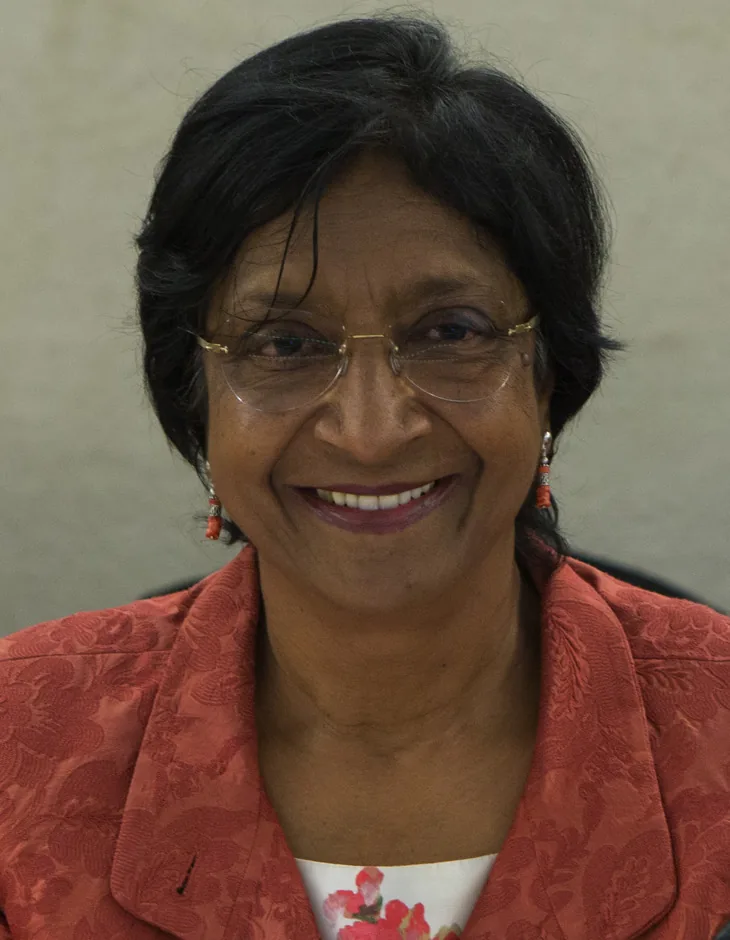
Navi Pillay Nobel Peace Prize Honors International Justice Career
Robben Island, Then The World Court
On October 9, 2026, a committee in Oslo answered a question it has been answering for more than a century: what does the law do when the institutions that enforce it are themselves under attack?. The Norwegian Nobel Committee awarded the 2026 Nobel Peace Prize to Navanethem “Navi” Pillay, an 85-year-old South African judge, making her the fifth South African to win it. [2] The committee praised her decades-long efforts to prosecute genocide and war crimes, which it described as marked by “judicial rigour, personal integrity and considerable courage. It called her one of “the great defenders of international legal principles in our time”, a person who helped hold states and national leaders to account and brought “hope to victims of violence and conflict”. Committee chair Jorgen Watne Frydnes framed the decision around a career rather than a single act: “Navi Pillay’s commitment to universal legal principles and her firm moral compass are constants in a long career He placed the beginning and the end of that career in the same sentence: “A common thread runs from her early work defending Nelson Mandela and others who stood up against apartheid to her service as a judge in some of the key international court cases of our time.” A citation is an argument about what law is for, and this year’s citation argues that the courtroom is the instrument.
The biography reads as a list of firsts, and every one of those firsts was a door someone had previously shut. Pillay was born in 1940 in the racially segregated city of Durban, in South Africa’s Natal province, to parents of Tamil descent. She earned a law degree from the University of Natal. She then became the first woman in Natal province to start her own law firm. Early in her career she helped defend numerous anti-apartheid activists. She later became the first woman of colour to sit on the High Court of South Africa. From that bench she moved to preside over the International Criminal Tribunal for Rwanda, the court convened to prosecute those charged with humanitarian crimes during the 1994 Rwandan genocide. Between 2008 and 2014 she served as United Nations High Commissioner for Human Rights. More recently she chaired the UN Independent International Commission of Inquiry on the Occupied Palestinian Territory. She currently sits as a judge at the International Court of Justice, the United Nations’ top court.
One case from 1973 shows the mechanism in miniature, long before any of those institutions existed. That year, Pillay took on a matter that helped secure basic rights, including legal access, for political prisoners on Robben Island, where Nelson Mandela was jailed. Access sounds procedural. While she was a student, she took part in boycotts and marches against apartheid. She has traced the origin of her later work to lived experience rather than doctrine, describing her early human rights practice as “shaped by what (she) had experienced under apartheid”. That sentence contains the whole strategy: when a domestic legal system is built to produce a particular outcome, the only available forum is the one above it — and using that forum first requires learning its language.
The Word That Keeps Returning
The Rwandan tribunal is where Pillay’s name became attached to two legal doctrines that now travel without her. The Nobel committee stressed her role there, saying that her influence helped establish “that rape and sexual violence could constitute a crime against humanity” — as well as genocide. Classification is not decoration in international law; it determines which court has jurisdiction, which elements a prosecutor must prove, and how long the sentence can run. The committee’s wording is precise about what changed: not the conduct, but the category into which the conduct could be placed. The second breakthrough came in the same case, and the committee named it as a first: “for the first time, a defendant faced charges of incitement to commit genocide purely on the basis of spreading propaganda”. That ruling moved the legal frontier upstream. Before it, the crime was understood to lie in the killing; afterward, it could also lie in the words that prepared the killing, spoken by someone who never held a weapon.
Pillay’s most recent institutional finding concerns Gaza, and it is the reason her name is now spoken in the same breath as the prize. In 2025, the UN Independent International Commission of Inquiry on the Occupied Palestinian Territory, which she chaired, concluded that Israel is responsible for carrying out genocide in Gaza. [1] The determination came not from a court with binding authority over a defendant but from a United Nations investigative body, a distinction that shapes what can follow from it. In a statement on the report, Pillay urged UN member states to do everything they can to establish a ceasefire in Gaza and to “ensure justice and accountability for all victims”. [1] The phrase “all victims” is doing deliberate work: the commission’s mandate covered the territory, not one side of a conflict. What such a finding can achieve in practice depends less on its legal reasoning than on whether member states act on it, and Pillay’s statement was addressed to those states rather than to a courtroom. Documentation is not enforcement. It is the raw material enforcement would need if it ever arrives.
Then the word turned up somewhere else entirely, doing a different job. The administration of United States President Donald Trump has clashed with South Africa over debunked claims that white Afrikaners are facing “genocide”. That is the same term, the same country Pillay comes from, and an evidentiary standard thousands of miles from the one her commissions applied. The contest over the word is not academic. Genocide is the most serious charge in international law, and the threshold for proving it — including the intent behind the acts — is correspondingly high. A claim that does not clear it still works as a political instrument, which is why fact-checking it does not end the argument it was used to start. Two processes are running in parallel here: one that gathers evidence and asks whether it meets a legal test, and one that selects a word first and looks for material afterwards.

When The Courts Themselves Are On Trial
The committee chose a moment as deliberately as it chose a person. It said that honouring Pillay is especially important at a time when international law “is under tremendous pressure and its institutions are under attack”. The UN’s rights chief, Volker Turk, called the prize “a recognition, a reaffirmation that human rights, the rule of law and justice and accountability are fundamental to everything, to peace, to security and prosperity”. The president of the International Criminal Court, Tomoko Akane, said the award carried special significance “at a time of profound challenges to the international legal order and the rule of law”. South Africa’s president, Cyril Ramaphosa, praised it as a tribute to Pillay’s “courage, integrity and lifelong commitment to justice”. Haakon Gjerlow, director of the Peace Research Institute Oslo, said it “sends a clear message that peace depends not only on political leadership, but on strong, credible international institutions and the courageous people who dedicate their lives to defending them”. Ashok Swain, a professor of peace and conflict research at Uppsala University, called the selection a “pleasant surprise” and the “best possible choice”.
The award also landed inside an American political argument. Swain said the committee likely took into consideration Pillay’s lifelong record fighting genocide and apartheid, and added that the prize could also be read as a message to Trump, who has long argued that he is deserving of it. The president has cited his claim to have ended multiple conflicts and “pre-wars” since returning to the White House, and on Wednesday, speaking in the Oval Office, he complained that the Nobel Committee has a “reputation for maybe not giving it to people like me”. He continued: “But whether I get it or not, I have done far more. And I think it would be a great discredit to them. And I’m not saying that out of scorn.” He also said: “I settled eight wars, and I’ve stopped maybe the total obliteration of the world because Iran will never have a nuclear weapon.” And he returned to a comparison he has made before: “Obama got it, and he didn’t do anything.” The winner was announced over an 80-year-old president whose administration is currently involved in a war with Iran, according to the Daily Beast.
The institutional pressure the committee described has a paper trail. The ICC had previously issued arrest warrants for Israeli Prime Minister Benjamin Netanyahu and former Defence Minister Yoav Gallant for alleged war crimes and crimes against humanity. The ICC described the US sanctions as a “flagrant attack against the independence of an impartial judicial institution” and against the victims of war crimes around the world, and stated that it would continue its work “without regard to any restriction, pressure or threat”. Each move is a response to the previous one. None of them is the last move.
There is a precedent for what a medal can be asked to do, and it was tested last year. The 2025 winner, Venezuelan democracy campaigner María Corina Machado, handed her Nobel medal to Trump during a visit to the Oval Office in January, saying that he “deserved” it. The gesture followed the US abduction of Venezuelan President Nicolás Maduro, who was brought to New York to face “narcoterrorism” charges. The Nobel Institute rejected the move, confirming that the prize cannot be “revoked, shared or transferred” after it has been awarded. This is a small piece of institutional housekeeping with large implications for how the prize functions as a political signal. If a medal could be passed to a third party, the prize would become a tradable asset and its citation would become negotiable. Because it cannot, the only thing a laureate can hand over is the appearance of endorsement — and the value of that appearance depends entirely on who is doing the reading.
Pillay’s own first response to the news was not a statement but a question. She appeared to learn of the award as media reports circulated, and told a group of applauding supporters: “Is it true? I thought it must be a joke.” The line that travelled fastest came right after it: “If you clap a little bit more, I may share this prize with Trump She was at the Nuremberg court in Germany — the site used for the post-World War II trials of Nazi leaders and killers — when she was told, in a moment captured on video by the French human rights activist and Amnesty International chief Agnès Callamard. Once the news was confirmed, she said she would dedicate the award to “all of the survivors of international crimes”. She added: “This award strengthens my conviction that we must stand together in defence of the rule of law, in defence of independent courts and an international legal order based on principle.” Her docket is not closed. She sits at the International Court of Justice in a case in which Myanmar is accused of genocide against its mostly Muslim Rohingya minority — proceedings the UN’s top court opened in January 2026. A verdict in that case would answer a legal question. It would not answer the one Pillay asked on the day she won?
Sources
Mentioned organisations (context, not sources)
- Norwegian Nobel Committee — Organisation (homepage)
- University of Natal — Organisation (homepage)
- High Court of South Africa — Organisation (homepage)
- International Criminal Tribunal for Rwanda — Organisation (homepage)
- United Nations High Commissioner for Human Rights — Organisation (homepage)
- International Court of Justice — Organisation (homepage)
- United Nations — Organisation (homepage)
- International Criminal Court — Organisation (homepage)
- Peace Research Institute Oslo — Organisation (homepage)