Cartoon Two Bills and Gas Reservation Divide Coalition
The Cartoon That Stayed Up for a Month
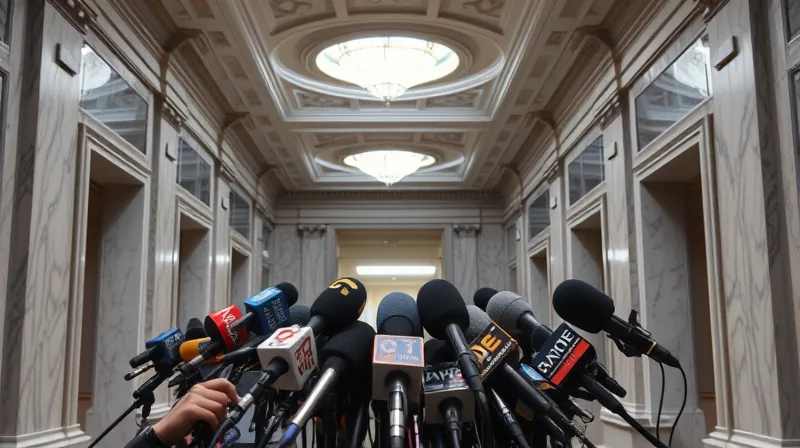
The microphones are set up in the same corridor at the same hour, and someone always has to explain what was said the day before. Taylor spoke to journalists in the corridor. Those sentences then travel — into clips, into bulletins, into the next day’s questions — and by evening they have hardened into a position. On this sitting day the position belonged to Angus Taylor, and it concerned a cartoon. Taylor said Pauline Hanson should immediately take down a cartoon video posted by One Nation that labelled Andrew Hastie a traitor for giving evidence against Ben Roberts-Smith in his failed defamation trial. Hanson has said she did not call Hastie a traitor, but the video has remained on her social media account for more than a month. [1] Taylor did not argue the point on her terms; he argued it on Hastie’s service. Hastie served the country with distinction as an officer in the SAS, Taylor said, and for that reason the post should come down.
The obvious question for an opposition that has spent the week talking about free speech is consistency, and Taylor was asked it. His answer separated two things that are often run together: what is legal and what is right. He said he was not suggesting that it should be illegal for the cartoon video to be put up in the first place. He said the post should nevertheless be deleted. “In the end, this is not a question of legality, this is a question of morality,” he said. Taylor drew a distinction between what is legal and what is right. Taylor also claimed a right that belongs to anyone in public life — the right to say that he thinks something is wrong. The test of his position will not be in the sentence but in what the Coalition does when it writes law about speech, which it is doing this same week.
From there the questioning turned to a smaller number with a longer tail: an honorary membership. Taylor said the prime minister should have publicly disclosed his honorary membership of the Marrickville golf club, which received $6m in funding as part of an invite-only grants program. [2] Anthony Albanese says he only recently became aware of the membership, and that someone had “apparently” given it to him back in 2012. [4] At the time of the exchange, the prime minister had not updated his register of interests to include it. For scale: a full yearly membership of the club costs $1,100, while a two-year social membership costs $5. [2] A register of interests is not a moral test; it is a disclosure rule, and its whole value lies in the fact that it is checked before anyone asks. Taylor’s argument was procedural rather than dramatic: “He should register his interests. He should have registered his interests.” Whether the membership was worth anything to him is beside the point of the rule; what the rule protects is the public’s ability to judge that for itself.
A Duty of
Care and a Virtual Iron Dome
The Senate was voting on one of two pieces of legislation that, taken together, would change how speech is regulated online in Australia. The first is the digital duty of care bill, which would impose obligations on tech platforms towards the people who use them. The second increases the powers of the eSafety commissioner, including the power to request documents from tech platforms to check whether they are complying with the under-16s social media ban. The Coalition is voting against the second bill. That is worth stating precisely, because the two bills are not one thing. The duty of care sets the standard a platform owes its users. The commissioner’s powers determine who can inspect whether that standard is being met. A government can pass the first without the second, and the Coalition’s objection is aimed squarely at the machinery of enforcement.
The Coalition’s stated objection is about who holds the power and how far it reaches. It says both bills give the minister, the government and the eSafety commissioner too much of it. “What we don’t support is giving strong, unfettered powers, frankly, to either the minister or the government or the eSafety commissioner,” is how the position was put. Freedom of speech, the Coalition argues, is the thing at stake. Its senators say they accept the goal — protecting children, protecting Australians against undue harm — but not the method, which they describe as political censorship. Sarah Henderson, the shadow communications minister, pointed to section 25(c) of the explanatory draft, calling the discretion granted to the minister there extraordinary and unacceptable. Asked whether the bill could be amended to make those ministerial powers more palatable, she gave a short answer: not really. She said she had no confidence in the prime minister to remove what she called the really offensive parts of the bill, and that the provision was open-ended and without safeguards.
Taylor’s own formulation is that the exposure draft is unacceptable in its current form. His reason: it provides, in his words, a blank cheque for political censorship to the minister and to the government. Matt Canavan, a Nationals senator, who has gone particularly hard against the legislation, put it in a more domestic image. He said he did not want to see a government given a virtual iron dome to protect itself and insulate itself from people’s feedback. Canavan’s second argument is about motive rather than text. He noted that the Labor party in recent weeks has blamed an election loss in Western Australia on social media, and reasoned that a party complaining about losing political debates on social media should not then be given the power to regulate what people can say and read online. That is an argument about incentive, and it can be tested: the party that loses a debate wants the rules changed, and the party that wins a debate usually does not. The government’s counter is that any changes to the definitions of harm would still be able to be rejected by the Senate — a safeguard that only works if the Senate is willing to use it.
The arithmetic of the chamber matters here, because the Coalition’s votes alone do not decide the outcome. The Greens support strengthened powers for the eSafety commissioner in the under-16s social media ban. [5] That support is the difference between a bill that can pass the Senate and a bill that cannot. It also means the same provision is being described in two directions at once: the Coalition describes increased powers as censorship, and the Greens describe them as the tools a ban needs in order to exist. A ban without an inspector is a statement of intent; an inspector without limits is a different kind of risk. The Senate is where that trade is made, and it was being made while the doorstop outside was still running.
Reserving Gas, Refusing to Ration People
Money is where a government’s intentions become measurable, and this week the measurement was gas. The revised plan would reserve up to 20 % of locally-produced gas for Australian use. [4] Chris Bowen says it is not a backdown, but a few key elements have changed. The reservation now starts in July 2028 instead of July 2027, which the government says aligns with companies’ cargo planning. The resources minister will have discretion to cut companies’ supply obligations all the way to zero if they wish. Bowen said some people told the government in feedback to make sure it does not oversupply the market so much that it becomes counterproductive, which is where that discretion comes from. The government says the reserve should push prices down, but Bowen said it is not setting any target or ceiling on prices. The west coast market has been split out from the east coast market: Madeleine King, the resources minister, said the government was not looking to mess up Western Australia’s reservation, and would release the state from federal obligations if it was already well supplied. The shift from July 2027 to July 2028 is a year of delay, and it is a year that the companies shipping the gas will now be able to plan around. In plain terms, a reservation is not a price control — it is a rule about who gets first call on a fixed quantity of gas. The number that names the policy is 20 %, but the numbers that decide how hard it bites are the start date and the discretion.
The same question — how far a government should intervene, and in whose name — ran through the argument about migration. The South Australian premier, Peter Malinauskas, warned his federal counterparts in a speech in Sydney against engaging in a race to the bottom with One Nation by drastically cutting migration. He said populism has well and truly arrived in Australia, that the government should push back against it, and this morning that Labor should be speaking more positively about migration. Julian Hill, the assistant multicultural minister, said that would not happen. Speaking to RN Breakfast, he said Labor had already learned this lesson with the Greens: “You can’t outgreen the Greens. If we say 10, they’ll say 20. We say 20, they’ll say 40. It’s a populist business model.” [4] He said the government has no intention of engaging in a race to the bottom that would destroy the economy or smash family life for millions of Australians. The mechanism he describes is straightforward: a party that competes on the same ground as a populist party must always bid higher, and the bidding ends where the populists want it to end. Malinauskas’s warning and Hill’s answer are the same argument from two positions — one from a state that carries the settlement cost, one from a federal government that carries the political cost. The microphones are set up in the same corridor at the same hour, and someone always has to explain what was said the day before.
Sources
1. One Nation
3. Nationals