
The Objects on the Museum Table
The handover is over and the objects have changed hands. On October 13, 2026, in the Altar Hall of the National Archaeological Museum in Athens, Greece’s culture minister, Lina Mendoni, received 22 antiquities from Israel’s ambassador to Greece, Pninat Yanay. Amir Ganor, head of the Antiquities Theft Prevention Unit of the Israel Antiquities Authority, attended the ceremony. The pieces had been illegally removed from Greece, and their return was the first of its kind from Israel to Greece.
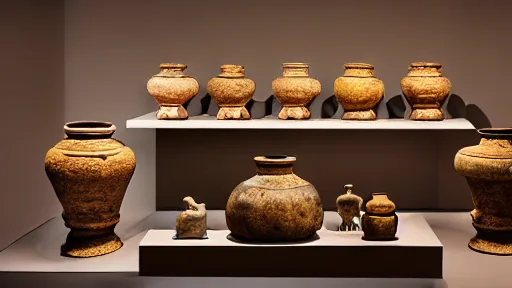
The collection divides into 21 vessels and one bronze statuette of a female figure. Fifteen of the vessels are Attic — made in the workshops of Attica, the territory around Athens. Eleven of those are black-figure, three are red-figure and one is black-glazed: terms that describe how the surface of a pot was painted and fired. Six further vessels came out of Corinthian workshops. The shapes are containers rather than monuments — drinking cups, perfume bottles, slender oil flasks and two-handled amphorae, one of them built to hold olive oil. Their painted surfaces carry mythological scenes and geometric motifs.
The Attic vases belong to the Archaic and Classical periods, while the six Corinthian vessels date from the Archaic period. The vases are up to 2,600 years old. The objects are provisionally dated to between about 700 BC and 320 BC, with most of the pottery made in the fifth and fourth centuries BC.
Mendoni put the significance in institutional terms: “It is the first time that Israel has returned antiquities to Greece, marking the starting point of closer cooperation between the two countries for the protection of cultural heritage.” [1] On the same day, the objects themselves said nothing. Their dates, their workshops and their shapes are the only testimony that arrived with them.
A Currency of Returns and Rearmament
The first counts objects, and it closed on October 13 with 22 entries. The second counts money, and its most recent entry was signed in August 2026.
In August, Israel signed a deal worth 3 billion euro, about $3.5 billion, to build a multi-layered air defence system in Greece. The system is called Achilles Shield. It is the largest defence deal between the two countries and one of the most significant export agreements in Israel’s recent history. Greece, under its current conservative government, and Israel have strengthened energy and defence ties in recent years, and the cultural handover landed inside that widening relationship.
On the cultural line the exchange is legible in both directions. Greece recovers objects it says were taken from its soil. Israel shows that its antiquities enforcement reaches across borders, through the same unit that identified and seized these pieces. Both sides also gain something operational: officials from the competent services of the two countries have already begun exchanging experience and best practices for preventing and tackling the illicit trafficking of cultural property. “Every return of a cultural object to its place of origin has a broader symbolic and moral dimension,” she said. She added that the repatriation “confirms that international cooperation can substantially contribute to the fight against antiquities smuggling.” In a further statement she called the handover “a tangible result of this approach” and confirmation that “cooperation between states can make a substantial and effective contribution to combating a major crime: antiquities smuggling.” She said it created “the conditions for further strengthening cooperation between Greece and Israel.” She gave the objects a human scale as well. “Let us try to imagine a child looking at one of these ancient vases today and feeling a spark of wonder,” she said. “The child sees something that another child may have seen and felt 2,000 years ago, thus becoming another link in the chain of generations that had been broken.” [1] She described her own part in the ceremony as a privilege: “placing this ancient object back into your worthy hands.” A handover measured in dozens of pots sits beside a procurement measured in billions of euros, and both are reported as parts of the same bilateral relationship. What the numbers suggest is where the weight of that relationship currently rests, not what was traded for what.
Provenance Is the Missing Witness
The objects came back, and the account of how they left is missing. Greek and Israeli officials did not provide details on how the artefacts were discovered in Israel, or on the circumstances of their illegal removal from Greece. A ministry statement said the pieces had been confiscated by Israeli antiquities authorities and gave no further detail on when, how and why they were seized. Yanay said the items were recovered during an “investigation by the Israeli authorities into the illegal antiquities trade.” [1] In previous cases, antiquities returned from private collections abroad have often been traced to illicit excavations.
One object in the group carries an open question of its own: the authenticity of the bronze statuette of a woman requires further investigation, the Culture Ministry said. Everything else in the consignment is pottery whose type and period the ministry states without reservation.
Greece’s wider campaign gives the October handover its context. In recent years Greek authorities have secured the return of hundreds of illegally excavated and exported ancient artefacts from the United States and other countries. They have pressed unsuccessfully for the repatriation of the Parthenon Sculptures, removed from the Acropolis more than 200 years ago and now displayed at the British Museum in London. Those sculptures are about 2,500 years old, which places their making inside the same broad span as some of the pottery returned from Israel.
Who is watching matters for exactly that reason. On the Israeli side the watching body is the Antiquities Theft Prevention Unit, which identified and seized the objects. On the Greek side it is the culture ministry, which is both the recipient of returned objects and the claimant in the Parthenon case.