Words Move Markets Fed Trade AI Guardrails
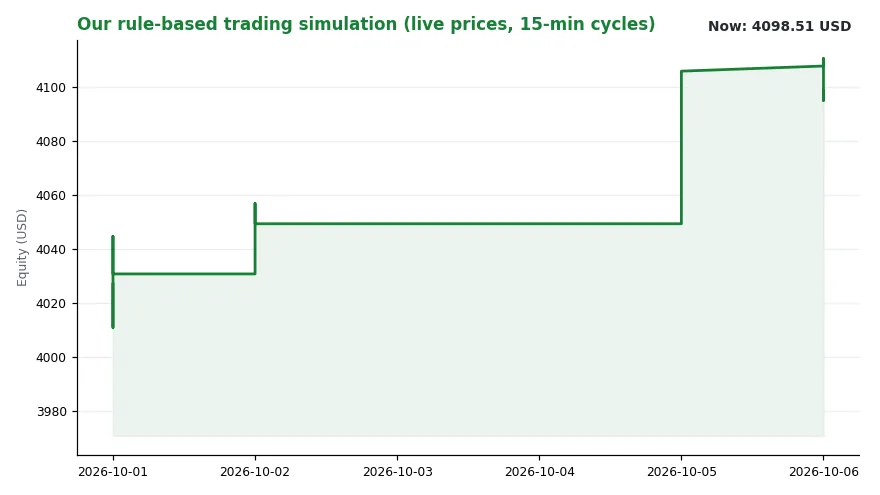
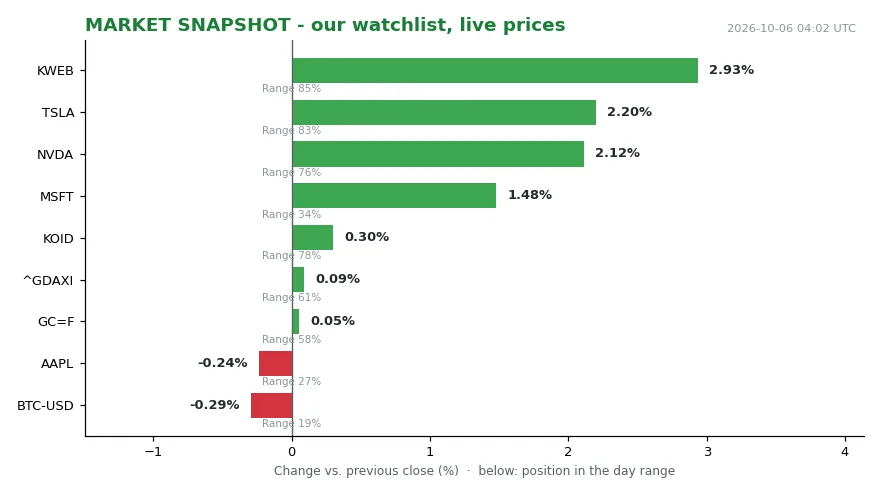
Our measurement window closed at 03:58 UTC on 2026-10-06. Quotes were fetched 0 minutes ago. NVDA trades at 238.90, up 2.12% and near day highs at 76% of its range. TSLA sits at 378.73, up 2.20% and near day highs at 83% of range. KWEB leads the watchlist at 24.56, up 2.93% and near day highs at 85% of range. BTC-USD is the outlier, at 85,499.38, down 0.29% and near day lows at 19% of range. Our simulated book stands at 4,098.51 USD, down 0.18% versus the same time yesterday, with 2,388.35 in cash. The busiest signal channel today is central banks, with one event, and the regime reading is trend falling, level 3.63.
Three numbers frame the story. A Wall Street Journal poll put support for Trump taking the lead on regulating AI at 7% [3]. US GDP — gross domestic product, the total value of everything a country produces — grew 2.2% in the second quarter of this year. The Federal Reserve lifted its short-term rate — the policy interest rate the central bank sets for overnight lending — to 3.75% to 4% to fight inflation [1]. The rhetoric is about control. The numbers are about constraint.
The clock provides the second frame. The Fed raised rates two days after Trump badgered it not to, and to cut sharply instead [1]. Two deadlines, one question. Does a sentence become an order?
What each discipline sees
The central banker sees a conflict. Trump asked for rates at 1% or half a percent [1]. The Fed moved the other way [1]. The reason is textbook. Extremely low rates heat an economy whose inflation is already considered too high [1]. The Fed’s instrument is cooling. The demand pointed at warming. Economist Justin Wolfers called the demand the dumbest thing ever said by a president [1].
The trade economist sees a bigger claim. Trump wrote: “I’ll stop trading with countries with which we have a deficit” [1]. He added: “If we stopped Trading with every country that we have a Deficit with, which is most of them, we would make, at least, 1.5 Trillion Dollars a year” [1]. The deficit partners — the countries the US buys more from than it sells to — named in the source include China, Mexico, Taiwan and the European Union [1].
The factory floor sees the consequence first. US manufacturers depend on imported computer chips, rare earths, auto parts and aluminum [1]. Cut those flows and plants stop. Farmers depend on imported fertilizer [1]. Homebuilders depend on imported lumber [1].
The wine drinker sees the accounting error. In the source’s hypothetical, the US buys $2bn of wine from France and France imports $1bn of Kentucky bourbon. The resulting $1bn trade deficit — the gap when a country buys more from a partner than it sells to it — is not $1bn handed away [1]. Americans are getting $1bn worth of fine wine. That is a gain wearing the costume of a loss.
The growth economist sees the arithmetic ceiling. Trump floated GDP growth of 14, 15, 16 and 20 percent [1]. The current print is 2.2% [1]. Since the second world war, the US economy has grown at 20% or higher exactly once — in the third quarter of 2020, when businesses reopened after the pandemic shutdown and GDP had plunged at a 28% rate the quarter before [1]. Reopening math, not policy math.
How a Sentence Becomes a Price
Channel one is the rate channel. Interest rates move through expectations before they move through borrowing costs. A credible demand for 1% rates signals future easing. That expectation loosens financial conditions today — how cheap or expensive it is to borrow and invest. Loosening fights the Fed’s tightening. Two authorities pulling opposite directions produce uncertainty, and uncertainty itself carries a price.
Channel two is the supply channel. Tariffs and trade halts are supply shocks — sudden changes in the availability of goods that move their price. They raise input costs — what a business pays for the raw materials and parts it uses — and shrink the set of available suppliers. The source’s list — chips, rare earths, auto parts, aluminum, fertilizer, lumber — is a list of inputs with few instant substitutes [1]. Substitute slowly and output falls. Substitute quickly and costs rise. Either way, the adjustment lands on margins — the profit a business keeps after its costs — and payrolls — the number of people employed and the wages paid.
Channel three is the regulatory channel. Trump wrote: “The only control or ‘guardrails’ that AI needs is a STRONG AND SMART (High IQ!) PRESIDENT, and the U.S.A. has that, in spades!” [2]. That sentence relocates oversight from institutions to a person. Markets tend to price institutional rules because rules outlast individuals. A personal guardrail tends to be a single point of failure. The poll number — 7% support for Trump leading AI regulation [3] — measures how little appetite exists for that design.
Who decides, who absorbs
The Fed decides rates [1]. Congress holds the fiscal and trade levers. Advocacy group Republicans Against Trump responded to the statements with “Dumbest. President. Ever.” [1].”.
Confidence is not a policy instrument.
The advisory question stays open.
What we watch next
First, the Fed’s next decision and the language around it. The last move went to 3.75% to 4% against the president’s preference [1]. We watch whether the gap between political demand and policy response widens.
Second, we watch whether words become instruments. That precedent is the reason to take the statements seriously rather than rhetorically.
Third, watch the November midterms [1]. They convert economic outcomes into votes, and the source frames them as the mechanism for accountability.
Honesty requires caveats. Our own tape shows a risk-on tilt — NVDA, TSLA and KWEB near day highs — while BTC-USD sits near day lows, so our book offers no single verdict on this story. The 7% figure is one poll at one moment [3].
The open question is narrow and testable. Can a single office, acting alone, redirect hundreds of billions of dollars of trade before markets reprice the risk? What remains unpriced is the gap between the sentence and the order.