
Uptober Is Not a Month. It Is a Bet With a Nickname.
A Yahoo Finance crypto headline asks whether “Uptober” is finished. [2] The more useful question is what the word ever described — and what it cannot.
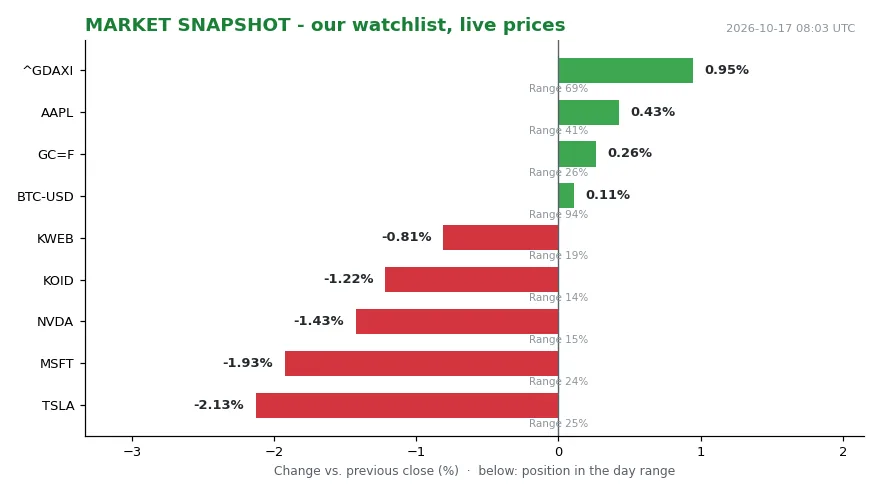
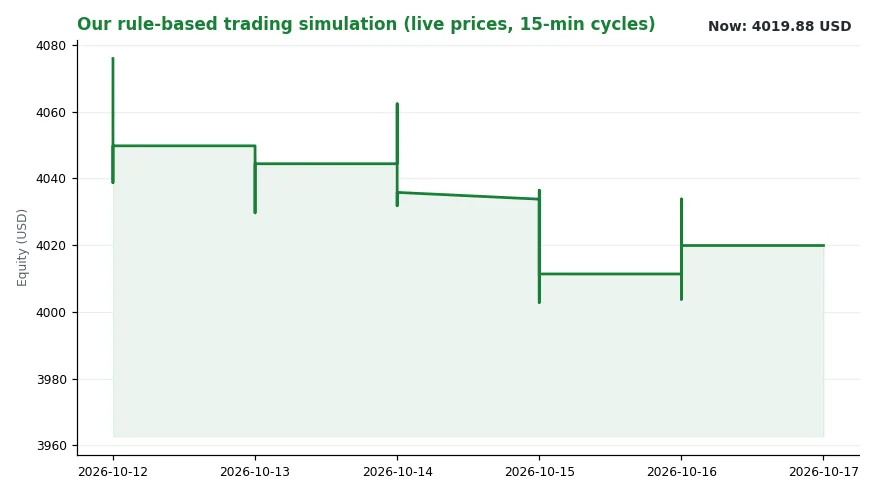
Our measurement first, because it belongs in the first paragraph. As of 2026-10-17 08:01 UTC, BTC-USD trades at 81,610.10, up 0.13% versus the previous close and near the day’s high (101% of range). Our sim equity stands at 4,019.88 USD, flat versus the same time yesterday, with 2,014.07 USD in cash. The busiest signal channel today is ‘central banks’ (5 events), and our regime reading is trend=falling, level=3.63.
The wish behind the word
“Uptober” is not an index. It is not a strategy, a derivative, or a product anyone can buy. It is a portmanteau — “up” welded to “October” — that traders use because Bitcoin has historically posted strong gains.
That phrasing carries an assumption worth slowing down for. It treats the nickname as a thing that can end, like a season or a tournament. The source reports Bitcoin down nearly 4% in October, from $84,856 on October 1 to $81,497 on October 17, with Ethereum, XRP and Solana each down more than 10% over the same span. So the news here is narrow and specific: Bitcoin is down nearly 4% this October, and a crypto publication is asking whether the month will fail to deliver what the nickname promises.
Read that way, the item is not a market event. It is a verdict on a piece of folklore. And folklore is exactly what “Uptober” is.
Why a calendar cannot move a price
A calendar cannot move a price. But a story about a calendar can, and the channel runs through expectations rather than through supply.
Here is the chain, and the source gives it concrete inputs: a hotter-than-expected US inflation report (CPI at 3.7% year-over-year, core up 0.3% in September) lifted the odds of a rate hike, nearly $1 billion in long positions were liquidated, and net ETF flows turned to $540 million of withdrawals this month. First, a memorable label spreads. Second, some participants treat the label as information about what others will do. Third, positioning adjusts ahead of the month rather than during it. Fourth, the month’s actual outcome gets compared to the label, not to fundamentals. The label survives a good month and gets explained away in a bad one.
None of that requires anyone to be irrational. It requires only that people forecast other people. A nickname that everyone knows is, by definition, a nickname that everyone can trade against.
The second channel is media. A headline that asks “Uptober over?” is not neutral reporting on a month. [2] It recycles the frame, and the frame gets reinforced every time it is used, including in pieces that question it. The frame gets reinforced every time it is used, including in pieces that question it.
There is no regulatory channel here, no central bank, no issuance schedule. When a market narrative has no mechanism behind it, its only support is belief — and belief re-prices faster than fundamentals do.
Who sells the attention
The winners from a seasonal label are the people who sell attention around it. Crypto media get a recurring hook every twelve months, free of charge. Exchanges get engagement. Analysts get a topic. None of them need October to be green. They need the word to be searchable.
The losers are less obvious. They are the participants who treat a rhyme as a base rate — who size a position on the strength of a nickname rather than on a stated thesis. The source shows the cost: $974 million in forced liquidations and nearly $1 billion in ETF outflows in a single month.
Who decides whether Uptober was “over”? Nobody, and that is the structural problem. There is no committee that certifies a season. A month ends, an outcome prints, and a label is either retired or revived depending on which version of the story travels further. The arbiter is a headline, not a benchmark.
Signs the folklore is fading
Three things would tell us whether the folklore is fading, in order of how much they would actually tell us.
The first is whether the term keeps appearing after the month closes. A nickname that disappears from the coverage has lost its hold.
The second is whether coverage shifts from the calendar to something measurable — flows, positioning, structure. If the framing moves, the folklore is weakening. The third is the price record itself: since 2017 Bitcoin has posted seven green Octobers and two red ones, and a close below $84,856 on October 31 would make this the first back-to-back red October since at least 2017.