UK Air Traffic Chaos Grounds 2000 Flights Markets Shrug
Two statements contradict each other, and both are true. The market is broadly red but not frightened. The UK shows an aviation system that lost nearly 2,000 flights to a single air traffic control problem. A grounded flight is a hard, countable loss. A market that shrugs is a soft, ambiguous signal. Both describe the same morning.
What the market feed says
Start with the numbers. Nvidia trades at 223.67, down 0.91 percent versus the previous close, near the day’s lows at 8 percent of its session high-low range. Apple trades at 315.34, down 0.28 percent, about halfway between its session high and low at 59 percent. Microsoft sits at 491.65, down 0.47 percent, about halfway between its session high and low at 40 percent. Tesla at 367.81 is down just 0.10 percent, yet it is pinned near the lows at 7 percent of its session high-low range — a small move with a weak posture. The China internet ETF KWEB at 24.78 is the outlier: down 2.29 percent and sitting at 0 percent of its session high-low range, meaning it has not bounced at all from the session’s weakest level. The German DAX index at 25576.45 is down 1.66 percent, near its lows at 16 percent of its session high-low range. The KOID ETF at 36.06 is down 0.61 percent, near lows at 12 percent of its session high-low range. Bitcoin at 78158.04 is down 0.17 percent, about halfway between its session high and low at 39 percent. Gold futures at 4460.40 are down 0.01 percent, about halfway between the session high and low at 58 percent.
The list is a pattern, not a scoreboard. Nothing here looks like a classic broad sell-off in risky assets. Gold is flat to the second decimal. Bitcoin is flat. The largest US listed companies are down by fractions. What is soft is Europe — the German DAX near its lows — and China-exposed equity, where KWEB sits at the very bottom of its session high-low range. That is money moving between sectors and regions, not a panic. The trend is falling. The theme channel carrying the most activity was central bank. Central banks, not airports, are what the market is pricing.
The news itself
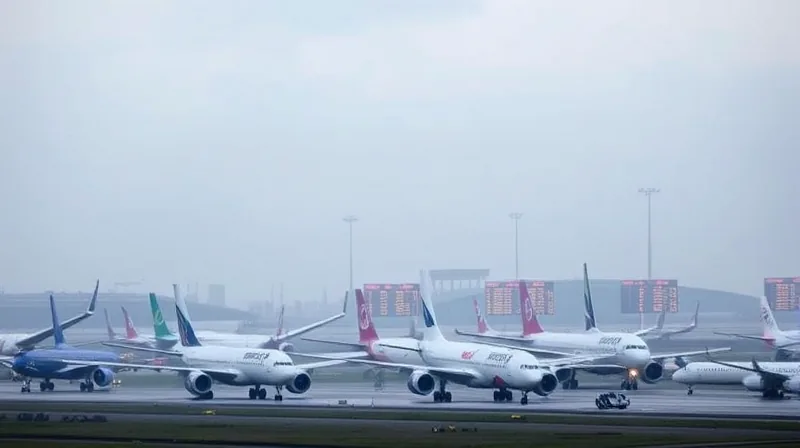
The aviation disruption is the other side of the story. Thousands of passengers across the UK saw their travel plans disrupted after an air traffic control problem grounded nearly 2,000 flights. [3] The disruption is operational, not financial. Its most measurable effects land on passenger welfare, and passenger rights are governed by rules that are unusually explicit.
A duty that does not care about cause
The regulatory angle is what connects the disruption to markets. When flights are delayed or cancelled, UK and EU airlines — and other carriers departing a UK or EU airport — have a duty to look after passengers. Crucially, the reason for the disruption does not matter. Anyone affected by the air transport delays is eligible for assistance. That is a minimum legal duty, not a discretionary gesture. The minimum legal duty includes meals and accommodation where necessary, and getting the passenger to the destination. The airline must organise an alternative flight at no extra cost. Where the carrier cannot arrange assistance, the passenger has the right to organise it themselves and claim the cost back later. The Civil Aviation Authority’s advice is to keep receipts and not spend more than necessary.
There are also timing triggers. The same assistance owed after a cancellation applies to delays over two hours for short-distance flights, three hours for medium-distance flights and four hours for long-distance flights. Beyond five hours, if the passenger no longer wants to travel, a full refund is due What is not included is extra compensation. Disruption from air traffic control issues — and from bad weather, airport staff strikes, conflict and other circumstances outside the airline’s control — does not entitle anyone to extra compensation. So the duty to care and the duty to compensate come apart. The first is unconditional. The second is fault-dependent.
A tour further down
The regulation becomes a pricing mechanism at a deeper layer. If a flight is covered by UK law, the airline must let the passenger choose between a refund and an alternative booking, regardless of how far in advance the cancellation occurred. Unused portions are refundable; a cancelled outbound leg on a return ticket means the full return fare comes back. If another airline reaches the destination significantly sooner, or another mode of transport works, the passenger has a right to be rebooked onto it.
Compensation, where it applies at all, is tiered by distance. Under 1,500 km, such as Glasgow to Amsterdam, up to 220 pounds per person. From 1,500 km to 3,500 km, such as East Midlands to Marrakesh, up to 350 pounds. Over 3,500 km, such as London to New York, up to 520 pounds The 1,500 km line is the first hinge in the schedule. Those tiers only bite when the airline is at fault and when less than two weeks’ notice was given. The amount then also depends on when the offered alternative actually arrives. Nothing in this event reaches that tier. The cause sits squarely in the extraordinary-circumstances box. So the cost the industry carries this week is care, rebooking and refunds — and not compensation required by law.
Who gains, who pays, who decides
Airlines have a duty to provide assistance. Rebooking on a rival carrier, hotel nights, vouchers and refunds are part of the passenger-rights obligations regardless of who caused the disruption. Passengers hold rights, but only if the ticket sits inside the right jurisdiction. Anyone arriving into the UK on a non-UK, non-EU airline has to check the booking’s terms and conditions instead — a materially weaker position. Package holidaymakers get a cleaner route: with an ABTA member, a cancelled flight entitles them to a suitable alternative flight or a full refund.
Further down the chain sit credit card providers, for unused accommodation where the card was the payment method, and then travel insurers. There is no standard definition of what a travel policy covers, so the practical answer lives in the fine print. UK government travel advice can also affect insurance rights.
Employers sit at the far end. Airlines are not required to refund lost earnings, and travel insurance usually does not cover them either. Employees must tell their employer if delays will make them late back. Employers have no legal obligation to pay absent employees in this situation unless the contract says so.
What cannot be measured yet
The aggregate cost of 2,000 grounded flights cannot be priced from a watchlist of seven tickers, one gold future, one crypto pair and a simulated equity account. The watchlist contains no airline equities.
What can be said is narrower and still useful. The market’s attention is on the central-bank channel, not on aviation. KWEB at the bottom of its session high-low range and the German DAX near its lows describe rotation, not shock. Whether that rotation persists, and whether this disruption later surfaces in airline earnings or in insurance claims data, is genuinely open. The operational loss is countable; the financial loss is unmeasurable. The first is visible in the data; the second is not. Whether that stays true is the open question.
Sources
1. Nvidia
2. Apple