
Triple Lock Pushes UK Pensions Into Taxable Territory
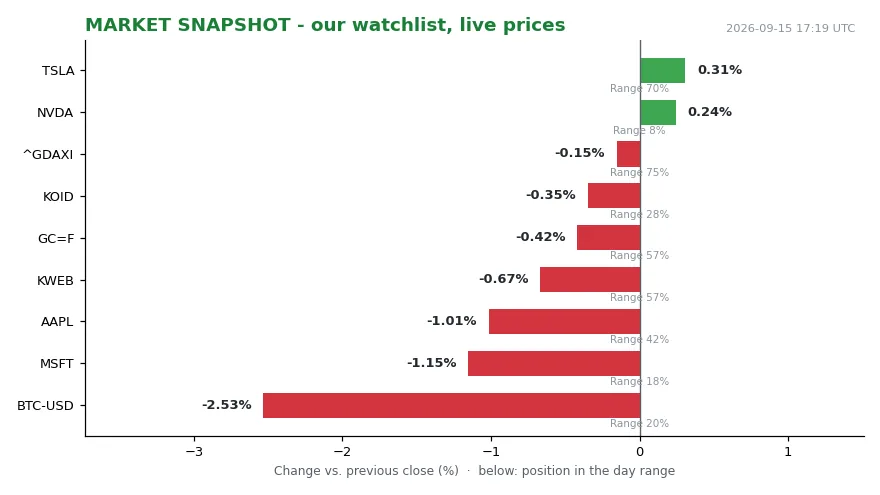
While Britain debates the triple lock, the market at 17:14 UTC on 15 September 2026 is uncomfortable but not frightened. NVDA trades at 211.51, up 0.26 % on the previous close, yet sits near the day’s lows at just 9 % of its range. MSFT is at 499.92, down 1.09 %, also pinned low at 22 % of range. BTC-USD has slipped to 76180.02, down 2.56 %, at 19 % of range. Against that, gold holds 4332.40, down 0.45 % but mid-range at 54 %, and the DAX holds 25402.28, down only 0.15 % at 75 % of its range.
The pattern is rotation, not retreat. Capital is leaving the crowded corners of the risk trade without rushing anywhere else in particular.
The triple lock is a name doing quiet work here. “Triple lock” sounds like a promise; “fiscal drag” sounds like weather. Both are arithmetic.
Britain has promised its pensioners they will not pay tax on the full new state pension. The arithmetic is straightforward.
On Tuesday, Office for National Statistics figures showed that average UK wages rose by 3.9 % in the three months to July. [1] Under the triple lock, that figure now leads the race to set next April’s increase, because the state pension rises by whichever is highest out of inflation, average earnings growth or 2.5 %. September inflation — the month that matters for the calculation — would need to exceed the 3.9 % wage growth rate to change the outcome. So the wage number is the map.
The consequence is concrete. The full new state pension would rise from 241.30 pounds a week, roughly 12,500 pounds a year, to 250.70 pounds a week, about 13,000 pounds a year, from next April. [5] For the two-thirds of pensioners who reached qualifying age before April 2016 and receive the old basic state pension, the uplift means 192.10 pounds a week, about 9,990 pounds a year. [5]
Here is where a policy name begins to hide something. The tax-free personal allowance has been frozen at 12,570 pounds — a policy introduced by the previous Conservative government and extended by Labour until 2031. [2] That freeze, combined with an inflation-beating pension increase, lifts the full new state pension above the threshold for the first time. Retirees were in line to pay income tax on the state pension. Ministers then moved to reassure pensioners with no other income that this would not happen.
Torsten Bell, the pensions minister, put it plainly: “In line with the commitment made at budget 2025, pensioners who only just exceed the personal allowance will not have the administrative burden of paying small amounts of tax in this parliament.” [2] He added that the chancellor would set out further details at the budget. That is the promise, in its own words.
Three channels carry this news: indexation, fiscal drag and the labour market.
The first is indexation. The triple lock was introduced by George Osborne in 2011. [3] It guarantees that the state pension grows by the highest of inflation, average earnings or 2.5 %. [3] When wages run at 3.9 %, the pension is mechanically dragged upward by the same amount. No one votes on it each year; the formula does.
The second is fiscal drag. Because the personal allowance stays frozen at 12,570 pounds while the pension rises, more of each pensioner’s income is pulled above the threshold. The tax take climbs without any vote in parliament, which is why the mechanism is called drag rather than tax.
The third channel is the labour market, and it pulls the other way. Wage growth has already slowed from 4.1 % in the three months to June. The Office for National Statistics reported that the number of workers on company payrolls continued to edge down, driven by declines in retail and hospitality. Vacancies in the three months to August fell to 702,000 from 706,000 the previous month. [1] The headline unemployment rate held steady at 4.9 %, confounding expectations of a modest rise to 5 %. [1]
For the Bank of England, that is the awkward part. Threadneedle Street’s base rate is 3.75 %. [4] That is below the 3.9 % wage growth now setting the pension, which means the real return on cash is negative while the pension formula locks in the nominal gain.
Meanwhile, oil prices have climbed, adding an external cost shock to a labour market that is already cooling. The Bank of England faces a dilemma between a weak jobs market and imported inflation.
The distributional effects split cleanly.
Pensioners on the full new state pension with no other income win first. They receive a 3.9 % uplift and, on the government’s commitment, no new tax bill on small amounts. Those on the older basic state pension receive a smaller cash sum, but the same protection principle is meant to apply. The Treasury gains in the short term from frozen thresholds. That same freeze forced ministers into a public promise, so the gain is political as much as fiscal.
The losers are harder to name, which is why the argument is heating up. The British Chambers of Commerce has called for the triple lock to be scrapped, with the savings redirected towards the youth unemployment crisis. [6] That is a generational claim, not merely an accounting one, and it lands amid rising pressure on the public finances.
The deciders are the chancellor, Rachel Reeves, who must deliver the detail at next month’s budget, and the Bank of England, which sets rates on Thursday. Pat McFadden, the work and pensions secretary, said the figures showed the jobs market had remained resilient. “But we know there is more work to do, particularly to ensure young people gain the skills, experience and confidence needed to succeed,” he added. [2]
Three dates and one number now matter. Wednesday brings official figures expected to show UK headline inflation rose above 3 % in August, against a Bank of England target of 2 %. [4] September inflation then settles the triple lock for next April. The budget supplies the machinery behind the tax promise. Thursday’s decision reveals how the Bank weighs a weak labour market against an energy shock.

The outcome is genuinely open. If September inflation surprises above 3.9 %, the pension rises by more than wages and the tax gap widens further. If unemployment moves above 4.9 %, the case for holding rates strengthens. The commitment to spare pensioners “small amounts of tax” is, by its own wording, a promise about size — and size has not yet been defined.
The market backdrop remains one of quiet rotation: risk assets sit near the floor of their daily range, while gold and the DAX hold the middle and the top. A market rotating quietly, a Treasury promising quietly, and a formula written in 2011 doing its arithmetic out loud.
Sources
1. Office for National Statistics
2. Labour Party
5. HM Treasury