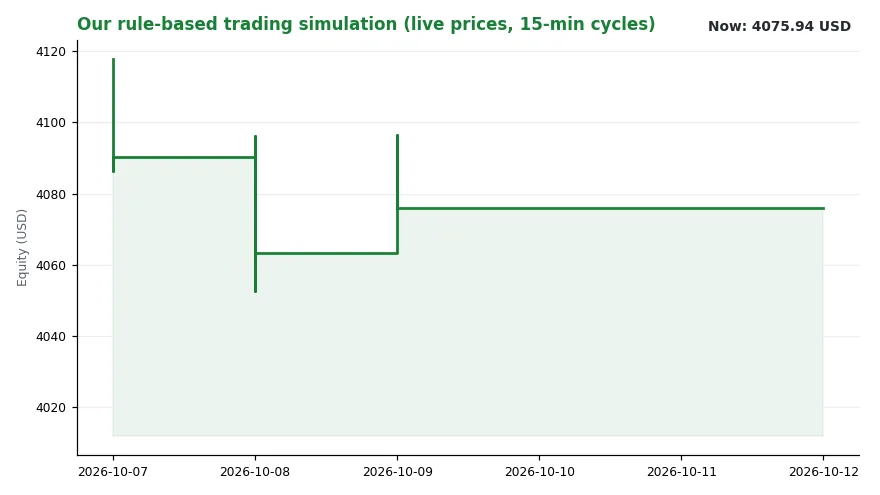
Measurement
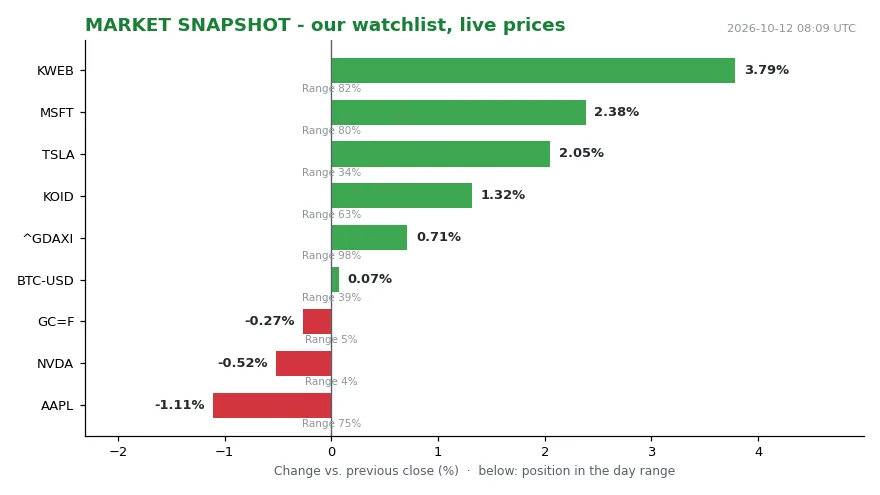
The tide runs flat this Monday morning; the interesting signal is where each price sits inside its own range. MSFT prints 535.07, up 2.38% and pinned near the day’s high at 80% of its band. KWEB prints 24.93, up 3.79%, also close to the top at 82%. NVDA sits at 229.28, down 0.52%, near the day’s low at 4%. AAPL is softer at 336.64, down 1.11%, yet still holds the upper part of its range at 75%. That is rotation, not a storm. Gold confirms the calm: GC=F at 4206.70, down 0.23%, near the bottom of its band at 10%. The DAX adds 0.64% to 25247.48, near its high at 86%. Our regime reading says trend=falling, level=3.63. Our rule-based sim holds 4075.94 USD, flat against the same time yesterday, with 2049.10 in cash. The last logged call was a WATCH on KWEB. The busiest signal channel today is “central banks”, with two events. Flat water, moving currents — and, across the Atlantic, a fiscal event that could change the swell.
Actors
The flood tide carries the news from London. John Healey has been warned by Britain’s leading tax and spending experts that his budget risks being a “work of fiction”. The warning comes from the Institute for Fiscal Studies (IFS), in its influential “green budget” report. The condition is specific: he must set out plans to cover £35bn in spending pressures. The budget itself lands on 28 October. Failure to address the gap, the thinktank argues, risks leaving the impression that Labour is setting unrealistic spending plans. Why should that move markets? Because the war in the Middle East has already rattled the public finances. Because the bond market backdrop is febrile. Because a budget is a promise about future borrowing, taxes and spending, and promises get priced.
Mechanism
Slack water is the right place to inspect the mechanism. Inflation is the channel. Higher inflation squeezes what a fixed budget can buy. At the same time it lifts nominal tax receipts. So one shock pushes in two directions at once. Start with the fiscal rule. Labour’s main rule is to balance day-to-day public spending with revenues in 2029-30. Against that rule, the former chancellor Rachel Reeves left a £24bn buffer at the spring statement. Higher borrowing costs are expected to erase a significant chunk of it, and leading economists have predicted the market moves since the start of the war in February could wipe out about half of the headroom. That is what the Treasury is watching.
The IFS adds a counterweight to the headroom story, and it warns against focusing on that buffer at all. A surge in debt interest costs could add £10bn to borrowing in 2029-30. But higher inflation also boosts tax revenue. The net effect on measured headroom: a cut of only £4bn. That smaller headroom figure is a trap, and this is the heart of the report. Inflation does not only flatter receipts. It also erodes what departments can buy. Keep spending totals unchanged and the consequence is implicit. The IFS says that path means allowing the quality or quantity of public services to fall. Compensating for the inflation shock, and funding Healey’s pledge to raise defence spending, would require tax rises or benefit cuts of about £35bn. It is a commitment, not a rounding error, and it lands against a bond market that is already febrile.
Helen Miller, the director of the IFS, framed the warning against a recent precedent. Jeremy Hunt, the former Conservative chancellor, was accused before the 2024 general election by the then head of the Office for Budget Responsibility of setting unrealistic spending plans. Miller’s line on Healey is exact: “Simply pencilling in implicit cuts that he has no intention of delivering would make the budget a work of fiction.” [1] The report itself is equally direct: “If John Healey sets out spending envelopes for public services that he would not be willing to live within, his plan for meeting the fiscal rules will not be credible.” [1] It urges him to avoid a “steady as she goes” budget that delays decisions until next year’s spending review.
Miller’s description of the default path is precise. “Choosing to stay the course with the inherited tax and spending plans would mean allowing inflation to blow departments’ spending plans off course,” she said. She added: “It would be a choice to tolerate chunky cuts to the quantity or quality of some public services — cuts that would be larger if defence spending was increased within existing totals.” [1] On process, she said that the Treasury adopting an assumption that “everything can be kicked forward” to next year’s spending review risked undermining the chancellor’s credibility. Her standard: “We would be better served by a chancellor who hopes for the best, but plans for the worst, rather than sets out plans that either say, ‘I hope it’ll be fine and some money will come in’, or ‘I’ll get a plan in a year’s time’.” Healey does not need detailed plans now, in her reading. He needs spending envelopes he would actually live within.
Outlook
The ebb decides who pays. The bond market arbitrates first. If the plan is not credible, the price of government debt adjusts. Andrew Bailey, the governor of the Bank of England, said last week that fiscal policy “must be credible and be seen as such by financial markets”. The following day, the Times quoted a government source as saying: “Andrew Bailey needs to focus on doing his job.” That exchange is itself a signal about the political space. Then come the departments. Fixed envelopes absorb inflation through pay, contracts and capital costs. Defence pulls the other way, because the 3% pledge points resources toward it. Public services already under pressure are the likely losers if totals stay unchanged.
The Treasury’s stated position is one of discipline. A spokesperson said: “The chancellor is fully focused on his priorities to boost business, help with the cost of living and support people in every postcode, underpinned by fiscal discipline and a commitment to meet the fiscal rules with a buffer against uncertainty.” The same statement added: “The Office for Budget Responsibility will publish its updated forecast alongside the budget in October and we will not comment on rumour, speculation or proposals about its contents ahead of then.” The turn of the tide is what we watch next. The date is fixed: 28 October, with the OBR forecast alongside. Watch whether the spending envelopes are ones the chancellor would defend under pressure, or placeholders. Watch whether the 3% defence commitment is funded inside existing totals or above them. Watch the gilt market’s reaction as closely as the speech. Uncertainty is part of the picture. We do not know how long the Middle East war lasts. We do not know whether inflation persistence offsets the debt-interest cost, as the IFS models suggest it might. We do not know whether the OBR’s forecast will match the IFS arithmetic. Our own regime reading is trend=falling, and our sim is flat — which is another way of saying we are not being paid to guess.