Bumble sold for 1.3bn dollars, in a deal its buyers call “a bet on the future of humanity”. Our own tape, and one 2023 study of the app’s match recommendations, suggest the interesting part is far smaller — and far more concrete.
Our tape first
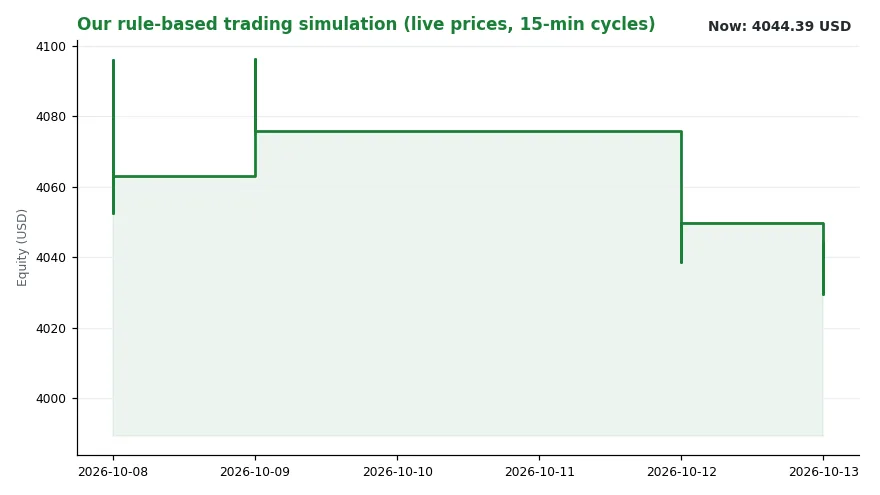
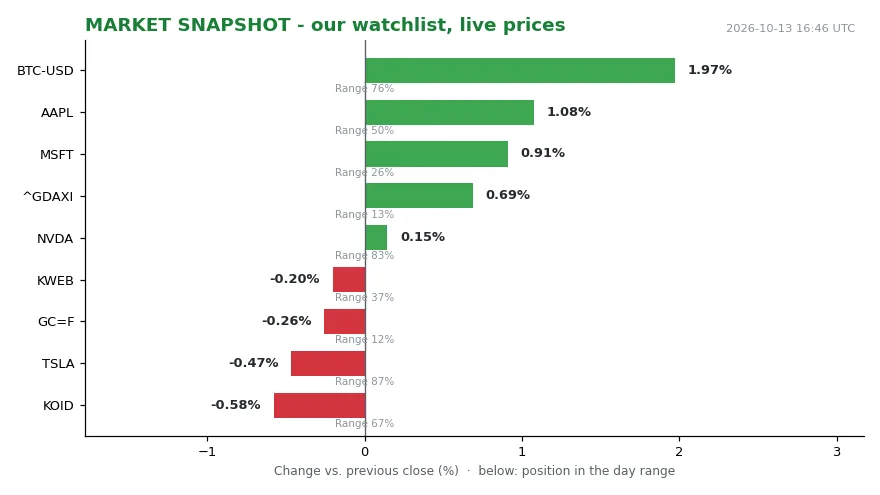
Our watchlist, quoted two minutes before this sentence, shows a narrow bid. The quotes were pulled at 16:41 UTC on 13 October 2026, two minutes before this sentence. NVDA trades at 226.98, up 0.29 percent, sitting at 91 percent of its daily range. AAPL is at 344.61, up 1.07 percent, mid-range at 50 percent. MSFT is at 546.32, up 0.96 percent, mid-range at 30 percent. BTC-USD is at 83,385.67, up 2.00 percent, at 76 percent of range. TSLA is at 375.85, down 0.58 percent, yet still at 80 percent of range. Gold is at 4,179.40, down 0.27 percent, at 11 percent of range. The DAX is at 25,259.90, up 0.69 percent, but sitting at only 13 percent of range. KOID, a humanoid-and-embodied-AI basket, is down 0.58 percent, mid-range at 67 percent. KWEB is down 0.20 percent, 37 percent of range.
Read as one set, that is not broad risk appetite. It is a top-of-range bid in two momentum instruments and a fade in the rest. Nine tickers, one timestamp, no positions. Our data describes the weather in which a piece of news landed. It cannot price the news itself. Bumble is not on our list. So nothing above is a view on the deal below.
What happened
Bumble, the dating app, has been bought for 1.3bn dollars, or 980m pounds [1]. The buyer is the investment firm Ithaca Holdings. The new owners called the deal “a bet on the future of humanity” [1]. Ithaca’s directors, Ravi Gupta and John Hegeman, will become co-chief executives. The company they are buying is loss-making. Bumble once set itself apart with a chat rule that only women could open a conversation. It abandoned that rule in August. Wolfe Herd founded the business 12 years ago and still runs it. She said she would remain “actively involved” [1]. The announcement leaves her exact role open. She said she would work closely with the new owners. Gupta and Hegeman want to use technology to “renew and accelerate businesses…in a world transformed by AI” [1]. Their fuller formulation is the one that travelled: “Technology should work in service of our deepest source of fulfillment, human connection and this investment is a bet on the future of humanity” [1].
That framing lands in a year of loud AI-safety warnings. Some experts argue the speed of AI development threatens the future of humanity [1]. The same word sits at both ends of the argument. The market reaction was concrete. Bumble’s share price soared as the deal news emerged. The jump lifted the company’s valuation above 580m dollars. That is still far below the peak of more than 14bn dollars reached after its 2021 Nasdaq float. Since going public, it has booked an annual pre-tax profit exactly once, in 2023. The two years that followed produced steep losses. Those losses arrived while the company was adding AI to the app. The rule change itself prompted debate among users about whether the app had lost what set it apart from rivals [1].
The thin file on the algorithm
A December 2023 paper is titled “Exploring Gender Disparities in Bumble’s Match Recommendations” [2]. It studies Bumble in India. Its method is an experiment. The authors set out to identify and address bias in the matching algorithms Bumble pushes to users as profiles for potential dates in the real world [2]. Their frame is AI fairness and inclusion studies. Their technical premise: apps like Bumble use algorithms that learn from user data to make recommendations [2]. Their central claim concerns responsibility. Even if the algorithm has no intentions or consciousness, it is a system created and maintained by humans [2]. Moral agency, they write, is “compositely derived from algorithmic mediations, the design and utilization of these platforms” [2]. From that they draw a duty. Developers, designers and operators of dating platforms have a moral obligation to mitigate biases in the algorithms, to create inclusive platforms that affirm diverse social identities [2].
That is the argument in outline. It matters to be precise about what it is not. It says something narrower and more durable: a ranking has authors, and the authors carry the consequences.
The mechanism
Three channels connect a private cheque to what you see on a screen. The first is time horizon. Bumble floated in 2021 into a category priced for growth. Since then: one profitable year on a pre-tax basis, 2023, and steep losses after [1]. A private owner can hold a loss-making asset through a bad stretch. A public shareholder, measured every quarter, generally cannot. Public markets price a story; private markets can wait for one. That mismatch is the deal’s engine, not romance.
The second channel is cost. Bumble has been folding new technology, including AI, into the app. Its 2024 chief executive, Lidiane Jones, saw “exciting potential” for AI in dating apps, especially on safety [1]. She pointed to research that Gen Z and millennials were interested in AI help with writing profiles. This year the app shipped several AI features, including profile guidance. When users resist paying, cheaper matching is the obvious lever to pull.
The third channel is demand, and it points the wrong way. Bumble said in 2025 it would cut almost a third of its workforce. Match Group, which owns Tinder, OkCupid and Hinge, has seen its shares fall sharply from a 2021 peak. Some single people now turn to board game evenings and book clubs instead [1]. A buyer at 1.3bn dollars is not betting on a growing category.
Winners, losers, deciders
Winners, on the record: Ithaca Holdings. It acquires a listed consumer brand far below its 2021 valuation, with two of its own directors at the top - Gupta and Hegeman, who take the product roadmap.
Those absorbing uncertainty: employees, after a stated plan to cut almost a third of staff. Users who valued the women-first rule, dropped in August. Wolfe Herd described her community as asking for “more flexibility, less pressure, and more opportunities to create real, meaningful connections” [1]. Match Group, whose decline reads as a category problem as much as a company one. Regulators appear only at the edges, through Ofcom’s usage numbers on the demand side.
Who decides? Not our watchlist. The decision sits with a private fund and two new co-CEOs. And, if the fairness literature is right, with the designers and operators of the ranking.
What we watch, and what we cannot know
First, the terms. We have a headline number and a market reaction. Second, the product. Whether the AI features already shipped survive the change of control. Whether the women-first rule stays gone. Third, the workforce. A plan to cut almost a third of staff is documented; its execution is not. Fourth, the category. Match Group’s relative performance is the cleanest test of whether the problem is Bumble or paid dating itself. Fifth, accountability. If moral agency is “compositely derived” [2] from mediation, design and operation, then a change of ownership changes who answers for outcomes. That is a claim to watch, not to settle.