Musk recreated a “Knight Rider” moment. Europe’s aviation regulator says any vehicle intended to operate as an aircraft would need to meet the applicable aviation safety requirements.
Our measurement first
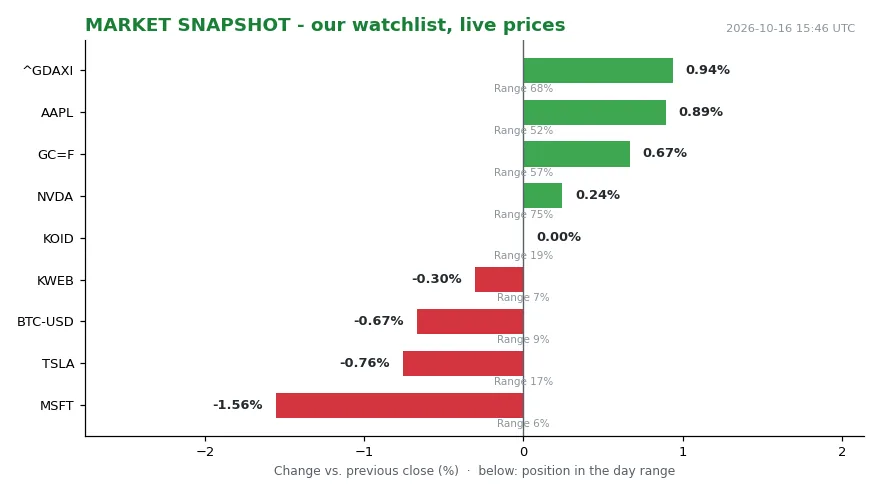
The ticker is the place to start, because it carries the unglamorous part of the story. TSLA opened 2026 at $438. On Thursday the shares changed hands above $362 — a fall of 14.6% in 2026 so far, as the source states. Our own tape puts the stock at $359.85, down 0.72% on the day and near the lower end of its daily range. The income statement underneath is more interesting than the price chart: second-quarter revenue rose 26% year on year to $28.24bn (EUR 25.20bn), while net profit attributable to shareholders fell about 5% to $1.11bn (EUR 990m) — sales compounding, profit not. First-half capital spending more than doubled to $8.28bn (EUR 7.39bn), and management expects capital spending above $25bn (EUR 22.31bn) in 2026, driven by AI and manufacturing investments [1].
Those measurements are best read as one pattern rather than four data points. Sales are still compounding, capex is compounding faster, profit is not — and the equity is being repriced downward while the spending goes up.
What was actually shown, and what it was called
Elon Musk, Tesla’s CEO and co-founder of SpaceX, recreated a “Knight Rider” moment, showing a supercar equipped with cold-gas thrusters developed with SpaceX technology. The car is the Roadster, a model unveiled in 2017. The thruster specification is called “Rocket”. Musk suggested a year after the unveiling that thrusters might allow the vehicle to fly, production was originally promised for 2020, and the current target for the start of production is 2028. Reservations are open; the flying Rocket version is available by invitation only; no final selling prices have been announced [1].
That is the disclosure set. The naming, not the specification, is what travelled.
The idea itself is old. A 2020 survey of flying car transportation systems describes the concept as an attempt to use underused near-ground space to relieve congestion, pressure on public transport and freight traffic, and it frames the field in terms of advances, techniques and unresolved challenges rather than a solved engineering problem. Tesla’s addition to that literature is a thruster package borrowed from a rocket company, a demonstration video, and a reservation page.
How the demo reaches the market — and where it stops
The first channel is narrative. Mamta Valechha, consumer discretionary analyst at Quilter Cheviot, described the presentation as a “headline-grabbing engineering moment” designed “to generate excitement around the brand”, and added that “The commercial value is likely to be strengthening Tesla’s innovation narrative rather than generating meaningful profits.” [1] Gene Munster, managing partner at Deepwater Asset Management, called the demonstration on X “an engineering flex with no commercial value beyond embarrassing traditional car makers”. Rico Luman, senior sector economist for transport and logistics at ING, called it “a publicity stunt which emphasises Tesla’s image as an innovative company, which offers brand value” [1].
The second channel is regulation, and it is not open. The flying features of the Roadster are not approved for public road use. Asked whether the vehicle falls under aviation rules, the European Union Aviation Safety Agency told Euronews Business that it does not comment on “specific certification applications or activities involving individual manufacturers”, but that “any vehicle intended to operate as an aircraft would need to meet the applicable aviation safety requirements” — which can include pilot qualifications for the driver. [1] Luman’s reading is that “larger scale flying car activity won’t be realistic in the foreseeable future as the same airspace rules apply as for aircraft and certification as aircraft by EASA (in Europe) is then required”, and that “Large numbers of uncontrolled flying cars won’t likely be allowed by authorities for safety reasons” [1].
There is a cost channel behind both. Valechha put it plainly: “Some technologies could filter into other vehicles over time, but flying or thruster-assisted features are unlikely to be economically viable for higher-volume cars in the foreseeable future due to cost, complexity and regulatory hurdles.” And on execution, her summary was blunt — “Credibility and execution risks remain high” [1].
Who wins, who loses, who decides
“This new futuristic model is great for fans and lovers of gadgets who have the ability to spend the money on it. And I’m sure there are quite some around” [1].
Exposed are anyone underwriting Tesla’s valuation on the assumption that expensive technology projects convert into profit at the pace of sales, and the equity itself: sales compound, capex compounds faster, profit does not.
Who decides is not Musk. It is EASA and the national authorities applying airspace rules that are, as Luman notes, already full — particularly with growing drone activity. It is also the invitation list for the Rocket version, and, potentially, Tesla’s shareholders
What to watch, and what we cannot know
Four things are checkable. Whether the 2028 production date survives contact with manufacturing. Whether Tesla publishes final prices. Whether a certification file ever lands with EASA — the agency will not say either way. And whether a SpaceX transaction materialises, which no one has confirmed.
What we cannot know is whether any of this becomes a product line rather than a press cycle. Luman’s own ceiling for the category is modest: “Flying cars in general may be a cheaper alternative for private jets, but not in this concept” [1]. The Roadster is called a Roadster; the specification is called Rocket; the thing it would legally have to be, the moment it leaves the ground, is called an aircraft.
Sources: [1] Euronews Business, reporting on Tesla’s Roadster demonstration and analyst comments. “Flying Car Transportation System: Advances, Techniques, and Challenges”, arXiv:2005.00832v1. This article is educational analysis, not investment advice.